
Radiation Survival of Microbes and Biomarkers in Deep Planetary Ices
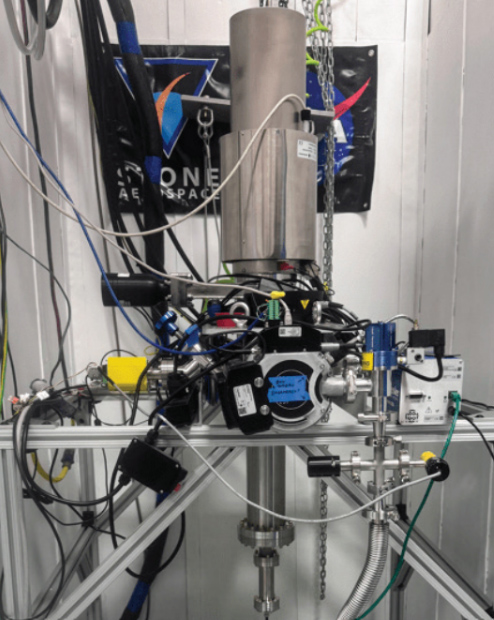
Stone Aerospace designed, developed, and operates the ALIENS (Advanced Laboratory for Instrumentation and Extraterrestrial Near-surface Simulation) space radiation facility in Austin, Texas. ALIENS facilitates simulation of planetary surfaces and sub-surfaces, including both composite ices and regoliths, under cryogenic temperatures (down to 77 K), hard vacuum (to 10-8 Torr), and a variety of radiation sources. These conditions are relevant to the Moon, Martian polar caps, and Ocean World moons such as Europa and Enceladus. ALIENS currently enables investigation of radiation effects to test specimen depths of 60 centimeters, which allows detailed investigation of secondary radiation (bremsstrahlung) effects on deep embedded materials (which can include microbes, biomarkers, endogenous and exogenous planetary sourced impurities as well as custom-fabricated regolith specimens). Specialized cold-room specimen fabrication methods have been developed in parallel that permit the assembly of homogeneously doped test articles with depth dependent dosimetry. The facility includes both walk-in -30 C specimen fabrication space and industrial medical grade -80 C long term specimen storage.
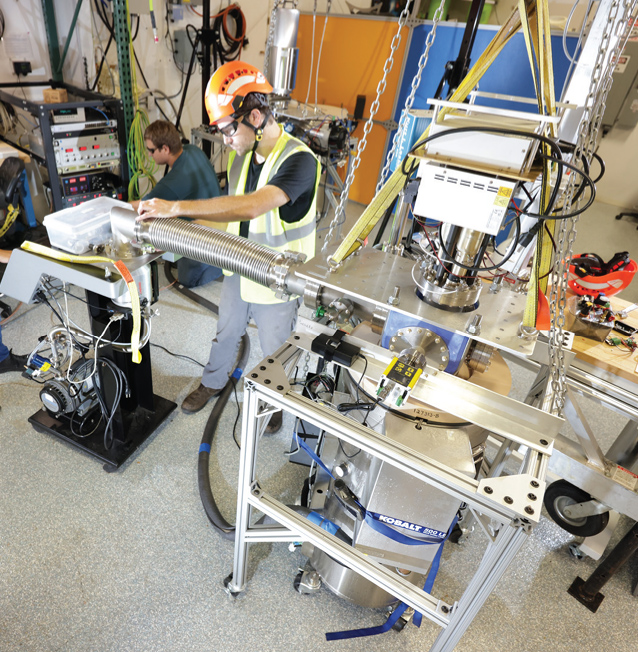
The experimental methodology utilizes retrofitted liquid nitrogen dewars and stainless steel vacuum chambers. To simulate planetary radiation, the chambers accommodate four distinct sources within the spatial constraints of the dewars: a 100 KeV flood electron beam linear accelerator; a 100 KeV X-ray tube; a 100 W Hydrogen Lyman alpha source; and a 180 W Deep Ultraviolet (DUV) source. Stone Aerospace maintains a team of licensed radiation technicians and certified industrial radiation shielding vaults for the ionizing sources.