• Skip to main content
  • Skip to footer

Stone Aerospace

Smart tools and systems for exploring the frontier

  • Home
  • About us
    • What we do
    • History
    • Design philosophy
  • Projects
    • BEAGLE
    • PARTI-Pucks
    • Thor
    • PROMETHEUS
    • ARCHIMEDES
    • ARTEMIS
      • Description
      • Field notes
      • Photo gallery
    • VALKYRIE
      • Description
      • Field notes
      • Photo gallery
    • ENDURANCE
      • Description
      • Field notes
    • DEPTHX
      • Description
      • Field notes
  • News
  • Employment
  • Contact us
  • Stone Aerospace in One Page

ENDURANCE

December 16, 2008 By Stone Aerospace

ENDURANCE: Mission 1: December 16, 2008

West Lake Bonney, Taylor Valley, Antarctica
Reporting from Blood Falls Basecamp

Today’s profiler mission, Mission 5, took us towards the lake shore south of the Bot House. Our aim was to fill in the gap between where we had gone on Mission 3 and our keep-out zone. The keep-out zone is the area around John’s limnology tent, where we know there are active experiments hanging down into the water. To avoid entangling the bot or disturbing the experiments with either the bot or the fiber, we’ve had to designate a wedge of the lake as a keep-out. Unfortunately this wedge means that there are a few grid points that we won’t be able to get to, even though they are within our range.

We ran through our launch checklist and dropped the bot in the water. The weather was much nicer today and the mission went quickly and cleanly. There was some worry that, even with our conservative stand-off distance from the limno tent keep-out area, we might snag something under the ice on our way back to the Bot House, but Leah reported that the fiber was feeding back in as it should and the bot came home without incident.
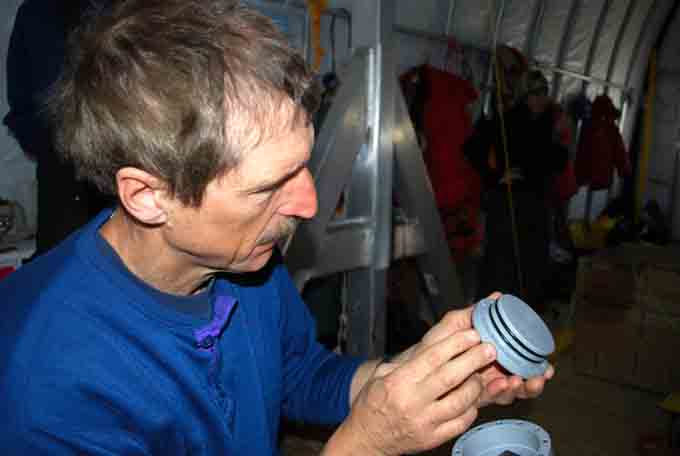
Going through the launch checklist, Bill inspects the o-rings before sealing up the radio beacon battery compartment.

Later that day, Maciej returned to the Bot House carrying a long pipe. He had spent the afternoon working around the limno tent and had encountered one of the experiments that defined a part of our keep-out zone, an ablation stake. It had ablated out of its spot in the ice and was lying on the surface, so he removed it. While there are still experiments to avoid in the keep-out zone, it is nice to know that there is one less object in the lake to trip us up.
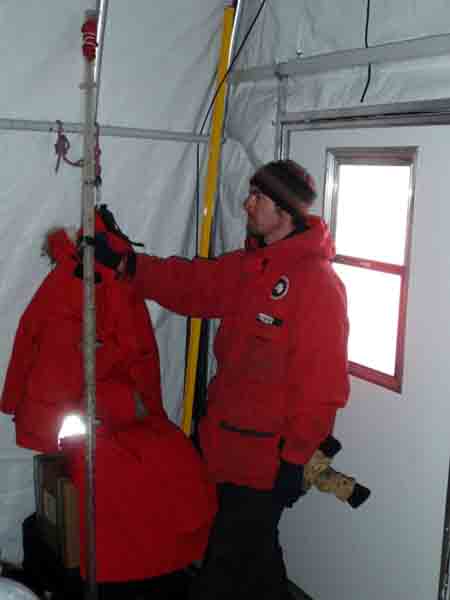
Maciej returns to the Bot House with one of the obstacles we have been avoiding near the limno hut, an ablation stake that has ablated out of the ice. It may be an object like this that snagged us a few days ago.
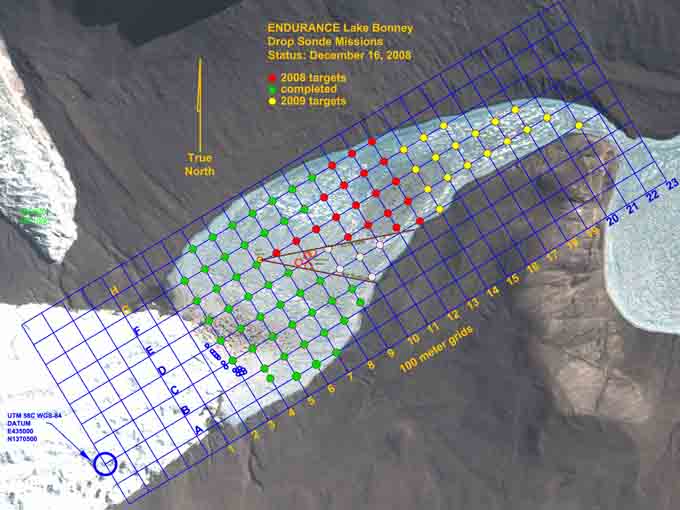
Our status at the end of Mission 5.

Reporting by Vickie Siegel
December 15, 2008 By Stone Aerospace

ENDURANCE: Mission 1: December 15, 2008

West Lake Bonney, Taylor Valley, Antarctica
Reporting from Blood Falls Basecamp

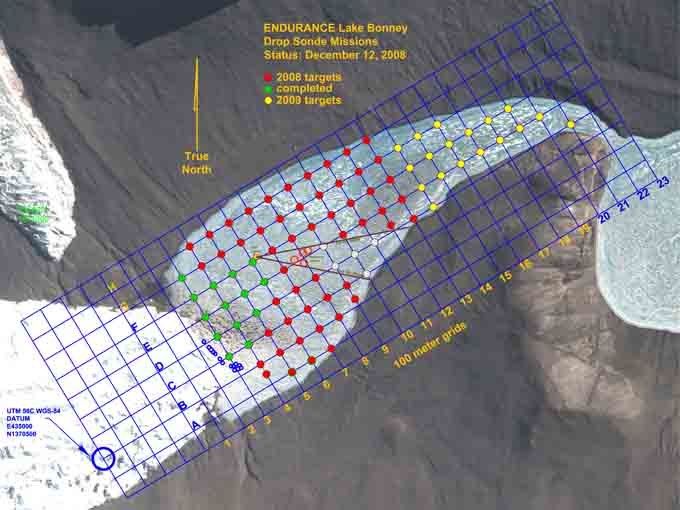
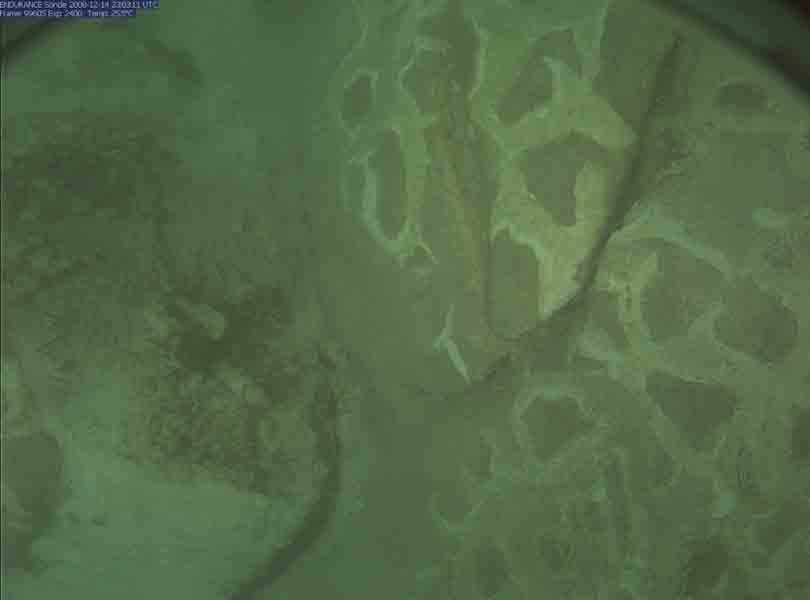
This morning was deceptively warm and sunny. As soon as we got out to the bot house and started mission four, the wind kicked up and the temperature dropped. Both the team at mission control and the team out tracking the bot had a chilly day. We had a few nervous moments where the communications link between mission control and the bot dropped out due to a kink in the fiber as it spooled out of the bot house but otherwise it was a textbook mission. In terms of the number of points hit, mission four was our most productive so far, with 13 new data points. We ran parallel to the north shore of the lake and got some exciting photos of the lake bottom.

Today the sonde camera recorded this image, among others, of microbial growths on rocks at a depth of 10 meters.

We pulled the bot back into the Bot House at the end of the mission and put it on charge. Originally our plan today had been to run two missions but the tracking team was chilled and tired and we decided that the day would just run too long by the time we had recharged the batteries, so we headed off to dinner.

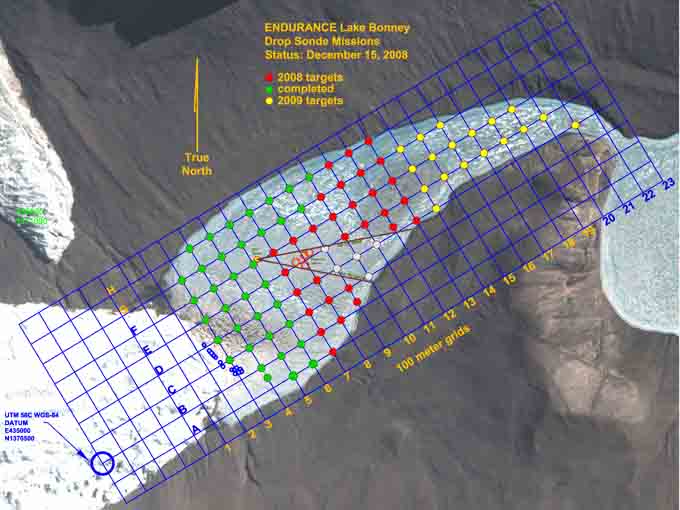
Our status at the end of Mission 4.

Reporting by Vickie Siegel

December 14, 2008 By Stone Aerospace

ENDURANCE: Mission 1: December 14, 2008

West Lake Bonney, Taylor Valley, Antarctica
Reporting from Blood Falls Basecamp

Now that we’ve completed three successful sonde missions, we took today off. We have been working 12 to 14 hours per day out here and now that things are going well, it is time to rest. We stayed up late last night watching a Bruce Lee flick, so most folks slept in a bit and then we all went to Lake Bonney Camp to lounge about in the Jamesway. Leah baked cookies, since there is an oven at the camp, and we each had the chance to take a shower of sorts by using a solar shower bag filled with water we heated on the stove.

Reporting by Vickie Siegel

December 13, 2008 By Stone Aerospace

ENDURANCE: Mission 1: December 13, 2008

West Lake Bonney, Taylor Valley, Antarctica
Reporting from Blood Falls Basecamp

Today we had a couple of changes in crew. We got a new helper, Leah, from the Berg Field Center in McMurdo to keep us sane, and Peter and Bart left in the afternoon for McMurdo. Since Bart had been the only person designing mission plans for the bot each day, he took some time in the morning to show Bill and Vickie how to design a mission plan and then check whether the mission length and number of sonde drop points planned was within the bounds of our battery power. After the coordinates for the mission plan were extracted from the planning map and Shilpa programmed them into the bot, we were ready to get in the water.

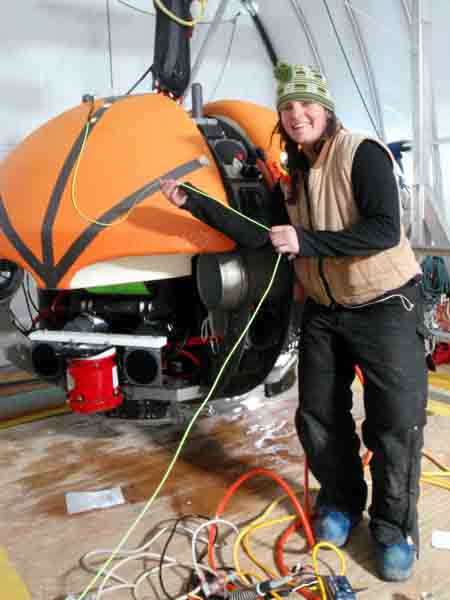
Our smiling assistant Leah from the BFC has come to help us stay sane. Good luck!

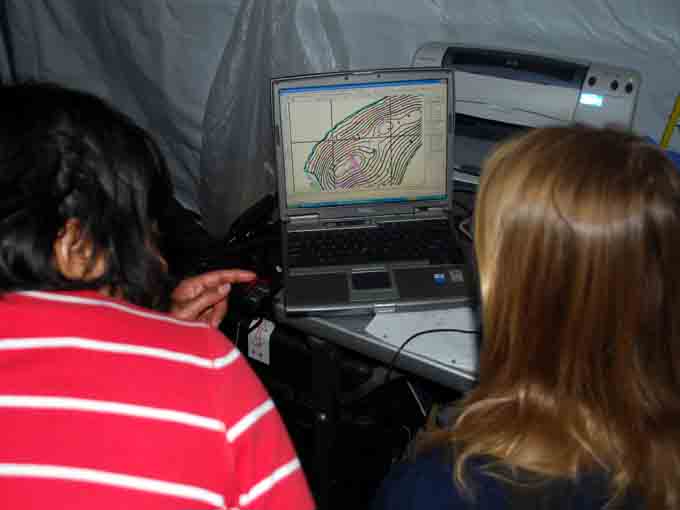
Shilpa and Vickie plan the upcoming mission. Mission planning is the balancing act of connecting the dots to hit as many points as possible without running out of battery power.

Today’s sonde mission took us to the southwest edge of the lake. We were able to get the bot much closer to the shore than we had predicted. We hit 9 points today, including the points we had to skip from yesterday’s truncated mission. We continue to rack up data.

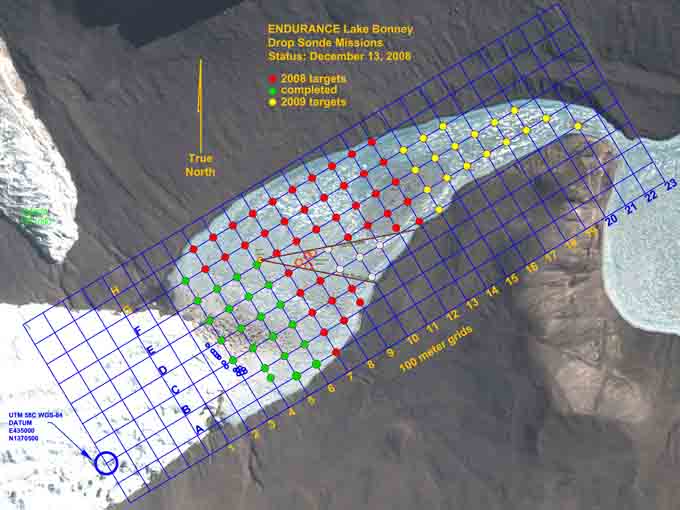
Our status at the end of Mission 3.

Reporting by Vickie Siegel

December 12, 2008 By Stone Aerospace

ENDURANCE: Mission 1: December 12, 2008

West Lake Bonney, Taylor Valley, Antarctica
Reporting from Blood Falls Basecamp

We were back to work as usual this morning. We planned a mission in the southwest end of the lake, around the same area we navigated to on our first long run. Launch went smoothly; we are really getting the hang of our routine here now. Bill and Vickie tracked the bot on the surface and the folks in mission control watched as the bot navigated from point to point. A little over halfway through the mission, though, mission control radioed a message to the tracking team, “We seem to have the fiber snagged on something. We’re going to stop here and dive a little, see if we can get the fiber free.”

In order to get as many points covered as possible per mission, the missions are planned to be long narrow loops, usually working up one row of grid points and down the next row. Somewhere in this loop, we had wrapped the fiber around something sticking out of the ice ceiling. Now, even though the bot was heading closer to home, the fiber in the bot house was still spooling out, instead of going slack to be pulled back in.

After the dive, mission control let the bot continue its planned route and hit one or two more grid points. When the fiber continued to feed out, even as the bot approached closer and closer to home, we decided to cut a few points off of the end of the mission and head straight home. Since we have a 1000 m long string of fiber, we had enough line to bring the bot home, even with the fiber wrapped on some mystery obstacle several hundreds of meters away.

With the bot safely home and the fiber optic still wrapped around something out in the lake, the debate began about how to proceed. Some people wanted to recharge the bot’s batteries and go back down and, using the upward and horizontal cameras, follow the fiber back to find whatever it was caught on. Others wanted to detach the fiber from the bot and just pull it through by hand. By pulling on both ends of the line—the outgoing and the incoming—we could feel that the line was wrapped around something smooth because there was not much resistance to tugging in either direction. In the end we decided that while finding and identifying the snag object would be useful for future missions, it was too risky to take the bot back out to investigate while the line was tangled—it might just make the problem worse. Instead, we decided to pull it through. We taped a small piece of foam to the metal connector on the end of the fiber so that it, like the rest of the fiber, would float on the ice ceiling. We tossed the connector into the water and began to pull on the other end of the line. Everyone watched with anticipation as Bill pulled the line and fed it onto the deck as it came up. We all wondered if the connector would get stuck in the snag point, should we have cut the connector off? After a few minutes of pulling line in, Bill reported that there was suddenly much less resistance in the line, the connector must have made it around the snag. It was several minutes more before the end of the line made it back to the bot house. What a relief to get out of that mess. Although we still don’t know what we got caught on—an old experiment or an imperfection in the ice surface—we had the foresight to mark the cable before pulling it through, so now we know how far away the snag was, and in what approximate direction. Even though we had to cut the mission short, we still got seven data points today.

Our status at the end of Mission 2.

Reporting by Vickie Siegel

« Previous Page
Next Page »

Footer

Corporate headquarters:
Austin, Texas

Smart tools for exploring the frontier
  • Facebook
  • Instagram
  • LinkedIn
  • Twitter
  • YouTube

Copyright © 2026 · Stone Aerospace, Inc.