• Skip to main content
  • Skip to footer

Stone Aerospace

Smart tools and systems for exploring the frontier

  • Home
  • About us
    • What we do
    • History
    • Design philosophy
  • Projects
    • BEAGLE
    • PARTI-Pucks
    • Thor
    • PROMETHEUS
    • ARCHIMEDES
    • ARTEMIS
      • Description
      • Field notes
      • Photo gallery
    • VALKYRIE
      • Description
      • Field notes
      • Photo gallery
    • ENDURANCE
      • Description
      • Field notes
    • DEPTHX
      • Description
      • Field notes
  • News
  • Employment
  • Contact us
  • Stone Aerospace in One Page

Stone Aerospace

December 10, 2009 By Stone Aerospace

ENDURANCE: Mission 2: December 10, 2009

West Lake Bonney, Taylor Valley, Antarctica
Reporting from East Lake Bonney Basecamp

The crew was up at 7am and met for breakfast at the Building 155 galley. The last of the BFC gear (sleeping bags, missing pee bottles, water bottles, food, and ice rigging gear) was collected, cleaned and returned, closing our tab at the Berg Field Center.

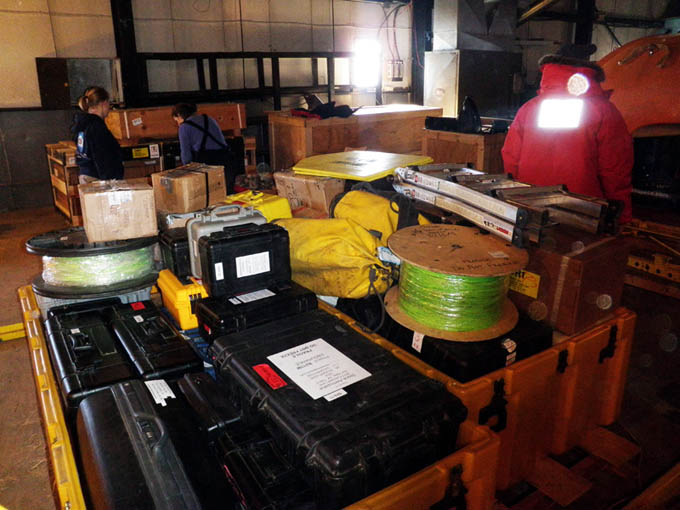
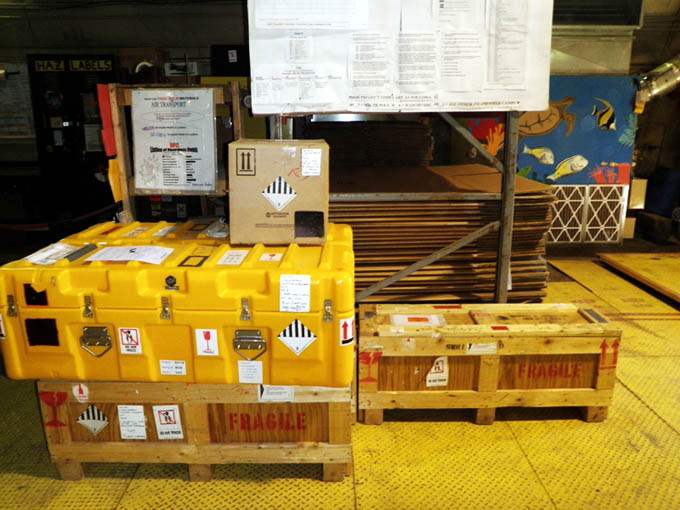
A final bolt-down of the syntactic to the bot took place up in Building 126 on Ob Hill. We used a pallet jack to move the 700 kg (each) yellow shipping crates to where they could be snatched by a “pickle” fork truck and taken to Science Cargo. By mid afternoon all our shipping crates were checked in at Science Cargo (including a large toolbox, the two yellow crates, and the two gray boxes that had finally come in from Marble Point as a one-stack pallet). The bot remained in Building 126 until the carps completed the crate around it. Science Cargo indicated that the bot, along with a science UAV (unmanned aerial vehicle) would be going back on a dedicated C17 at the end of January.
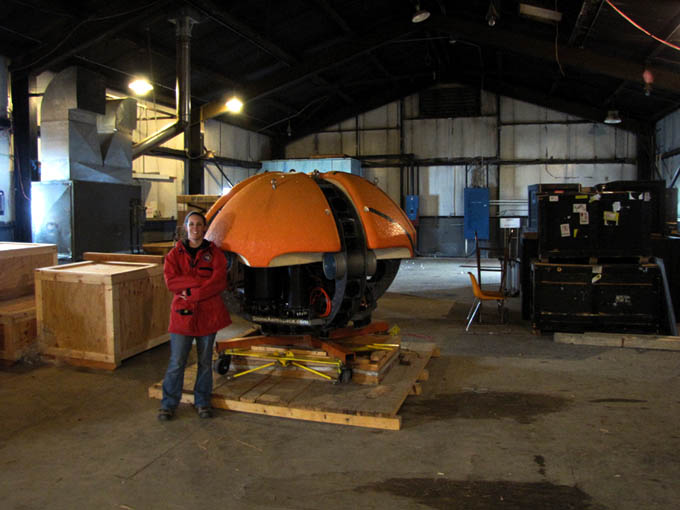
Rachel poses in front of the bot inside Building 126 on Ob Hill.

We spent the rest of the day cleaning up our rooms, packing, completing blog entries, and closing out our offices in Crary Lab. At 8pm we did the ritual “bag drag” up to the post office building where flight loads were prepared. Given the amount of field gear we had brought with us it took two heavily-laden trips per person.
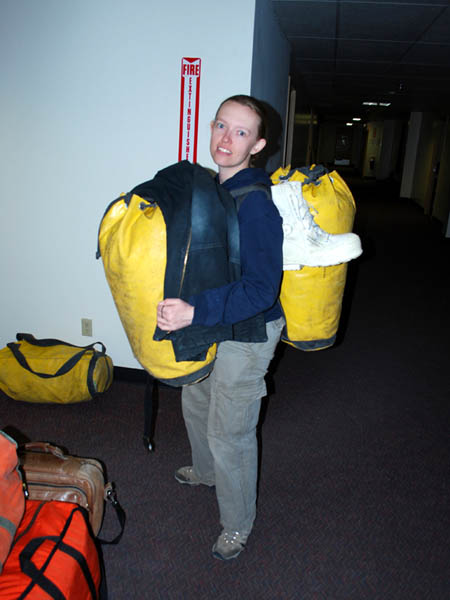
Vickie backpacks a double load on the first bag drag haul to the flight staging area at the post office building.

Reporting by Bill Stone
December 9, 2009 By Stone Aerospace

ENDURANCE: Mission 2: December 9, 2009

West Lake Bonney, Taylor Valley, Antarctica
Reporting from East Lake Bonney Basecamp

Some of us were up at 6am working on data reduction and blog postings. There was a small team meeting at breakfast at 7:15am. Emma and Jim helo’d back to West Lake Bonney today to pack up the last remaining BFC items (tables, chairs, stove, heaters) contained in a small auxiliary Jamesway hut that had been erected adjacent the bot lab during the original set up in October. There had been a mis-communication last Saturday with the carp crew there about who would wrap that part up and so this last bit somehow never got done. Since no one gets cleared to leave MCM without cleaning up their field camp mess, back we went.

We spent the morning doing an inventory of all equipment in the two large yellow shipping containers. At 1pm we assembled a critical mass of crew at Building 126 and took down the hoist and gantry then transported that by truck back to the MEC shop. By 4pm we had the two yellow shipping crates closed up and cargo-strapped, ready for transport. We picked up the carpentry foreman over at the Carp Shop and went back to Ob Hill to discuss proper tie down procedures for shipping the bot as well as the bolt up of the sidewalls and top to the giant crate that went around it. We returned at 5:30pm and met the rest of the crew for dinner, including Emma and Jim who had successfully completed their mission to WLB.

First to go: ENDURANCE Li-ion power stacks at Science Cargo, ready for retro to CONUS.

This evening everyone spent time sorting through their ECW gear for tomorrow’s bag drag. The remaining six of Team ENDURANCE (Maciek Obryk, Jim Olech, Emma Steger, Vickie Siegel, Rachel Price, and Bill Stone) were now on the manifest for the December 11th C17 flight to Christchurch. Personal gear sorting at the end of a season is somewhat tedious. MCM gives you up to 70 kg of checked baggage but only one orange hand bag to carry on board, which includes your laptop. There is also a similar small orange bag that you can pack with emergency clothing in the event the flight “boomerangs” (has to abort and return to MCM due to weather or mechanical issues). The rest stays locked down in the cargo nets if the flight returns so you have to anticipated that if things go wrong you will be living with those two small orange bags for some time, hence the considered packing exercise.

Reporting by Bill Stone

December 8, 2009 By Stone Aerospace

ENDURANCE: Mission 2: December 8, 2009

West Lake Bonney, Taylor Valley, Antarctica
Reporting from East Lake Bonney Basecamp

Following a team breakfast we bade farewell to Peter, Shilpa, Kristof, and Chris. They hiked off to the post office at 11:40am for pickup to the Pegasus ice runway and the waiting C17 for the ride back to Christchurch. The remaining members of the crew (Maciek, Jim, Vickie, Rachel, and Bill) met at Crary at 1pm and drove up to Building 126 to continue breakdown, sorting, and re-packing of the shipping containers.

We spent the afternoon setting up the lightweight gantry that had been used at the glacier melt hole, laying down the 6 inch steel channel rails for it, and getting the hoist loaded onto the trolley (a not-inconsequential feat given that the hoist weighed over 50 kg). We then picked up the bot for placement on its heavy wooden shipping pallet. Next came the four orange syntactic flotation quadrants (they had been removed for helo flight due to load restrictions; there were no such restrictions on the C17 so we re-assembled most of the durable systems into the bot frame. The expensive, sensitive electronics and sensors went in their own shipping containers. With the bot tied down on the pallet, we then turned the job of completing the giant box sidewalls and top to the more capable hands at the carp shop, who had been unendingly helpful this entire season. We plan to meet with them tomorrow to go over the bolt up procedures.

At that point what remained was to empty two large “Triwalls”—large 3-layer corrugated cardboard shipping boxes—into which we had dumped a good portion of our science cargo hastily at Lake Bonney and repack that load into the two now-empty yellow boxes. We put the lead on the bottom. There was a small debate over setting up the gantry to pull boxes out of the Triwalls (the men favored just jumping in and passing them out; the women wanted to use the hoist. As they had a 3:2 majority the men were chastened to finish their work at Crary while the others completed the transfer and the Rubic’s Cube dense packing. Around 5:30pm a call was received in Crary and the truck was driven back up Ob Hill to retrieve the three women. Everyone went to dinner then and retired early. While having more diverse and plentiful food, McMurdo certainly lacked the ambience that made staying up late and working at Bonney a pleasure.

Packing shipping containers in Building 126

Inside Building 126 on Ob Hill, Vickie, Rachel, and Bill repack the ENDURANCE shipping containers for maximum density.

Reporting by Bill Stone

December 7, 2009 By Stone Aerospace

ENDURANCE: Mission 2: December 7, 2009

West Lake Bonney, Taylor Valley, Antarctica
Reporting from East Lake Bonney Basecamp

At a 7:15am breakfast the team discussed the current status of our equipment. The bot, the two yellow shipping containers with the syntactic flotation blocks, and two heavy gray shipping containers full of instrumentation and power supplies were still at Marble Point, some 45 minutes by helo away from MCM. These were scheduled to arrive today (gray boxes at 5:35pm on 36H; bot at 10:20am from WLB on 08H; then several white science cargo shipping containers with such things as left over food, dive lead, ice axes, ropes, heaters, rigging hardware, tables, chairs, and the like from Marble at 10:25am on 36J; and two yellow boxes from Marble at 12:40 and 2:45pm also on 36J). Of these, the gray boxes failed to materialize due to deteriorating weather along with one of the yellow crates.

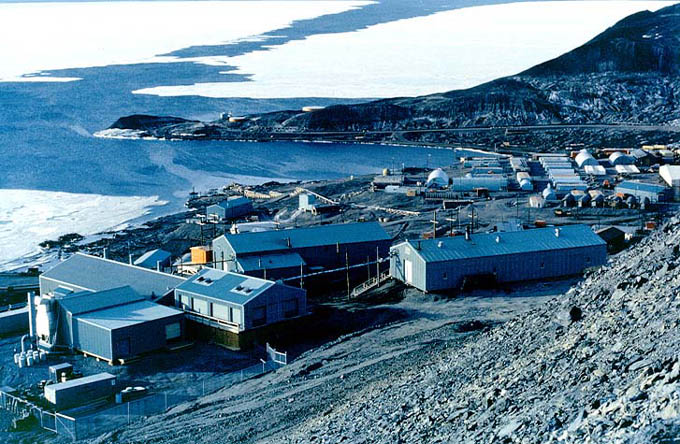
Science lab space, particularly space with an overhead crane, is at an absolute premium in McMurdo during the austral summer, when scores of large projects are passing through and returning to the base from further inland. We were not surprised, therefore, to find that neither our original work area of 2008 in the MEC complex, nor our more recent “A-Team” set-like staging locality for 2009 in the Incinerator building were available upon our return. There were some eyebrows raised, however, when we were issued a key to Building 126, where the bot and our gear would be warehoused until their shipment back to CONUS sometime in January. The building was located halfway up Ob Hill, where the old “SLOWPOKE” reactor had been located, in a building scheduled for demolition—due to asbestos. The place had a thick layer of dust over all surfaces with cracking plywood and deformed, rusting metal plate floors. It was being used for temporary storage of large, mostly black-painted, wood boxes and Triwalls and gave the strong subliminal impression of a 1930s era warehouse where gangsters would have had a shoot out with Tommy guns. The fact that it had been a part of the old reactor complex did nothing to dispel the ambiance. In the late 1950s the Navy, which had first established McMurdo as part of the original “Operation Deep Freeze”, decided that nuclear power was the solution to the base’s growing diesel consumption. The PM-3A, NNPU “Nukey Poo” US Navy power reactor produced 1.75 megawatts of electrical power, and, as well, provided heating and desalinization power. Initial criticality was achieved on March 3, 1962. It was “decommissioned” (shut down, due to chloride metal corrosion) in 1972. It operated on 93% enriched U235. The reactor, its associated building, and 9,000 cubic meters of irradiated foundation were retro’d to CONUS by 1979. Further fascinating reading on this topic can be had here:

The Antarctic Environmental Awareness Page at Southpolestation.com (not an official USAP website)

SLOWPOKE Reactor Wikipedia Entry

1950s photo showing the SLOWPOKE reactor complex on Ob Hill. In 2009 Team ENDURANCE used the right-most building for equipment re-packaging for retro to CONUS.

At 1:10pm we drove up to Building 126 and not long thereafter Tony Buchanan from MEC arrived with the bot from helo ops on a trailer. A large fork truck also arrived with a long extender “Y” shaped gadget that went on the forks to make a shackle suspension point. Using that they picked the bot off the trailer and dropped it in the building inside the role up door. Later Michael Davis at Science Cargo located the big crate ENDURANCE had been shipped in from Port Hueneme and brought that up on a large “duty fork”. We later had to request a “pickle” (green Mk4 2-ton capacity small fork truck) to come up to move this inside along with one of the yellow boxes.

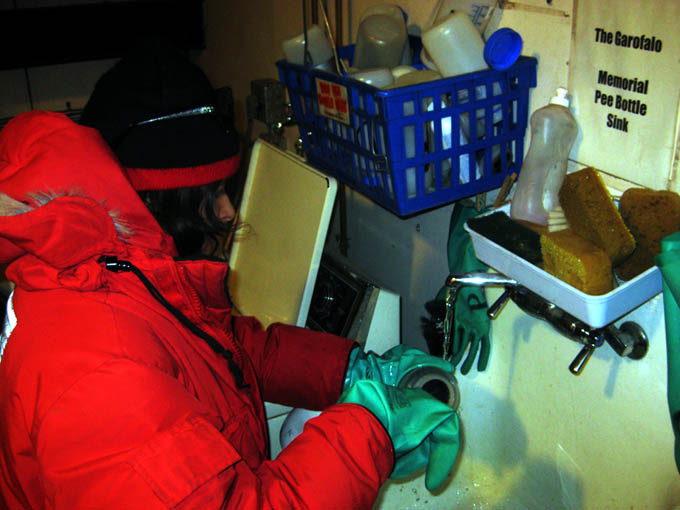
A final team meeting was held at 3:30pm in Crary to discuss 2009 completion tasks. In addition to the above activities, throughout the day materiel was being returned to such places as the BFC, the field outfitting center. This included all of our sleeping bags, cook sets, and… pee bottles (no waste of any kind is allowed to touch the ground in the Dry Valleys). With regard to the last item, each person was responsible for cleaning their own bottles at the “Garofalo Memorial Pee Bottle Sink”.

Shilpa gets her turn at using the Garofalo Memorial Pee Bottle Sink in the Berg Field Center.

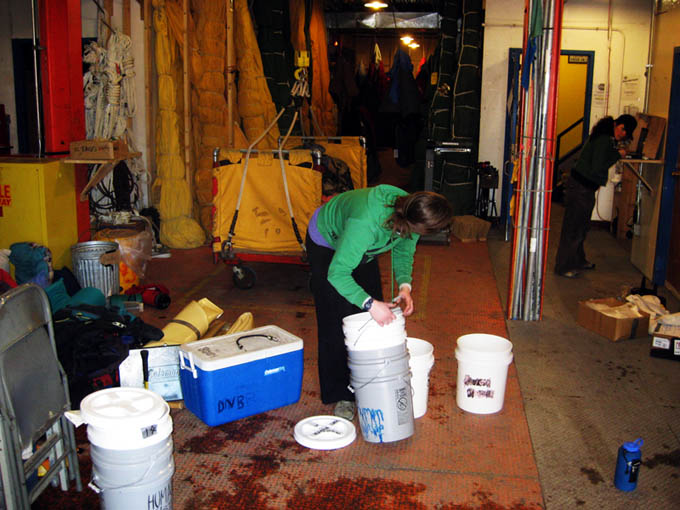
Also at the BFC, Emma returns unused human waste buckets.

Later in the evening a final Team ENDURANCE departure party was held at the Southern Exposure bar.

Reporting by Bill Stone

December 6, 2009 By Stone Aerospace

ENDURANCE: Mission 2: December 6, 2009

West Lake Bonney, Taylor Valley, Antarctica
Reporting from East Lake Bonney Basecamp

Sunday is “brunch” day at McMurdo Station, so the team met for breakfast at 11am before going their separate ways to begin sorting out their various chores and responsibilities. Four of our crew (Peter, Shilpa, Kristof, and Chris) were scheduled to leave on the C17 flight on the 8th, in just two days, so they were more pressed for time than the rest to resolve any open issues in town (a lot of equipment had to be returned to various labs; offices had to be cleaned up and gear stowed; data had to be backed up; and any excess personal cargo had to be boxed and shipped).

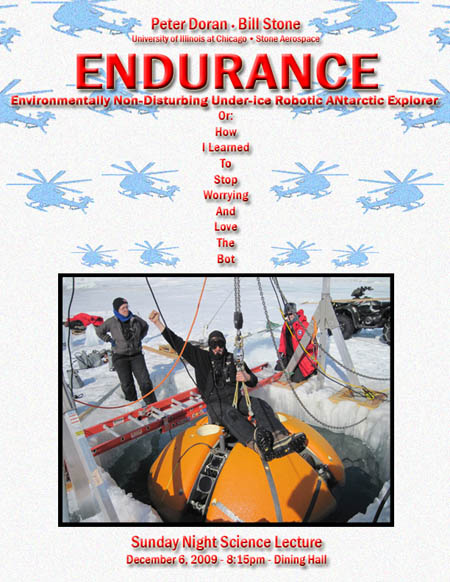
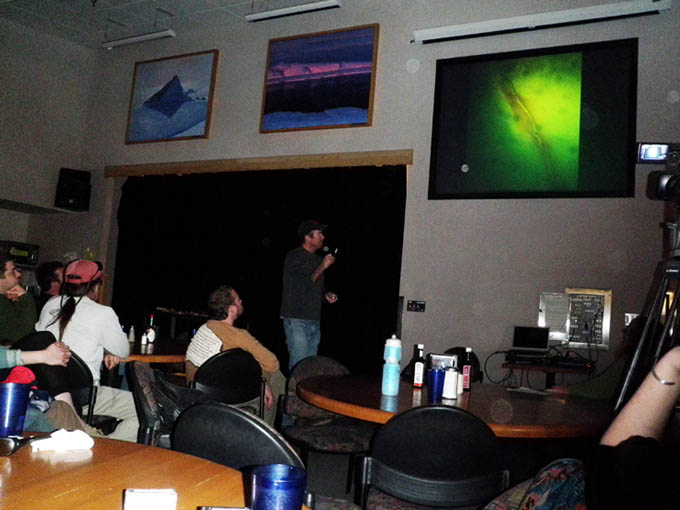
Peter Doran and Bill Stone presented the Sunday Night Science Lecture at McMurdo to a crowd of about 150 in the main dining hall in Building 155. These lectures are a frequent place to catch up on what other field researchers have underway, what conditions exist out on the ice, and what logistics problems are currently at hand. Even as our team was leaving Taylor Valley, other crews were coming in for their 2-month projects.

Sunday Night Science Lecture series poster for December 6, 2009.

Peter Doran describes some unusual Sonde down-look camera images from West Lake Bonney at the Sunday night lecture.

Reporting by Bill Stone

« Previous Page
Next Page »

Footer

Corporate headquarters:
Austin, Texas

Smart tools for exploring the frontier
  • Facebook
  • Instagram
  • LinkedIn
  • Twitter
  • YouTube

Copyright © 2026 · Stone Aerospace, Inc.