• Skip to main content
  • Skip to footer

Stone Aerospace

Smart tools and systems for exploring the frontier

  • Home
  • About us
    • What we do
    • History
    • Design philosophy
  • Projects
    • BEAGLE
    • PARTI-Pucks
    • Thor
    • PROMETHEUS
    • ARCHIMEDES
    • ARTEMIS
      • Description
      • Field notes
      • Photo gallery
    • VALKYRIE
      • Description
      • Field notes
      • Photo gallery
    • ENDURANCE
      • Description
      • Field notes
    • DEPTHX
      • Description
      • Field notes
  • News
  • Employment
  • Contact us
  • Stone Aerospace in One Page

Stone Aerospace

November 20, 2009 By Stone Aerospace

ENDURANCE: Mission 2: November 20, 2009

West Lake Bonney, Taylor Valley, Antarctica
Reporting from East Lake Bonney Basecamp

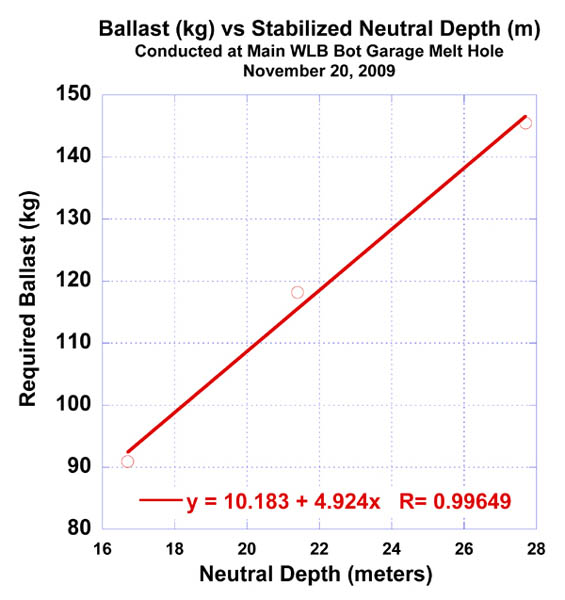
This was planned as an extremely long day. The team was up and working early and by 10:30am a pulley system was installed over the melt hole and the first test load of lead had been loaded into the carrier bags located about the circumference of the vehicle. Three tests were conducted with the following resulting data acquired:

Ballast (kg) Neutral Depth(meters)
145 27.7
118 21.4
91 16.7

The recorded sub-chemocline ballast data at the main lab melt hole showed a near linear fit. The team planned for initial ballasting to 21 meters depth to explore underneath Taylor glacier.

No thrusters were used in these experiments and, because the overhead electric hoist only had 6 meters of range, we used a manual, 2:1 rope pulley system and ascenders to maneuver the vehicle passively down into the chemocline.
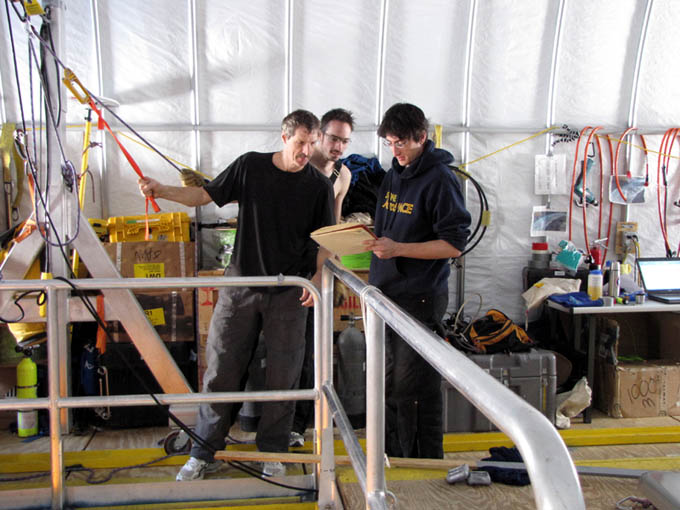
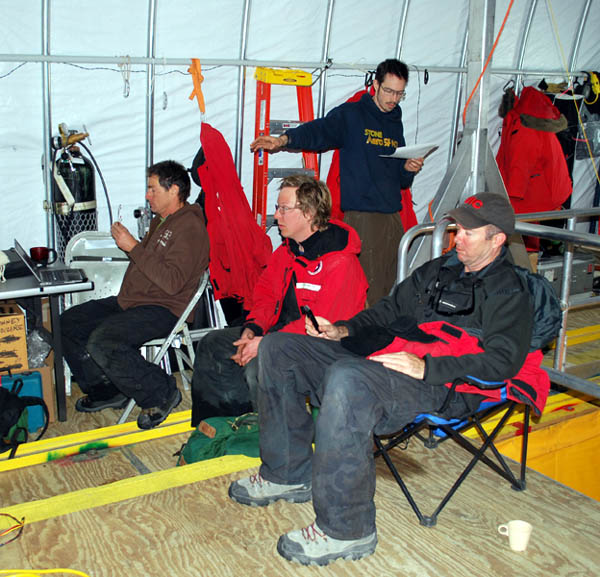
Kristof and Bill man the 2:1 haul system to retrieve the bot following a neutral ballast test. The vehicle was sequentially weighted and the neutral stabilization depth in the sub-chemocline zone was recorded. These were compared with numbers Chris (at right) had predicted based on free-release accelerations (which we could record very accurately with the onboard IMU).

Meanwhile, Vickie had re-acquired the GPS location for the glacier melt hole (now labeled GMH09), since the position had moved since our original fix several weeks earlier due to abnormally warm weather over a two day period sending runoff water ponding at the original site. By this time GM09 was 1.9 m in diameter—still too small to allow for the bot to surface there—and Maciej and Peter had two Hotsy coils running 24/7.

Although the original mission for today, following the ballast tests, was to scan the central portion of the glacier where the sub-chemocline mission would be run and thence make a trial approach and docking at GMH09, interest began to change amongst the science team to conduct a refined grid sonde mission near the glacier effluent source. A total of 39 sonde casts were being discussed with a predicted 9 hour run time. It was decided to forego the glacier scanning and docking experiment to get these sonde data. It was going to be a marathon mission, after which the team would sleep in late, take Sunday off and then return to the sub-chemocline mission on Monday.
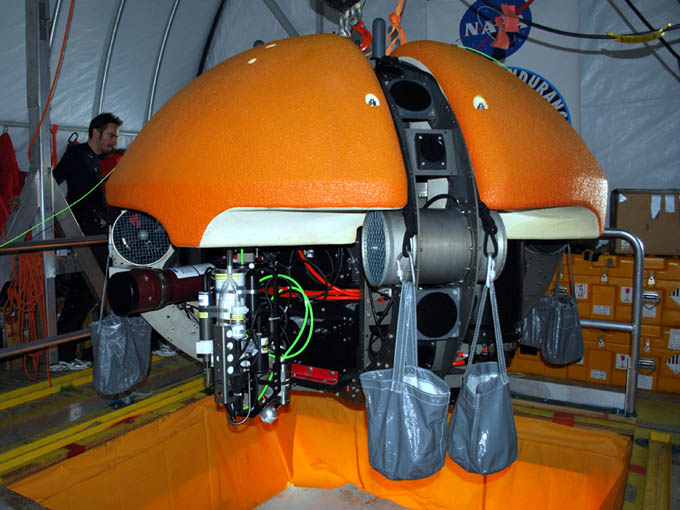
The ballasted bot: with 145 kilograms of lead distributed evenly in eight satchels around the perimeter.

By 2:44pm the vehicle charging had been completed and the mission plan was generated and loaded for the “Fine Grid” mission. However, at 4:30pm, not long after the bot had been released for descent through the melt hole, bubbles were seen coming out of the vehicle. The vehicle was immediately recovered and inspected and found to be in working order—the bubbles apparently having been from a captured pocket of air that did not get released during the normal “burping” exercise that we perform before releasing the vehicle. This false alarm pushed our schedule too far and it was decided to abort the mission and start early tomorrow.

At 5pm Vickie and Bill resumed the RTK GPS survey roundup of prior sonde cast location, completing all but six. Everyone was in bed by 10pm.

Reporting by Bill Stone
November 19, 2009 By Stone Aerospace

ENDURANCE: Mission 2: November 19, 2009

West Lake Bonney, Taylor Valley, Antarctica
Reporting from East Lake Bonney Basecamp

With the sonde casts completed for 2009 we turned our efforts today to the more complicated task of exploring beneath Taylor glacier. We completed a 3D map of the entire face of the glacier (and its north and south lateral moraine areas) in 2008 but in the central portion of the glacier it appeared that the glacier was floating on top of the super saline chemocline at 14 meters depth. Below that, we had no 3D imaging returns (due to acoustic bounce off the denser water). So our next objective was to go through the chemocline, neutrally ballast the vehicle at a depth that would split the difference between the beginning of the chemocline and the lake bottom (at approximately 28 meters in that location) to give us the best chance to enter any sub-glacial caverns, if they existed. The problem with this scenario is that there is a dramatic increase in buoyancy at the chemocline. Earlier measurements from the LTER project predicted a water density of 1090 kg/m^3 at 20 meters depth and 1110 kg/m^3 at 40 meters depth, thus a precise ballasting would be required to achieve neutral buoyancy at the desired depth. With a vehicle displacement of approximately 1.5 cubic meters estimates for ballasting the vehicle at 21 m depth ran as high as 160 kg of additional lead that would have to be added to the vehicle—otherwise it would bob like a cork on top of the chemocline.

We were operating under further, administrative, restrictions imposed by the environmental impact statement (a 3 cm thick document) that the project had to file in compliance with the Antarctic Treaty (the Dry Valleys are in a specially protected locality). This allowed for no powered flight below the chemocline except for limited forays permitted immediately adjacent the glacier. This presented a logistical problem: we had to fly almost half a kilometer from the lab to reach the glacier, yet the vehicle did not have sufficient vertical thrust to maintain itself within the fresh water lens if ballasted to operate neutrally below the chemocline. The approach that evolved over 2009 was as follows:

  • create a second melt hole at the glacier
  • have the bot surface there
  • attach the ballast lead
  • conduct the sub-chemocline sub-glacier mission
  • return to the melt hole and remove the ballast
  • return to the lab for recovery

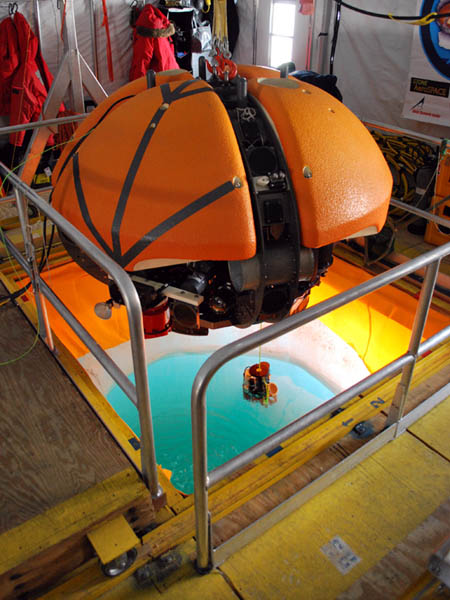
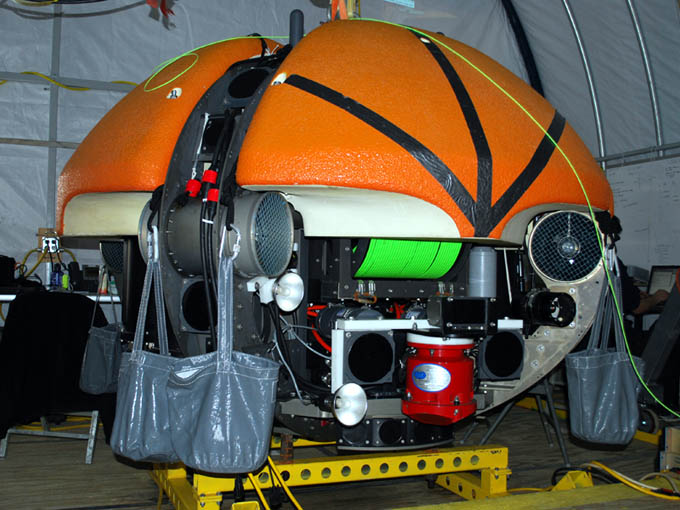
The second and third steps required a second portable gantry at the auxiliary melt hole and a means to quickly attach and remove the lead. Bill and Vickie spent today transporting lead to the bot garage from the helo drop zone and working up a rigging system for quick attachment of the lead. The solution was low-tech: eight heavy duty contractor open-top haul bags were connected to four sets of double 11 mm PMI rope harnesses that could be looped over the four auxiliary lift eyebolts between the four syntactic flotation blocks (see figure). The ballast calibration test would take place tomorrow.

View of the vehicle with the sub-chemocline ballast carrier test rigging.

Meanwhile, Kristof, Shilpa, and Chris performed several hours of short range calibration runs with the vehicle out to 200 meter radius from the melt hole to test the sensitivity of the iUSBL navigation system. These suggested that the melt hole transponder battery was dying. We subsequently disassembled the transponder and replaced the power pack.

The team returned to basecamp at 8pm. At that time John Priscu announced that the sonde data were indicating a potentially exciting discovery of an anomalous, very cold water entry near Blood Falls at cast G3. He and Peter Doran had discussed the findings and requested that we develop a mission plan for a refined sonde cast matrix in that area to localize the source. Everyone was in bed at 12:20am.

Reporting by Bill Stone
November 18, 2009 By Stone Aerospace

ENDURANCE: Mission 2: November 18, 2009

West Lake Bonney, Taylor Valley, Antarctica
Reporting from East Lake Bonney Basecamp

With the success of the previous day’s foray into the “no fly” zone behind the LTER limno cables and the knowledge that with proper battery balancing we could likely hit 5 kilometers of cruise range with the new power stacks, we began hatching a plan to visit East Lake Bonney. The previous year we expected that it would be necessary to create an auxiliary melt hole a kilometer east of the bot garage where we could surface and recharge the vehicle and then maybe continue on to the end of West Lake Bonney. The new batteries made that obsolete, but it did not solve the problem that the “narrows” at Bonney Riegel made a sharp 90-degree turn. With the presence of boulders along the lake edge, the probability was high that the data fiber would be drawn into the boulders and snag the vehicle if we attempted to navigate through the narrows. The success of the diverter pole concept changed all that.

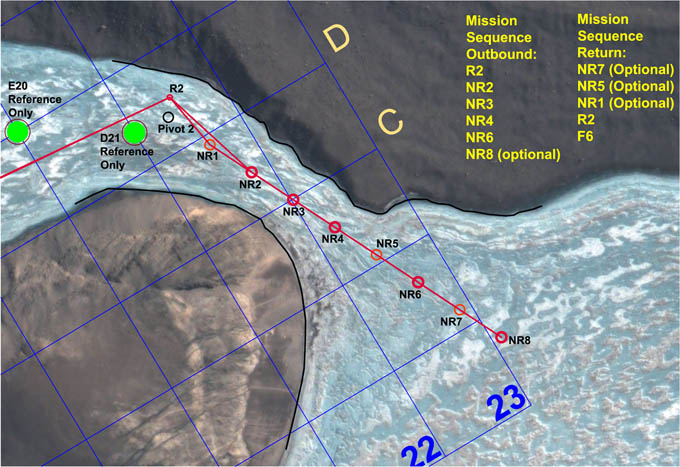
We began work on the complicated mission plan at 11am. This work was punctuated by the arrival, on short notice, of a Bell 212 load of NSF visitors who toured the lab for close to an hour then choppered off. By 2:20pm we had the plan and vehicle trajectory worked out: the anticipated mission length was 3,931 meters with 8 sonde drops through the center of the Narrows. Run time was predicted at 6.5 hours door-to-door with 5.5 hours underwater. Some time before that, Vickie had driven an ATV out to the Narrows with the RTK GPS equipment and had set out two new locations “R2” and “Pivot2″—the latter was the location for the diversion tube and the former was the targeting point for the bot some 30 meters to the northeast of the tube to ensure the fiber stayed on the north side of the tube as the bot headed southeast. At 3pm John Priscu drove out to run the Jiffy drill and install the pipe. By this time we had also upgraded the radio communications system at the lab with a 5-watt base station that could be received all the way to East Lake Bonney camp—the previous hand-held radios inside the lab had difficulty with interference from the metal arch frames of the habitat.

The bot was programmed to proceed directly to mid-stage targeting point R2, 1520 meters from the lab while mapping the south lake shore grounding line along most of that distance. It then proceeded southeast through the narrows and more than 400 meters out into East Lake Bonney. It performed 8 sonde drops along the way (the “Ninja Romeo” series).

The November 18 narrows mission would be the longest ever attempted with ENDURANCE. To ensure the bot would make it back we kept the vehicle on charge through the sonde calibration cycle. The vehicle was then lowered into the water, the sonde “homed”, and the cables freed to allow it to begin its journey.

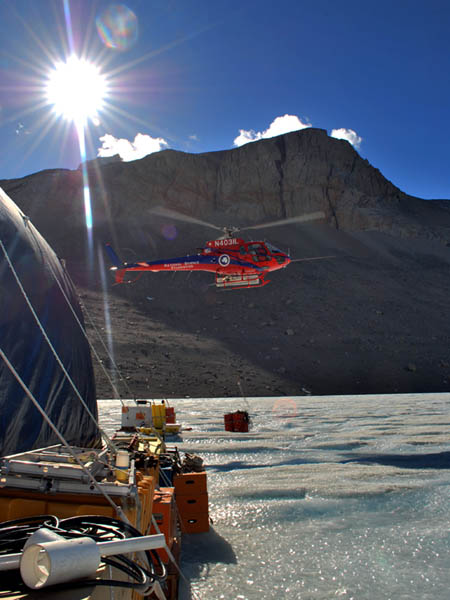
The bot garage was abuzz with helo activity today, with several pickups and drop offs. Here an ASTAR is dropping off another load of AN8 (diesel) for the main 10 kW generator.

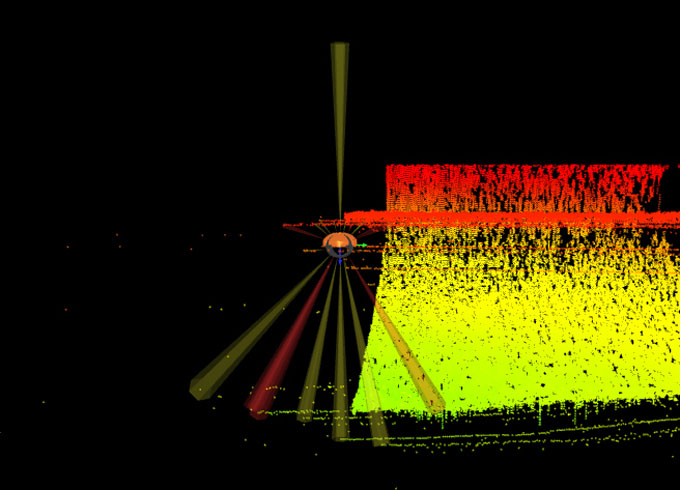
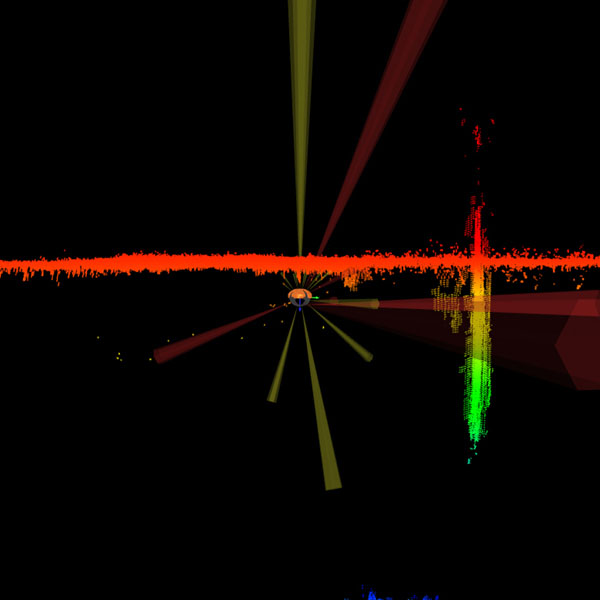
By 3:50pm the bot was underway to station R2 with a predicted 100 minute run time to get there. Meanwhile, Kristof began a novel dance physically miming the vehicle programming for today with Shilpa calling out the various commands to verify that the bot was going to do the correct thing inside the narrows. We had the multi-beam sonar configured in side-look mode and it had been programmed to scan the south shore of the lake from an 80 meter standoff on its way outbound (see figure for a glimpse of the data results from the 3D visualizer). However, once it got to the narrows we needed to perform a series of obstacle avoidance sweeps to ensure the way forward was passable. The least energy configuration for achieving this (and today every coulomb counted) was to perform a 180 degree yaw rotation of the vehicle at the sonde drop points and then continue forward, alternately sweeping each side of the narrows; on the return to base the bot would sweep the opposite quadrants and all of this was verified by Kristof’s miming routine. For the same reasons, prior to launching the bot today we kept the vehicle on charge while the sonde calibration was being performed and only removed the charge cables at the exact instant when the vehicle was ready to be released.

Kristof Richmond (standing in the bot garage) mimes the mission programming steps for the run through the narrows.

In addition to the sonde runs through the narrows, today was also the first lateral imaging bathymetry mission. We maintained an 80 meter standoff range from the south shoreline (which we had acquired with RTK GPS) and mounted the multi-beam sonar in its horizontal (forward-looking) position. Because the vehicle is orientation-independent, we rotated the multi-beam so that its field-of-view was perpendicular to shore and drove the vehicle “sideways” down the lake to achieve the desired scan. Yellow points in this figure are valid bottom bathymetry hits; the bottom of the red points represents the underside of the ice cap. Above that are multi-path ground bounce (fictitious) points which will later be filtered out in the post-processed data set.

At approximately 5:45pm Bill and Vickie detected the vehicle under station R2 and verified it was sweeping past the pivot point on the correct side for a safe passage. They continued tracking it for another 400 meters out into the wide open expanse of East Lake Bonney. By 8pm the vehicle was back at R2 and the diverter tube was removed, leaving roughly 1600 meters remaining to reach the lab. The vehicle arrived at the bot house on cue shortly before 10pm and post-processing of the data took place for another 2 hours. We headed for bed at 12:30am. Given the long last three days we gave people till noon to recover. With the additional maneuvering to station F6 and some short range navigation testing prior to surfacing the total actual mission length was 4250 meters.

Bill sets station NR2 in the heart of the Bonney Riegel narrows.

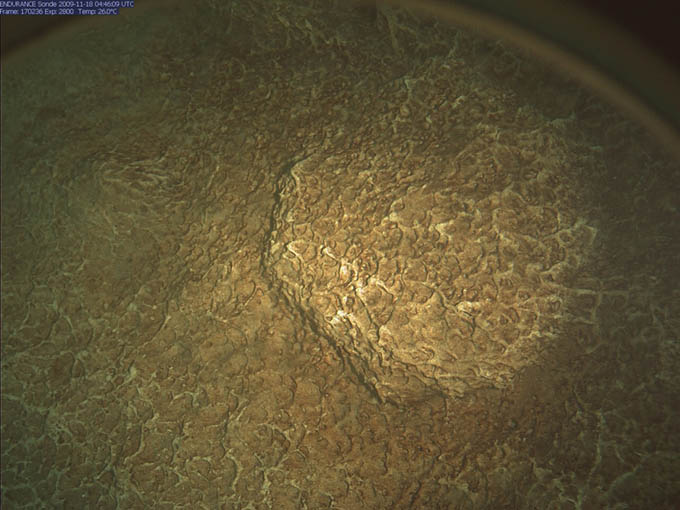
The sonde camera bottom image at station NR2, showing what appear to be dendritic microbial mats.

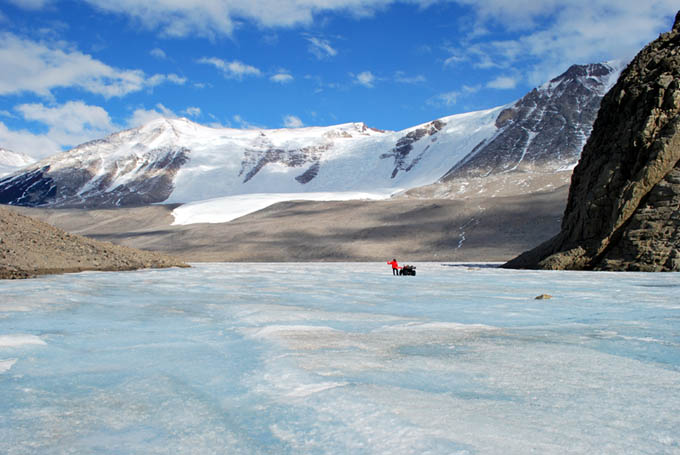
Looking out into East Lake Bonney from sonde point NR8.

The narrows looking northwest from NR8. Vickie sets the final drill hole for GPS tagging.

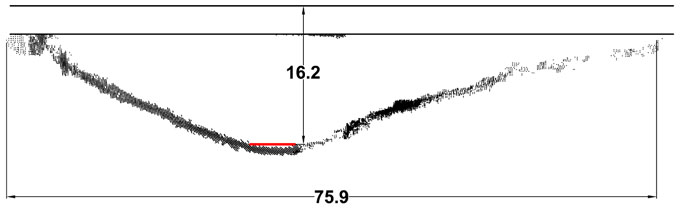
Today’s mission was of some historical interest. In 1903 Capt. Robert Falcon Scott’s party passed through the narrows at Bonney Riegel. In addition to taking several black and white photographs they also measured the width of the narrowest portion of the ice at that location. This was a crucial measurement that, together with the high resolution multi-beam measurements just acquired by ENDURANCE, enabled us to demonstrate that the water level in Lake Bonney had risen more than 16 meters since Scott’s team was there. We wondered what they would have thought had they known that 106 years later a robot would be hovering beneath where they had stood.

Lake Bonney water levels: 1903 vs 2009. This computer-generated plot shows a slice through the 3D sonar data acquired by ENDURANCE as it navigated through the narrows. Scott’s party, whose ice width measurement is plotted to scale here in red, almost certainly stood at this location, about halfway between NR2 and NR3. The top horizontal line represents the surface ice cap level today; the second horizontal line represents the measured underside of the ice cap today.

With the December 18th mission the entirety of West Lake Bonney sonde grid was completed, plus the additional 8 casts made through the narrows.

Reporting by Bill Stone
November 17, 2009 By Stone Aerospace

ENDURANCE: Mission 2: November 17, 2009

West Lake Bonney, Taylor Valley, Antarctica
Reporting from East Lake Bonney Basecamp

Although ENDURANCE is an autonomous underwater vehicle (AUV)—it has several independent onboard navigation systems and auto-return and docking behaviors and can be programmed for entirely “hands-off” missions; in addition it contains its own redundant power supplies and is self-sufficient for up to 10 hours on its own—we have found over time the enormous benefit of a fiber optic data link to mission control. On deep space missions NASA enjoys the benefits of seeing (in delayed real-time, due to the transit speed of light) the responses and actions of its deep space probes and can upload revised mission plans if problems are foreseen, or, more importantly, if new science is detected in the data stream so that the vehicle can take a closer look. For identical reasons, the science coming from Lake Bonney ranks #1 on the priority list of what we are here to achieve and we have found it prudent (given the investment in the vehicle) to look over the shoulder of the bot during most missions.

Underwater, however, bandwidth is limited and the only way to see real-time data—especially the torrents of geometry data coming from a vehicle like ENDURANCE—is through fiber optics. Thus we trail out a thin data filament on all missions. The new ENDURANCE “situational awareness” 3D visualizer was built around this capability and it has allowed us on many occasions already to catch new features and to immediately investigate them during the course of an ongoing mission.

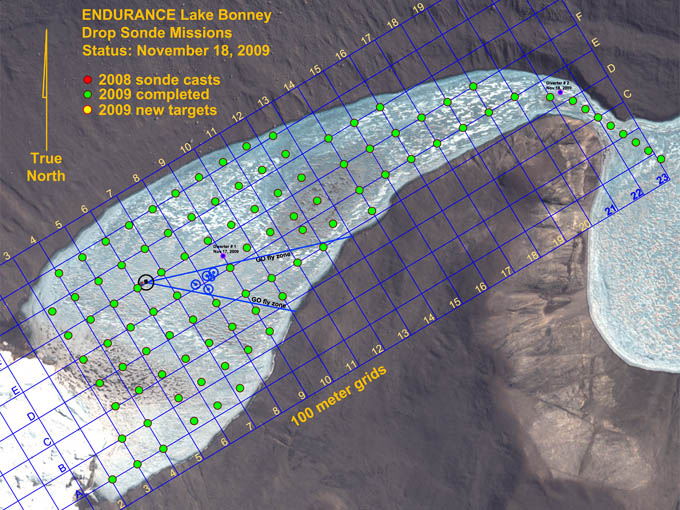
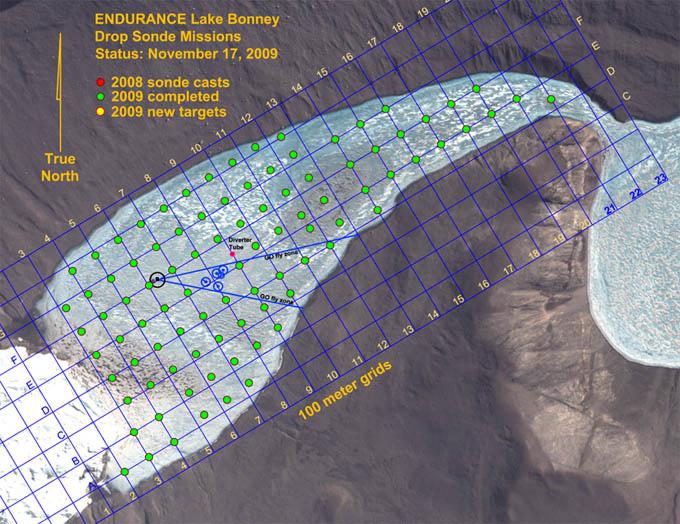
This capability comes with a price in a sub-glacial environment, namely the possibility of fiber snagging. Lake Bonney has an unusual constituency: under the 3 to 4 meter thick ice cap is a 10 meter fresh water lens riding on top of a 27 meter thick, ancient, hypersaline layer. The buoyancy of that layer is sufficient to cause a vehicle like ENDURANCE (ballasted to free-fly in the fresh water lens) to bob like a cork on water. Within this restricted domain we had three choices in the design of the data fiber: to have it sink and float on the salt layer; to have it neutral and free-float in the fresh water lens; or to make it positively buoyant and float under the ice cap. The middle option was ruled out due to the possibility of it wrapping up on the vehicle. But we did come equipped to work either of the other scenarios. Fortuitously, it turns out that the underside of the ice cap at Bonney is glass smooth in almost all localities except for some notable pressure-ridges near the glacier, and so we have successfully operated using the floating fiber approach. There are, however, several permanent science monitoring experiments near the center of the lake that are used by the LTER program and these have cables that run the entire depth of the lake. They constituted enough of a fiber snag concern that during 2008 we designated the “shadow” area (see map) behind the limnological experiments to be a “no fly” zone. This year we came prepared to scan the entire lake.

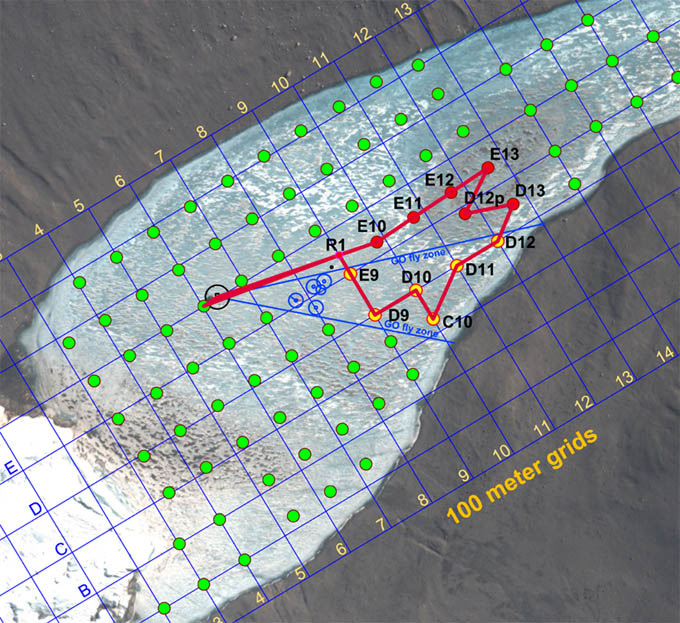
The November 17 mission plan took the bot into last year’s “no fly” zone to achieve full lake sonde cast coverage. To do so we employed a fiber diverter (the small black circle adjacent to R1).

The concept was simple enough: sink a 100 mm diameter smooth wall PVC tube through the ice cap so that it projected out approximately 3 meters below the underside of the ice and strategically divert the fiber away from the known obstacles. After selecting this point in the mission planner Vickie tracked out and marked it using GPS. Peter Doran then took responsibility for placing the tube (the location can be seen in the two figures as a small black dot just northeast of the obstacles, shown as blue circles). The procedure involved using a “jiffy” drill to make the hole and then lowering the tube on a piece of parachute cord to the precise depth. By 11am we received the cryptic radio message “Diverter King to Bot Garage. Mission complete,” meaning the tube was in place.

Today was a sunny, windless day, so we took the opportunity while the pre-launch checklist was being run to collect GPS fixes for some previous sonde casts (E14, E15, E16, E17, E18, E19, E20, F10, F11, F12, F13, F14, F15, F16, F17, F18, F19, G11, G12, G13, G14, G15, G16, H11, H12, H13, D14, D21). The bot launched at 2:45pm with the initial waypoint being R1, just 30 meters north of the diverter tube. We took the opportunity to navigate over to the tube for a visual inspection (see figure) as well as to verify the sonar image of the limno cables (our adversary today) then continued on with the pre-programmed mission to the final sonde casts for the general lake set in 2009: E10, E11, E12, E13, D12p, D13, D12, D11, C10, D10, D9, E9, F6.

From waypoint R1 we navigated back to the diversion point (30 meters away) to verify the status of the tube. Since all gear coming to our site is flown by helicopter, the MEC shop sent the tube out in sections. The tube is actually suspended from its bottom by a length of parachute cord inside the tube and gravity holds the pieces together. We duct-taped the joints, however, to prevent a fiber snag.

The multi-beam scan clearly showed the presence of the limno sediment trap cables extending the full depth of the lake, just behind the diversion tube.

The mission proceeded flawlessly. Run length was 1803 meters over 5 hours and 20 minutes, with 42% power remaining when the bot rose up the melt hole—all predicted within a few percent by the mission planner, which Bart Hogan had meticulously calibrated to recorded performance data prior to his departure. Also, the new balancing procedure developed for the batteries indicated that all but 3% of the theoretical maximum power was accessible. And the diverter tube concept had worked. This gave us ideas for a mission none of us believed possible before today.

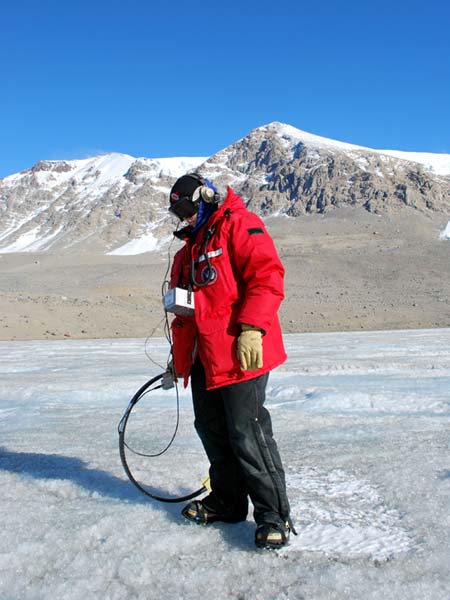
Vickie listens for the approach of the bot to station R1 during the November 16 sonde mission. On a long approach to the first point in a grid, the tracking team can estimate the location where the bot will be and drive there (using an ATV). By orienting the radiolocation coil horizontally and using a digital phase-locked loop receiver, it is possible to detect the approach or recession of the field. Two people using these in orthogonal directions can predict the arrival from almost 200 meters out.

The tracking team at station D9, the point of maximum angular incursion into the previous “no fly” zone.

As of the conclusion of the November 17th mission the entirety of West Lake Bonney was sampled, bringing to fruition the concept developed five years earlier by Peter Doran and Bill Stone—that a robot could do with repeatable precision what no dedicated field limnological team could achieve: the full 3D aqueous chemistry characterization of an entire sub-glacial lake in a single season.

Reporting by Bill Stone
November 16, 2009 By Stone Aerospace

ENDURANCE: Mission 2: November 16, 2009

West Lake Bonney, Taylor Valley, Antarctica
Reporting from East Lake Bonney Basecamp

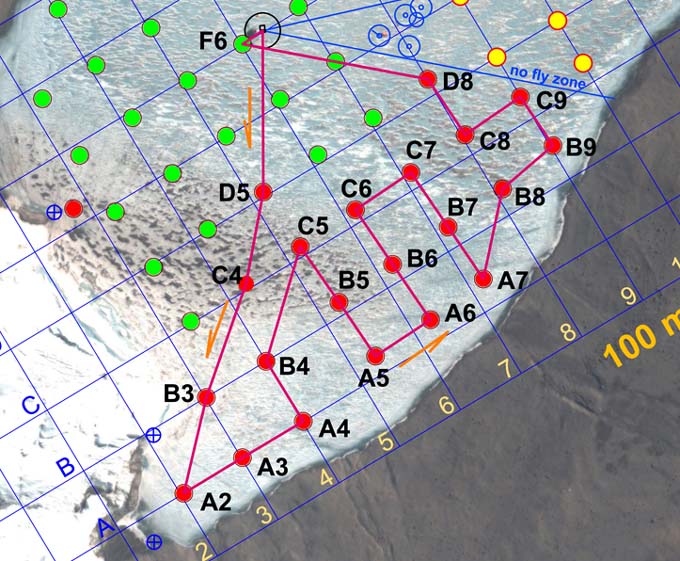
We awoke to the sound of tents fluttering madly in 25 knot + winds—katabatics coming down the valley. The temperature rose to 3C (37F). Bill prepared the mission plan this morning, an ambitious 22 sonde casts to mop up the entire southwest quadrant of the lake. While this was underway Vickie pulled the sonde flags from the November 9 and 11 missions and she and Rachel re-labeled them for today’s run.

Mission plan for November 16 called for another ambitious sonde cast run to clean up the southwest quadrant of the lake.

Meanwhile, the strong winds played havoc with our melt hole wind screens, lifting up and tossing heavy ballast ice into the hole that had been piled on the sheets. Vickie and Kristof went to work and re-anchored the ends of the flaps (seen as the yellow colored panels on the four sides of the moon pool access port in previous photos) using ice screws and some clever rigging tricks Vickie had picked up on other expeditions.

Project PI, Peter Doran, arrived on a helo flight at 11am, in time to participate in the team meeting. By 12:33pm the vehicle was underway. It returned at 6:35pm in a textbook mission, acquiring all 22 casts: D5, D8, C4, C5, C6, C7, C8, C9, B3, B4, B5, B6, B7, B8, B9, A2, A3, A4, A5, A6, A7, and F6 without incident. The latter station is included in all missions as a time varying measure of lake activity over the season. Total distance traveled underwater today was 2.7 kilometers with an in-water run time of 6 hours. We still had more than 40% power reserves at the conclusion of the mission.

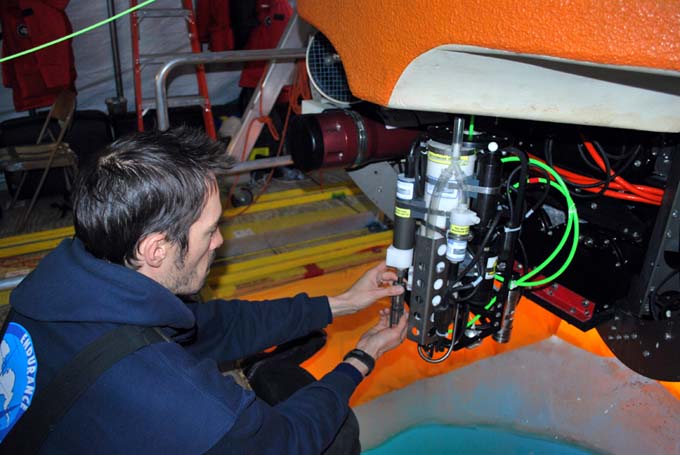
Kristof preps the pH sensor on the sonde before launch.

Vickie locks in on the bot position for the 22nd sonde cast of the day.

After being with us during the tedious start-up phase for six weeks, SAS chief engineer Bart Hogan began the long return to the US and his family today, hopefully arriving in time for Thanksgiving. Given the substantial changes and improvements made to the hardware and software on ENDURANCE over the past year, Bart’s presence on the field team was of enormous benefit. Thanks Bart!

SAS engineer Bart Hogan leaves the valley after six weeks on the ice.

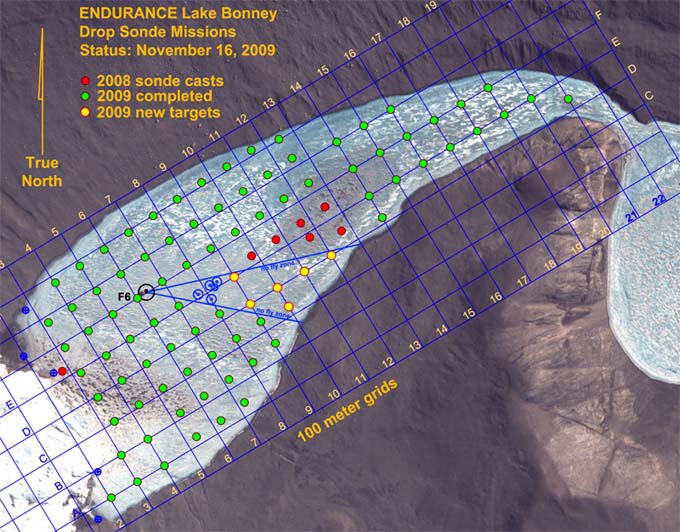
Sonde cast progress at the conclusion of the November 16 mission.

Reporting by Bill Stone
« Previous Page
Next Page »

Footer

Corporate headquarters:
Austin, Texas

Smart tools for exploring the frontier
  • Facebook
  • Instagram
  • LinkedIn
  • Twitter
  • YouTube

Copyright © 2026 · Stone Aerospace, Inc.