• Skip to main content
  • Skip to footer

Stone Aerospace

Smart tools and systems for exploring the frontier

  • Home
  • About us
    • What we do
    • History
    • Design philosophy
  • Projects
    • BEAGLE
    • PARTI-Pucks
    • Thor
    • PROMETHEUS
    • ARCHIMEDES
    • ARTEMIS
      • Description
      • Field notes
      • Photo gallery
    • VALKYRIE
      • Description
      • Field notes
      • Photo gallery
    • ENDURANCE
      • Description
      • Field notes
    • DEPTHX
      • Description
      • Field notes
  • News
  • Employment
  • Contact us
  • Stone Aerospace in One Page

Stone Aerospace

November 25, 2009 By Stone Aerospace

ENDURANCE: Mission 2: November 25, 2009

West Lake Bonney, Taylor Valley, Antarctica
Reporting from East Lake Bonney Basecamp

We were up early at 6:20am catching up on data processing and planning for today’s mission under Taylor glacier. The internet remains down and the tops of the surrounding peaks are still obscured in fog and snow. The mission plan (see figure) was conservative, given the absolutely unknown nature of what lies below the chemocline and underneath the glacier. The bets amongst the team as to what the bot would discover ranged far and wide from “a continuation of the vertical glacial interface wall straight to the bottom of the lake” to “a vast sub-glacial tunnel” extending westward under Taylor glacier.
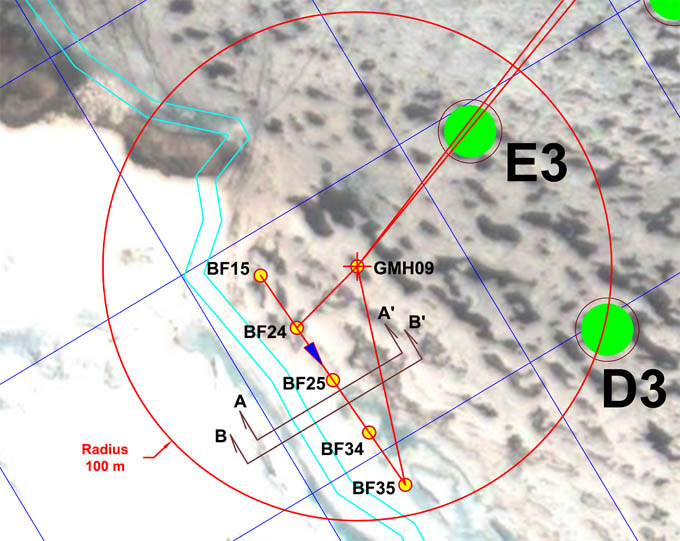
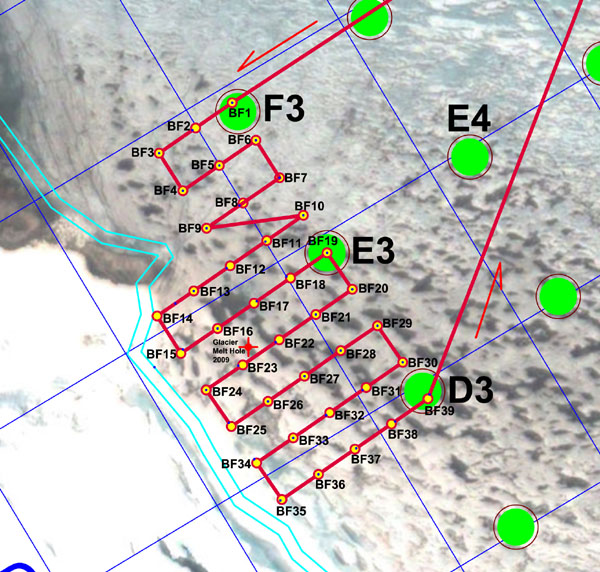
Mission plan called for the bot to surface at GMH09, load up on ballast, then maneuver to pre-points BF15 through BF35 and from there to make tentative perpendicular excursions under the glacier to the west, leaving a straight egress path to the melt hole. The multi-beam data from Sections A-A’ and B-B’ are plotted in the subsequent figures.
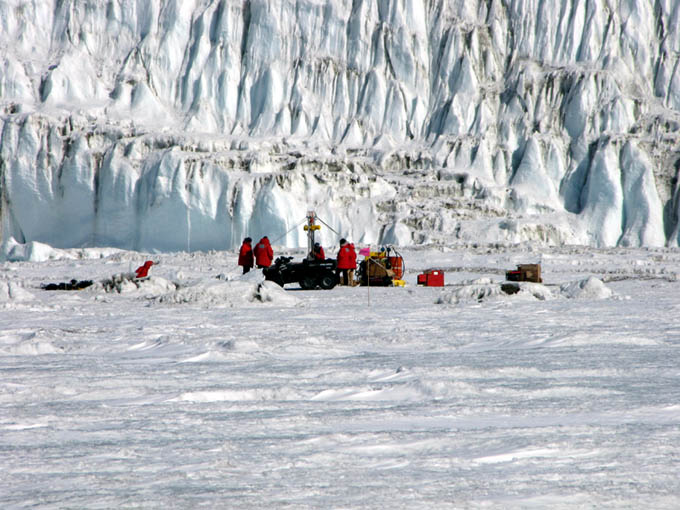
The ice team awaits the arrival of ENDURANCE for re-ballasting for the first sub-chemocline mission. Taylor Glacier forms the backdrop, just 30 meters behind melt hole GMH09.

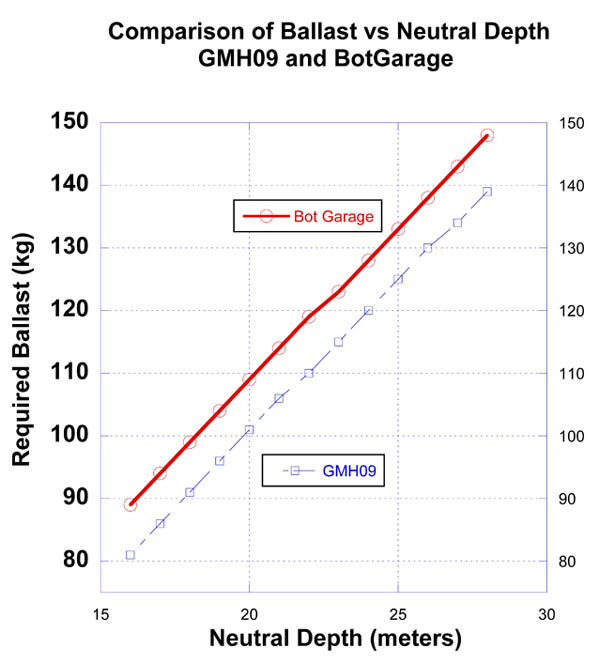
By 2pm the bot had autonomously surfaced at GMH09 and the crew, led by Vickie, went to work adding a series of ballast test loads to the vehicle to confirm the previous calibration done at the bot garage melt hole several days earlier. The first measurements suggested that there was a problem—the bot was sinking further than it did at the main melt hole. We therefore set about running another calibration run since it was certain that the bot was going to have to be ballasted to a precise depth once we got the first multi-beam data that showed where the best approach depth would be to get under the glacier. Within the chemocline we had limited vertical excursion capability. Even at full upward or downward thrust we would be limited to about a 6 meter rise or descent, all the while potentially stirring up bottom sediments. So the concept was to precisely ballast at the depth of interest and set the bot free for horizontal exploration. Here are the data we acquired today:

At Glacier Melt Hole
Ballast Load (kg) Depth Reached(meters)
85 16.9
88 17.2
90 17.64
91 18.01
105 21.2
118 23.4

New ballasting data acquired today at GMH09 showed a striking offset from the data originally gathered at the bot garage melt hole several days earlier. The consensus is that fresh water entering from underneath the glacier is locally mixing and slightly reducing the salt content of the chemocline at this locality.

We finally ballasted at 105 kg of additional lead, which took us to a neutral depth of 21.2 meters. With all systems go the melt hole team radioed back to mission control that the bot was free and descending into the chemocline and they began a close approach to the original BF15—BF35 line (see mission plan). Because of the bot’s depth (at 21.2m) and the rising moraines to the north and south we were unable to reach BF15 without violating the ENDURANCE under-keep minimum depth. The deepest lake bottom depth recorded in this zone was 27 meters, so there was not a lot of maneuvering room. For the same reason we were unable to reach BF35. But, within that line we were able to sweep the face of Taylor glacier to the bottom with clean line of sight.
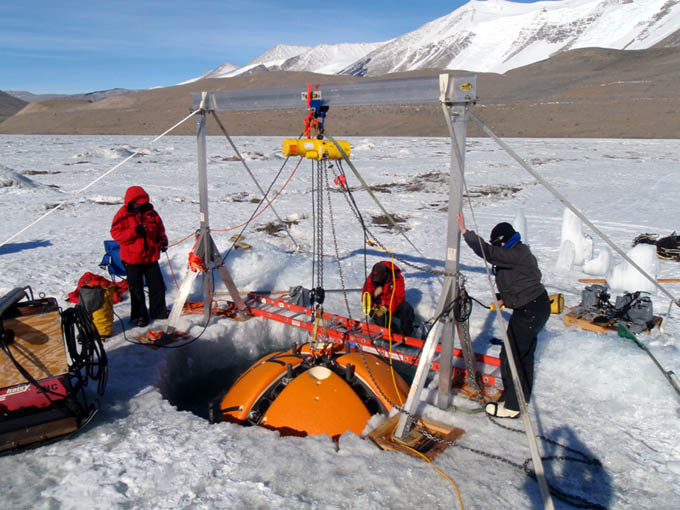
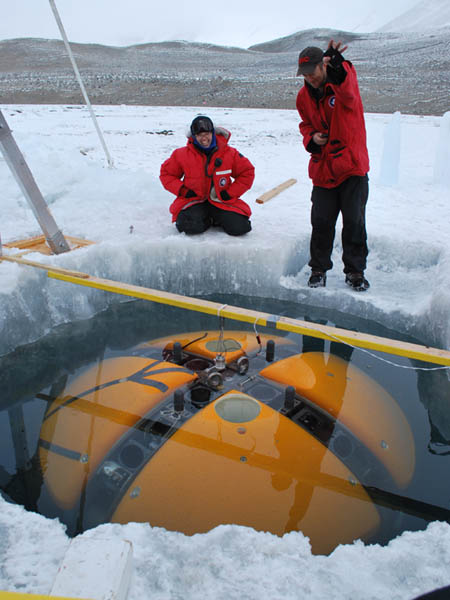
Getting down to the business of negatively ballasting the bot. The overhead 1-ton gantry is just barely strong enough to get the vehicle 2/3 out of the water—but high enough to add the additional 105 kilograms of lead to sink the vehicle to 21.2 meters depth, 7 meters below the chemocline layer.

ENDURANCE moved up close to the nose of the glacier at BF24 to try to get images of the grounding line. However, we were ballasted too heavy and the down-look cameras on the Sonde showed that we were beginning to stir up lake bottom sediment with the vertical thrusters attempting to maintain minimum standoff under-keep clearance so a retreat was ordered. We then cautiously moved southeast and again moved in close to the glacier about midway between BF25 and BF34, and midway between B34 and B35. The further southeast we went the shallower the lake floor / moraine deposit became. Based on this data it seemed clear that the ideal ballasting depth would be about 19.2 meters, and we made a note of that for tomorrow’s closer proximity explorations.

The bot’s multi-beam imager brought back a treasure trove of clean 3D map data (see Section figures A-A’ and B-B’ for a sample of some 2 meter slices of the data taken between BF25 and BF34). Unfortunately for those who had wagered on the presence of a vast sub-glacial cavern, there was no borehole leading off into the unknown. But there was plenty to be investigated further once we had the right neutral approach depth to minimize disturbance of the grounding line sediment. We auto-docked back to the melt hole around 9pm, removed the excess ballast, released the bot and it returned home for a second autonomous docking and ascent at a mission clock time of 7 hours and 26 minutes underwater. It had been a good day. We had pulled off a dangerous exploration mission and did not lose the bot. Tomorrow we will return for close-in visual imaging.
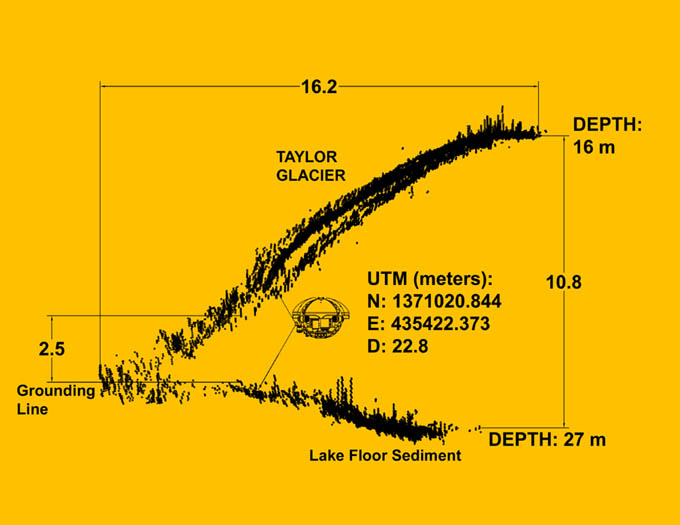
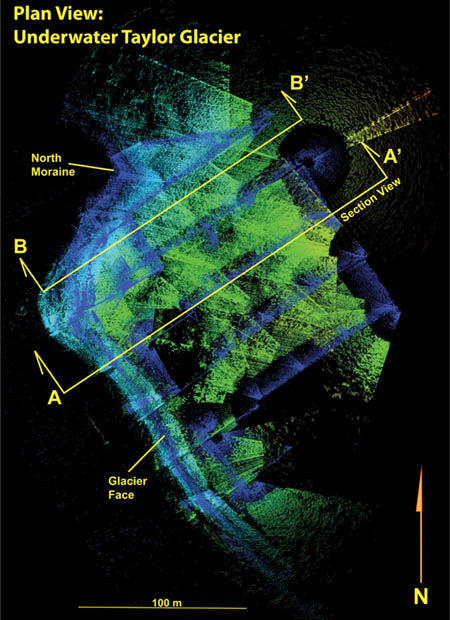
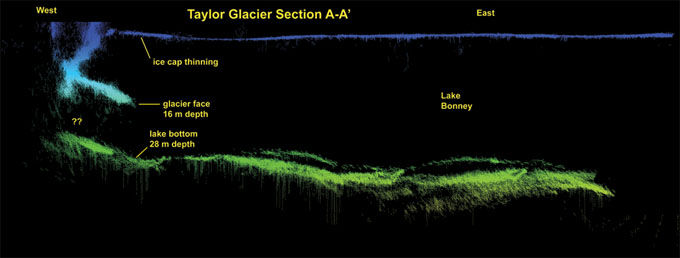
Section A-A’ (see mission plan above) shows a multi-beam 2-meter-thick slice of the underside of Taylor glacier, below the chemocline. Above 16m depth (to the right) the glacier face rises above the chemocline to the Lake Bonney ice sheet roof. Generally there is a concave cusp above this level (see the multi-beam image for November 26 that shows this well). The “grounding line” is where the glacier ice mass rests in contact with the moraine sediments. It is along this line that the anomalous cold water source localized yesterday is presumed to originate.
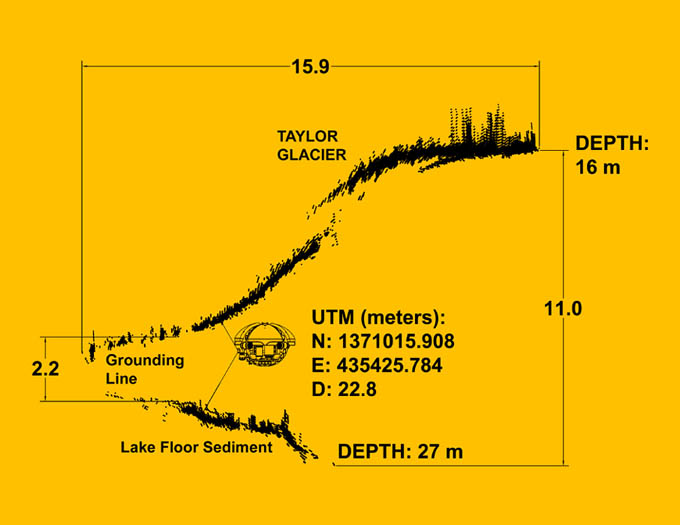
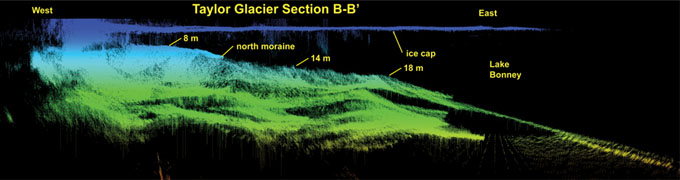
Section B-B’. Similar to the previous section but further south along the glacier face. ENDURANCE had a hard obstacle standoff limit of 1 meter of overhead space and 2 meters under keel for maintenance of navigation and image sensor reliability. The vehicle cross section is to scale and is located at the actual closest point of approach to the grounding line in this location.

Reporting by Bill Stone
November 24, 2009 By Stone Aerospace

ENDURANCE: Mission 2: November 24, 2009

West Lake Bonney, Taylor Valley, Antarctica
Reporting from East Lake Bonney Basecamp

The team was up at 9am. A little over a centimeter of dusty snow had accumulated over the night and it was dark and overcast, unusual for the Valley. The surrounding peaks were obscured in snow and clouds. The internet link was down. Helo ops were cancelled today. Neither supplies nor personnel would be making their way towards Lake Bonney.

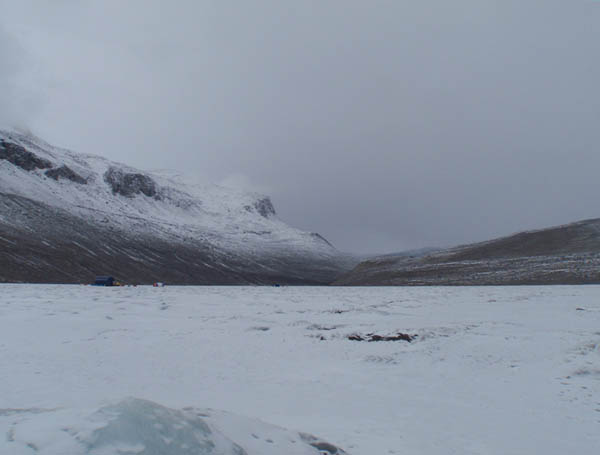
The afternoon view of the bot garage and the southern flank of Mt. J.J. Thompson from GMH09.

The plan for today was to run a horizontal sweep of auxiliary sonde drops at 25 m spacing along the glacier face from north to south at about 10 m standoff from the ice wall in order to obtain a more exact locality for the mystery source of cold water that had been detected in the fine grid. The grid casts of the last three days had indicated that a pronounced cold source was coming in at around 21 meters depth from somewhere south of the BF35 to BF39 line. The presumed source was from the glacier grounding line. Our job today was to find the low point in temperature along that line.

By 10am Peter and Emma were off to GMH09 to start the Hotsies in a final effort to assure the glacier melt hole would be ready for use later in the day. The main crew reached the bot garage at 11:10am and began work on the mission plan. By 4pm the Bot was in the water and the glacier melt hole team reported the site was ready for arrival.

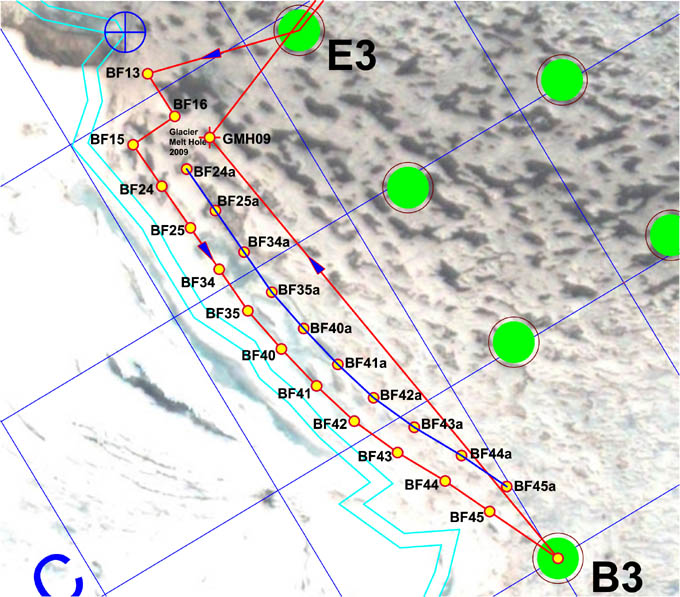
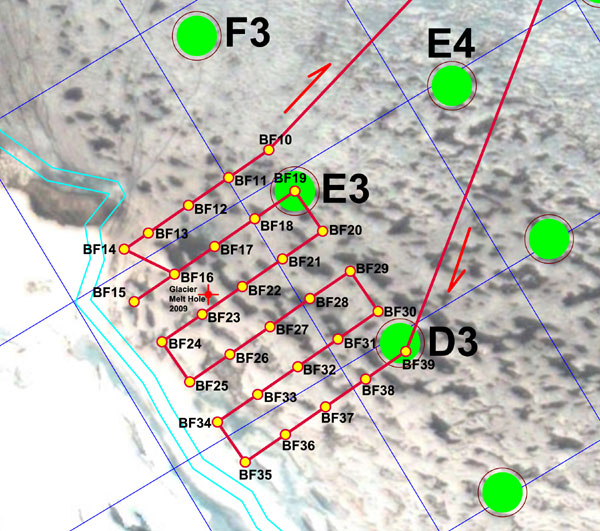
Mission Plan for November 24, 2009. The outbound trajectory goes through waypoint E3 as a tracking check then to the glacier face proximity points BF13, BF15, BF24… BF45. Because the anticipated stand-off distance was less than 10 meters from the glacier we constructed a fall-back trajectory (BF24a … BF45a) in case an unforeseen obstacle appeared. The vehicle periodically swept the forward and westerly (left) pathway with multi-beam to guard against any surprises. The vehicle never had to deviate from the red path, ultimately converging at GMH09 for the first underwater traverse and surfacing at West Lake Bonney.

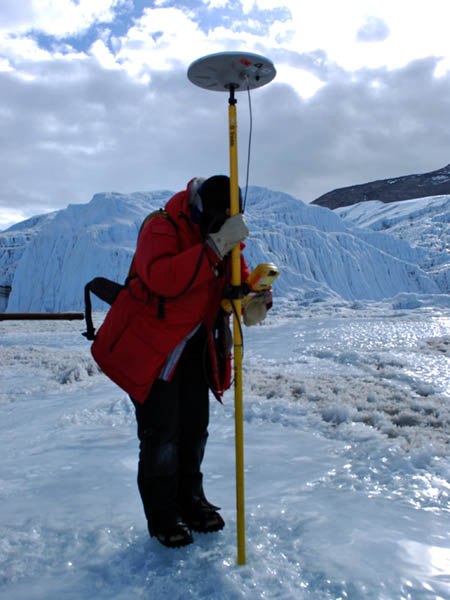
The mission proceeded smoothly until around 6:39pm, outbound about midway between BF15 and BF45, there was an apparent fiber snag. This was rough terrain under the ice in this location, as we had learned last year. Shilpa momentarily over-rode the mission sequence and caused the bot to dive a few meters (still above the chemocline). This evasive maneuver was enough to free the fiber and we resumed the mission at 6:50pm. At 7:30pm an auxiliary sonde drop mid-way between B3 and BF45a produced the lowest recorded water temperature reading in West Lake Bonney:—5 C (23F) [at UTM N: 1370881.271; E: 435585.644 meters]. The navigation system was performing well. Real-time GPS acquired by Vickie and Bill had shown a horizontal error (including ice picking) of less than 1 meter at E3 on the inbound journey and 0.8 meters at B3 just before the low temperature measurement.

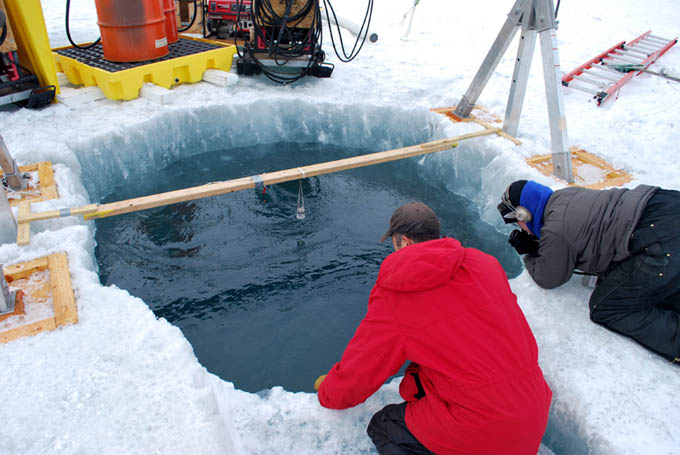
Peter Doran and Vickie Siegel anxiously await the arrival of the bot at GMH09, just 30 meters from the glacier face. The 2×4 across the melt hole supports the collimated alignment beacon. Shimmering on the water surface is from thruster centering action of the bot as it rises up through the 4 meter thick ice cap.

At 8:30pm ENDURANCE completed the first “through-trip” in West Lake Bonney and surfaced at the glacier melt hole, GMH09. By 10pm the bot had completed autonomous recovery back at the lab and the entire crew was enjoying dinner before 11pm, an early night. With the successful completion of the localization and auto-docking and with the melt hole completed we were now ready for the sub-chemocline exploration of Taylor glacier.

Peter Doran waves hello to the crew back in mission control (the upward looking machine vision camera has a wide field of view and can easily see both Peter and Vickie).

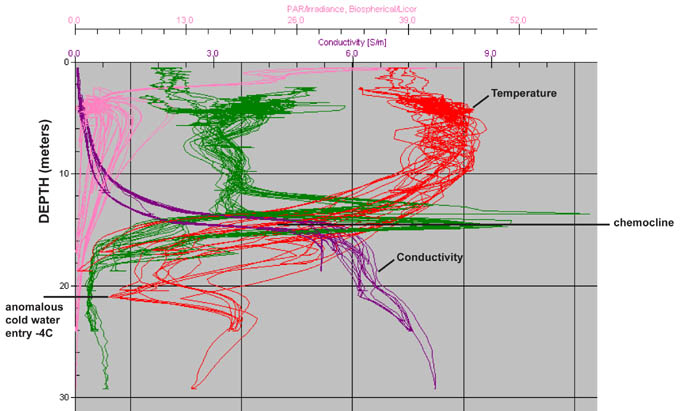
Chemistry profiles from the Sonde instrument package in the refined cast zone near the glacier. These indicate an anomalous cold water source originating somewhere along the glacier line at a depth of 21 meters. Later work would locate an even colder source at -5C near BF45a.

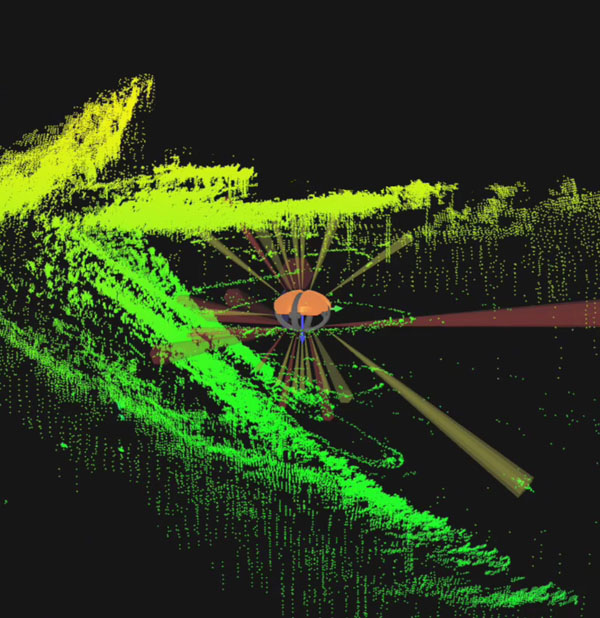
The bot scans the upper face of underwater Taylor glacier at its interface with West Lake Bonney. The lowest green returns to the right show the lip of the glacial under-hang at the chemocline. The next two missions will explore underneath this ledge.

Reporting by Bill Stone
November 23, 2009 By Stone Aerospace

ENDURANCE: Mission 2: November 23, 2009

West Lake Bonney, Taylor Valley, Antarctica
Reporting from East Lake Bonney Basecamp

The team was up at 7:20am discussing the mission plan. John Priscu requested a synoptic fine grid measurement, meaning essentially that we would need to re-run as much of the original 39-cast grid as possible. Given that at least 14 of the previous casts were good (BF1 to BF14) we decided to invert the mission trajectory and would target BF39 as the first cast for today (see figure).

The mission plan for November 23, 2009 involved a clock-wise repeat (in reverse order) of the November 21 mission to recapture the sonde casts between BF15 and BF39.

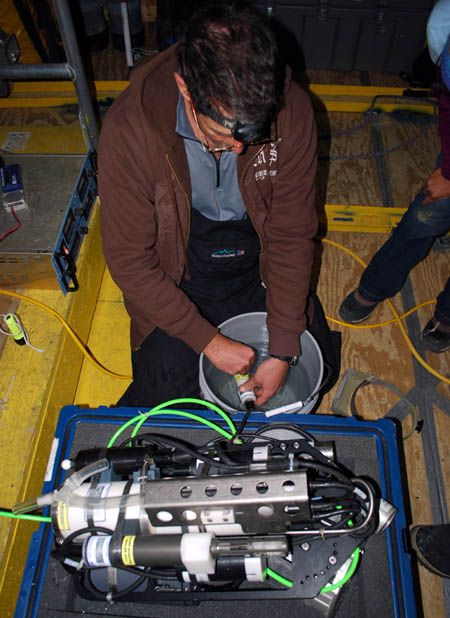
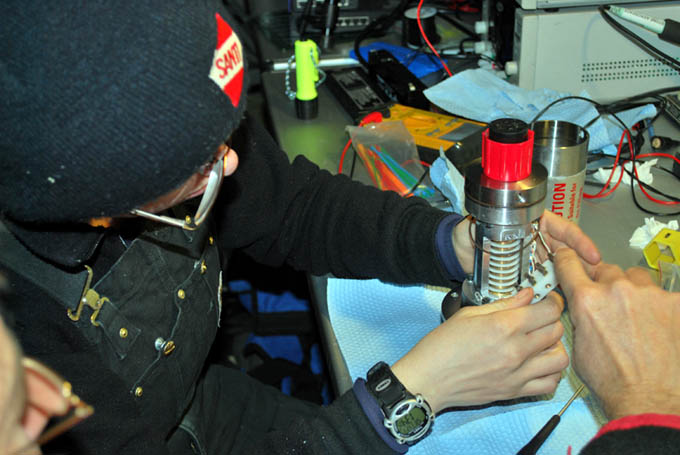
By 10am the team reached the bot garage and began working up the mission plan and going down the pre-launch checklists. We suffered a minor setback during the morning battery top-off charging when one of the parallel high power amp systems was connected to a battery with reverse polarity. The battery promptly shut down on that system (the protective circuitry worked). It was not software re-bootable. There was an immediate conference and the consensus was that the internal battery fuse had blown. Vickie and Rachel pulled the battery housing from the vehicle and disassembled it on the workbench. A 35 amp fuse solved the problem and both batteries were back on charge by 2pm. Labels were installed on the charging cables to preclude a future error.

Rachel replaces the fuse on battery stack A.

Meanwhile an investigation of the SeaBird water pump used on the Sonde sensor suite proved that it had indeed been clogged, although it was not immediately evident from an external inspection. John, Vickie, and Chris disassembled it and found a small piece of gravel blocking the impeller. By 4pm the vehicle was down-hole and passed both the ice-picking (positive buoyancy) test and a sonde test cast at F6 that John reviewed and found to be delivering valid data. With that the vehicle began a half hour traverse to the glacier. The protocol for today was slightly different than two days ago. We skipped the surface PAR measurements (John indicated he already had what he needed from that area) and only performed GPS-tracking at the grid end points. The data from the previous mission had been reduced this morning by Bill and found to indicate a 1.7 meter CEP navigation accuracy, including the effects of sliding (up to a meter or more) that occurs during ice picking stabilization (due to the uneven, sloping underside of the ice cap). This was repeatable enough accuracy that we did not need to ground-truth all casts today, just the ends of each scan line for a spot measurement check.

John Priscu begins the investigation into the clogged water pump on the Sonde instrument package.

Vickie and Bill left the bot garage at 4:15pm to lock in the starting fine grid position for the vehicle at BF39. However, at 4:30pm, with the bot only a few tens of meters away from the radio location team, the navigation system crashed. Chris immediately confessed that he had, unbeknownst to everyone on the team until that minute, re-written the vehicle status monitor the previous evening and installed it to see how it would perform. It took close to half an hour after leaving the melt hole before a bug in the new code manifested itself and dropped the navigation system. Fortuitously, the bot was not far from fixed Sonde cast station D3, for which we had solid GPS coordinates. Thus, Bill and Vickie talked the mission control team in to the known point by providing guidance vectors to closure. When the bot was directly beneath D3 the coordinates were uploaded via the data fiber and the nav solution was back on track. Chris purged the new status monitor and re-loaded the prior version and we were back on the job.

Vickie locks in the GPS coordinates for sonde cast BF39, start of the fine grid sonde casts for today.

Things proceeded smoothly for the next five hours until 9:20pm when the cast at BF10 again lost altimeter data in a particularly non-acoustically-reflective zone of soft lake floor sediment and momentarily touched bottom before mission control could issue an over-ride (they could see it happening on the sonde down-look camera). We discussed the portent of this in view of the previous loss of data update to those sensors (3 of them) that depended on the water pump and Peter made the call to end the mission. He had been monitoring the live data from the sonde instruments along the way and was pleased with the data. They had already indicated that the anomalous phenomena of interest (a previously unknown cold water source at -20 meters) was located further south and west from any of the remaining grid points (BF9 through BF1). Combined with the previous good casts from BF1 through BF14 Peter declared the data set to be complete and we issued the recall message to the bot. It returned at 9:55pm and completed autonomous melt hole detection and docking.

While conducting the sonde casts we also programmed in yaw-rotational sweeps of Taylor glacier in preparation for the upcoming sub-glacier exploration. This plan view shows the edge of the glacier (in bright blue) along with section lines for the next two profile images. All of these were created using the multi-beam imager mounted in the forward-looking position.

A multi-beam side-look view of the north Taylor glacier moraine under the Lake Bonney ice cap.

Multi-beam sectional image of Taylor glacier beneath the Lake Bonney ice cap. Note the undulation of the lake ice thickness and the thinning as it approaches contact with the glacier (due to warm water run off from the glacier as summer begins to arrive in Antarctica). The main object of interest is the dark gap under the ledge at 16 meters depth. To see further, the bot has to be ballasted to descend below the chemocline, and will be the subject of the next few missions, now that GMH09 (the glacier melt hole) is open.

In parallel, efforts at GMH09 (the glacier melt hole) continued, with Peter, John, and Bill setting up the gantry crane over the hole and mounting the second electric winch. The hole now appears to be large enough to permit the bot to surface there.

More diesel fuel for the Hotsies arrives to complete the melting of GMH09.

The long ride back to East Lake Bonney camp continues to get longer as the moat ice begins to crack up, in some cases leaving 10 cm gaps where none existed when we first arrived. By 11:30pm the entire crew was back at camp working on dinner. It had been a day of success mixed with small glitches. Today we concluded that an investigation into the (now repeatable) Sonde altimeter spoofing under certain sediment conditions on the lake bottom needed a better-automated solution. With the sonde casts now complete and upcoming sub-glacier exploration and lake bathymetry pending, however, this became a side project that we vowed to return to before departure.

Reporting by Bill Stone
November 22, 2009 By Stone Aerospace

ENDURANCE: Mission 2: November 22, 2009

West Lake Bonney, Taylor Valley, Antarctica
Reporting from East Lake Bonney Basecamp

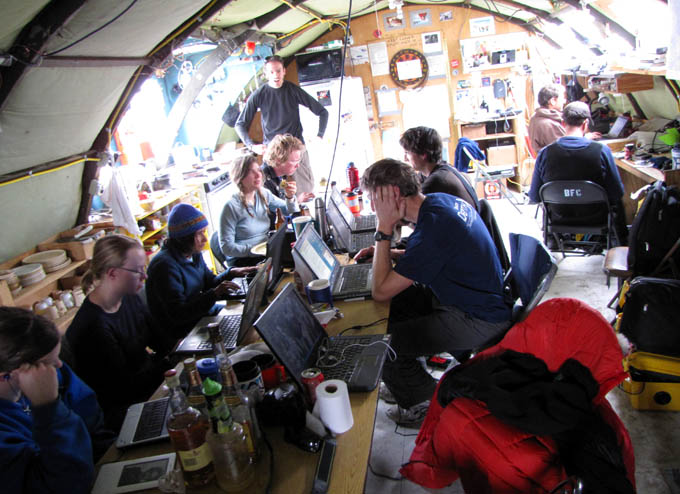
Most members of the team were up by 11am (having gone to sleep around 4am) and congregated in the main Jamesway structure at East Lake Bonney camp. Today was a rest day for most given the non-stop pace of the past week. Also, after a long, long dry spell the internet was suddenly up… which had the effect of reducing what would normally be animated chatter around the breakfast table to a cluster of isolated, silent individuals intently staring at 10 separate laptop screens. Maybe it was better without internet?

The impact of the internet on Antarctic scientist sociology. After 14 days without internet the team catches up on email. Clockwise from lower left: Emma, Vickie, Shilpa, Loralee, Jim, Kristof, John, Peter, Chris, and Bill.

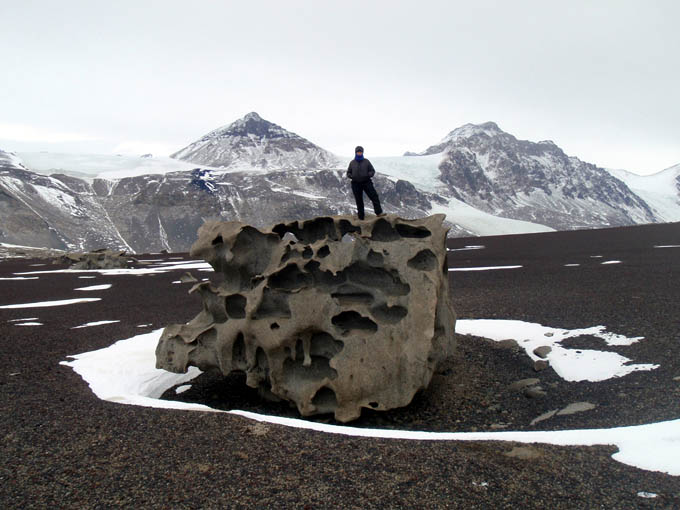
Several people took long hikes up to the ventifact fields high above camp to the south. This is a plateau-like shelf some 500 meters vertically above the lake where wind-eroded, bizarrely shaped granite blocks sit atop a field of red and black colored volcanic clinker. There were still residual pockets of snow surrounding the ventifacts.

Vickie stands atop a striking ventifact on a wide shelf of volcanic cinder some 500 meters above East Lake Bonney. In the background the pyramidal-shaped Matterhorn peak is at left center while Peak 1882 is to the right. The internet relay station for Taylor Valley lies atop the latter and any severe weather that blows through can knock it out for weeks. The only access is via helicopter and the maintenance crews must wear harnesses and clip into fixed ropes—the south face drops precipitously for over a kilometer immediately adjacent the relay box.

While those on the marathon sonde mission of yesterday took the day off, John Priscu, the recipient of the data, spent the entire day reducing the results of the 39 casts with 9 instrument logs per cast. At 10:20pm he turned from his work with a grim look on his face and announced that all data beyond station BF15 were compromised. Well, not all—just the ones that depended on the water pump to flush the sensors. Apparently the BF15 cast had plugged the CTD water pump when it touched the silt floor and although the readings looked nominally correct during the mission it was now clear that they had not been updated due to the clogged pump. The import of this message hit us all: we would have to re-run the mission for all stations beyond and including BF15. Not a good day for Team ENDURANCE.

Reporting by Bill Stone
November 21, 2009 By Stone Aerospace

ENDURANCE: Mission 2: November 21, 2009

West Lake Bonney, Taylor Valley, Antarctica
Reporting from East Lake Bonney Basecamp

Everyone was up at 7am. The rumor today was that helo-ops was going to make an attempt to reach Peak 1882 today to repair the internet repeater link that has been down now for 11 days and counting… it’s only after you lose your high-tech link to humanity that you begin to realize how remote the Dry Valleys are.

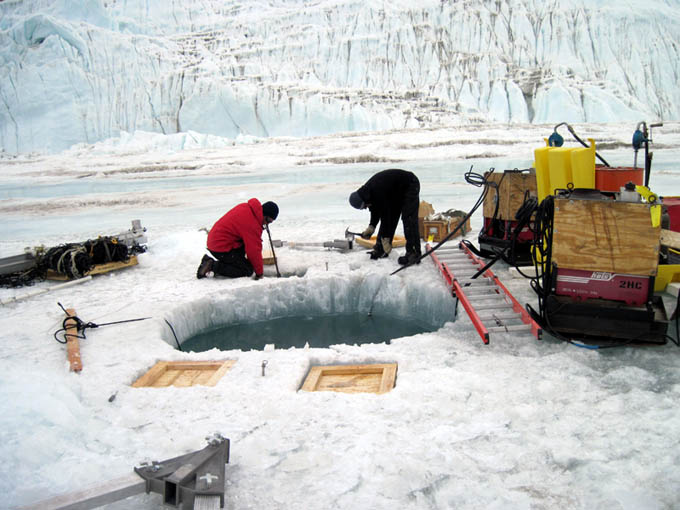
Jim and Maciek continue work on GMH09, the glacier melt hole. We are still at least a day away from being able to surface at this location.

By 10:13am the bot was in the water and being “burped”. This was usually accomplished with a boat pole, causing the vehicle to rock significantly in pitch and roll to encourage trapped air to come loose. Chris had implemented a text translator for the vehicle status monitor so that critical warning messages would be vocalized over the speaker system in the lab. Thus, hearing the computer-generated phrase “High Roll and Pitch” boom out over the speakers meant that you were rocking the vehicle sufficiently to purge the residual air bubbles. By 10:22am Sonde Mission 16 was underway to Taylor glacier. Shortly before noon the mission was aborted. The data feed from the sonde instrument payload was being intermittently interrupted. In normal operations the Sonde was an independent autonomous entity and it would relay data packets to the main System Executive that oversaw management of the mission. Today, the System Executive reported all systems operational but for some reason the data link to the Sonde would periodically drop out. Since the fine grid sonde mission was the objective, we could not continue with only partial data being recovered. Thus we issued an override causing the vehicle to return to the lab.

During the half hour return flight from the glacier we pondered what had happened. There was no question that whatever problem had arisen was not in the main vehicle but lay somewhere between the main power/data interface and the sonde. The key clue lay in the fact that the data drop outs appeared to be periodic. The only thing that was periodic about the Profiler system was the rotation of the drum that was spooling out the instrument package. Because the drum rotated and the data and power had to come in through a fixed cable connection we employed a device known as a “slip ring” to avoid twisting the cable. This is a rather complicated device that transfers all of the electronic connections through a series of rotating contacts, all contained within a waterproof housing. We focused our efforts there. At 2pm, with Vickie leading the investigation, we pulled the slip ring from the vehicle and found it to be flooded with highly salty water. Since we had maneuvered only in fresh water during today’s mission this could only have come from the previous day’s sub-chemocline buoyancy calibrations. As we carefully dissected the instrument we discovered something odd: a radial o-ring at one end of the sealing cover was not in its proper groove, but rather was compressed into a radial gap between two of the rotating cylinder core elements. The unit had been refurbished in mid-2008 and apparently the technician charged with the reassembly had mistaken the rotating clearance gap for the o-ring groove and installed the o-ring there. From a casual glance it would have looked correct. But when the system had gone to 27 meters depth the previous day the external hydrostatic pressure was enough to buckle a short section of the o-ring inward into the gap, thus creating a pathway for water to enter. Enough water seeped in to leave a quarter liter of the brine sloshing in the bottom of the slip ring. As the drum rotated, the contacts would periodically immerse themselves and short out, dropping the communications data for a short period of time. Fortunately, the contacts themselves had been robustly designed and had not corroded. Vickie completed the debug and rebuild by 4pm. During this time the vehicle had been placed on charge and by 5:30pm we were back in the water and headed for Taylor glacier.

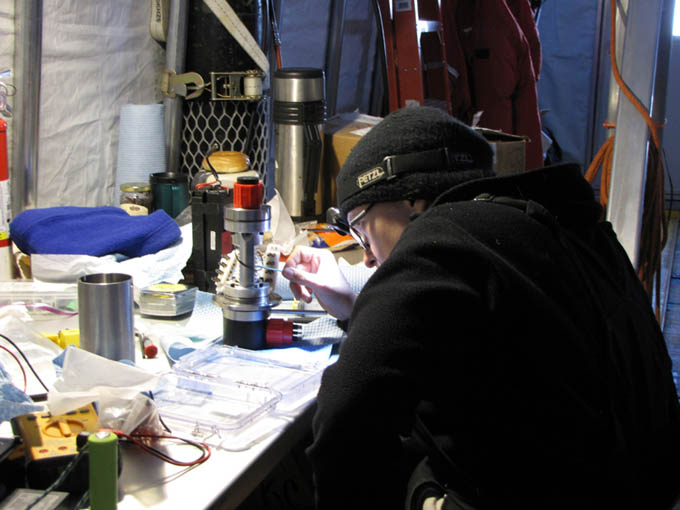
Vickie debugs the flooded slip ring.

Re-assembly of the errant slip ring.

The mission proceeded almost flawlessly from that point forward, with the surface tracking team spending the next 8-1/2 hours on the ice keeping up with the bot as it maneuvered to the 39 pre-designated sample points. The live GPS fixes for the actual sample locations are shown as small dark blue dots within the red and yellow target circles. The majority of the navigational drift, where present, was due to the vehicle sliding on the ice ceiling during ice picking (when the thrusters were shut down for power conservation during a cast)—the ice cap frequently was not flat and given the very low friction of the ice picking contact hemispheres it would slide more than a meter on occasion. We were not able to reach point BF14 (see figure) due to the presence of underwater obstacles. We retargeted to a point halfway between BF13 and BF14, then moved on to BF16, then BF15, and BF15a (shown as an un-labeled blue dot under the glacier) before resuming the remaining as-planned sonde casts. During the cast at BF15 the floor sediment in the last few meters absorbed the altimeter sonar pulse and the auto stop system did not trigger. The instrument payload contacted the bottom momentarily before mission control caught it and ordered a retrieval. The sonde instrument readings appeared to be unaffected and the mission was continued to completion. The bot returned to the lab at 2am and the final crew returned to basecamp at 3am.

Mission plan for November 21 called for an ambitious 39 sonde casts. Yellow-filled red circles are the target points. Real-time GPS locations of the actual sonde casts are shown as dark blue dots.

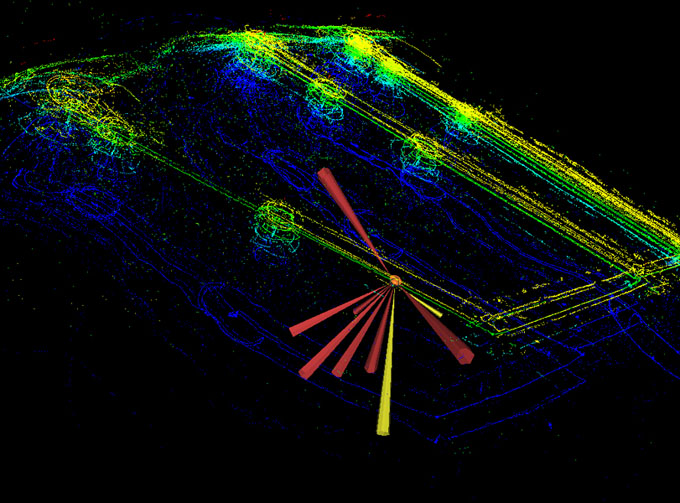
A portion of the mission trajectory. Yellow and bright green lines show the trace of the vehicle sonars on the underside of the ice cap; deep blue lines are bottom sonar returns from the lake floor. Circular clusters of activity show locations of sonde casts. The vehicle thrusters were shut down during these times and, if the ice surface was not flat, the vehicle could either slide, rotate, or both over short distances. Surface GPS recorded the final stabilized location of the sonde cast.

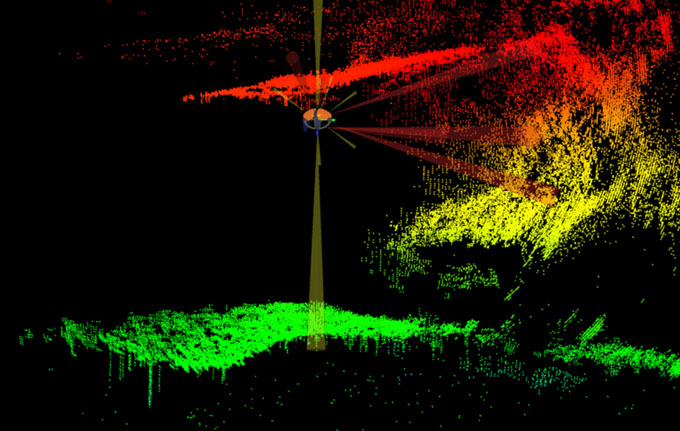
Although this mission was not targeted specifically at Taylor glacier, we were within multi-beam sonar range and caught several interesting glimpses of the underwater portion of the glacier. The bright red points show the underside of the ice cap and the beginning of the top of the glacier. The ice cap thinned as it approached the glacier. The shadows between the green and yellow points highlight the unknown region beneath the glacier we hope to investigate in the next few days.

Reporting by Bill Stone
« Previous Page
Next Page »

Footer

Corporate headquarters:
Austin, Texas

Smart tools for exploring the frontier
  • Facebook
  • Instagram
  • LinkedIn
  • Twitter
  • YouTube

Copyright © 2026 · Stone Aerospace, Inc.