• Skip to main content
  • Skip to footer

Stone Aerospace

Smart tools and systems for exploring the frontier

  • Home
  • About us
    • What we do
    • History
    • Design philosophy
  • Projects
    • BEAGLE
    • PARTI-Pucks
    • Thor
    • PROMETHEUS
    • ARCHIMEDES
    • ARTEMIS
      • Description
      • Field notes
      • Photo gallery
    • VALKYRIE
      • Description
      • Field notes
      • Photo gallery
    • ENDURANCE
      • Description
      • Field notes
    • DEPTHX
      • Description
      • Field notes
  • News
  • Employment
  • Contact us
  • Stone Aerospace in One Page

Stone Aerospace

November 5, 2009 By Stone Aerospace

ENDURANCE: Mission 2: November 5, 2009

West Lake Bonney, Taylor Valley, Antarctica
Reporting from East Lake Bonney Basecamp

Today we tested the obstacle avoidance system. This year we have the high resolution Delta T sonar pointing forward for our sonde drop missions to identify objects, such as other science projects, hanging in the lake that may snag our fiber optic link to the bot. This is a change from last year, where had the Delta T facing down to map the lake bottom, so we wanted to see just what kind of objects the Delta T could resolve. Below are some of the results from our tests.
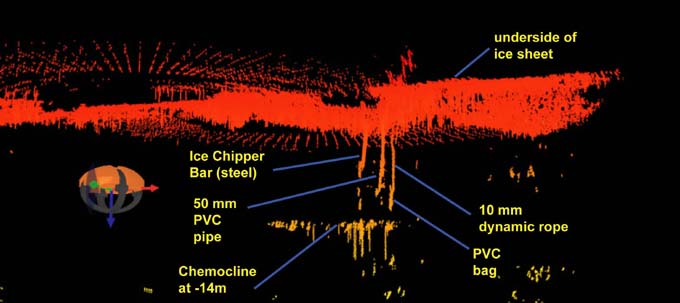
In this augmented reality visualization (part of the newly developed “situational awareness” system for ENDURANCE) the forward looking multi-beam sonar is swept under the ice cap at West Lake Bonney in the vicinity of the melt hole. We lowered three test “obstacles”—a steel ice chipper bar on a 10mm diameter rope; a 50 mm diameter pvc pipe; and a sack of lead weights on a 10mm diameter rope. At 15m radius we were easily able to detect them. The overhead red points are reflections off the underside of the ice cap. Interestingly, we also got returns from the surface of the super-saline chemocline at -14m depth (the yellow vertical lines near the bottom).
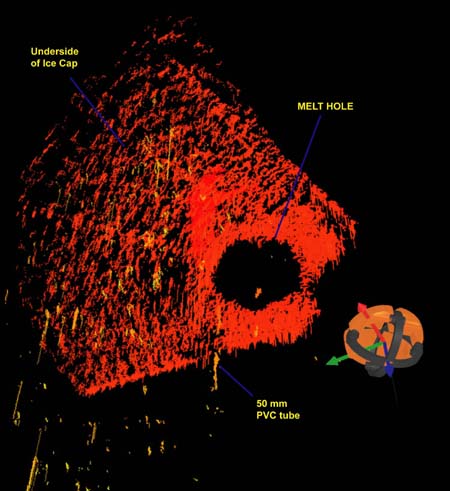
In this oblique image of the underside of the ice the bot is about 7 meters east of the melt hole—the underside edge of which can be clearly seen along with a long yellow vertical line on its west edge. This yellow stripe is the sonar return signature from a 50 mm diameter pvc tube that we lowered to a depth of 5 meters below the melt hole—so ENDURANCE is also able to detect plastic materials.
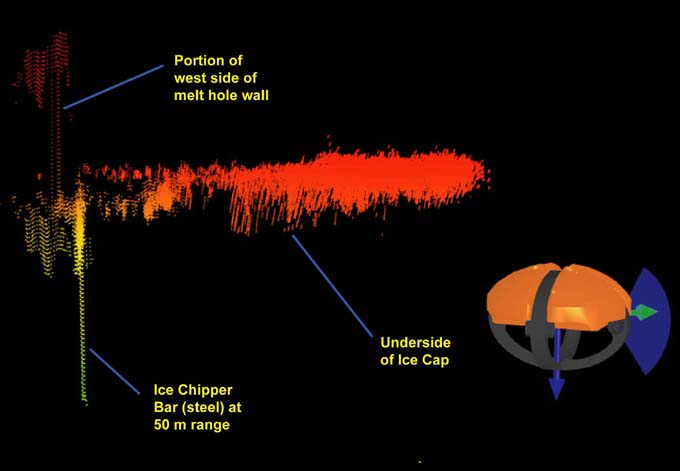
In this final test of the obstacle avoidance and detection system for ENDURANCE we maneuvered the vehicle to 50m radius and 7 meters depth. We removed all obstacles but the steel ice chipper bar (to simulate cables) and the vehicle was able to clearly detect it, along with the western side of the melt hole (the beam pattern from the vehicle was able to “illuminate” the back side of the hole and hence obtain ranges which show up as red vertical lines to the left of the image). The chipper bar shows up as the bright yellow vertical line projecting below the ice cap at the left of the image.

Reporting by Vickie Siegel
November 4, 2009 By Stone Aerospace

ENDURANCE: Mission 2: November 4, 2009

West Lake Bonney, Taylor Valley, Antarctica
Reporting from East Lake Bonney Basecamp

This morning we set straight to work on the ballast and got the bot neutrally buoyant pretty quickly. After the pre-dive check we lowered the bot into the water, ready to swim and perform some tests away from the hole. As the bot descended to the lower reaches of the hole for the first time this year it unexpectedly stopped just before it reached open water. We pulled out Maciek’s “fish cam”—a small underwater camera, camouflaged to look like a perch, with a live feed to a black and white monitor—and confirmed our fear. The bot was stuck. The hole had started to refreeze and now the last half meter was too narrow.

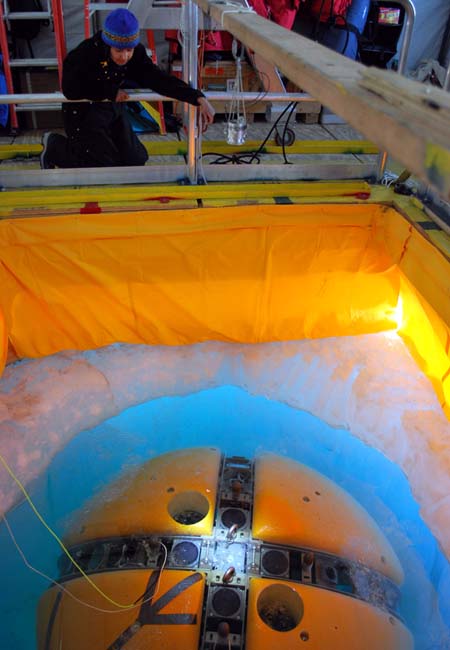
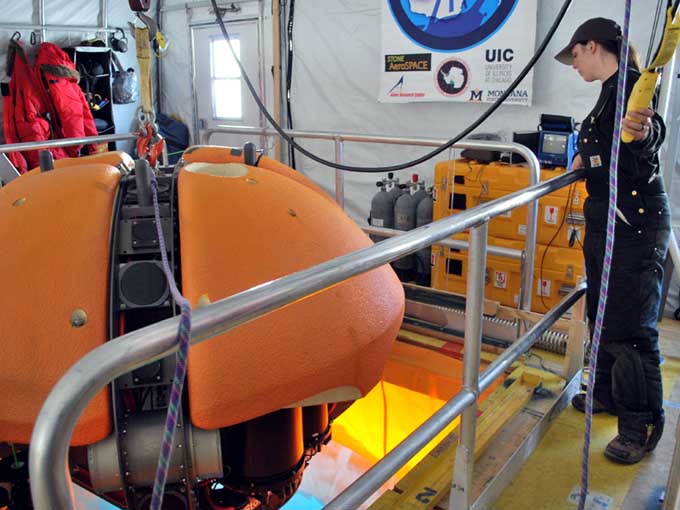
Rachel lowers the bot, complete with syntactic this time, into the melt hole for its first real swim this year.

Fortunately, it was only stuck in one direction, that is, it could not go down but it could still come up. So we brought the bot back to the surface, put the hotsies back in to work on the worst spots and ate lunch while debating our next move. It was decided that Bill would dive in and try to chisel the bottom edge with an ice chipper bar. After some hard work on Bill’s part, sure enough, good sized ice chunks started to float up and bob on the surface of the hole. After he made a couple circuits around the bottom edge, he came back up and we pulled him and the new ice chunks out.

The products of Bill’s underwater chipping efforts float to the surface to be scooped out.

Hopeful that Bill’s efforts widened the hole enough for the vehicle to pass, we dunked the bot again. Luck was with us and the bot made its way through the hole and down and under the ice. We proceeded to set up the visual homing beacon, a flashing light suspended over the melt hole. With the light in place, we ran some visual homing tests (for more on Endurance’s visual homing feature, see last year’s blog) and tested other basic behaviors: navigation, station-keeping and ice-picking. Everything is up and running!

Bill adjusts the visual homing light so that it points straight down the melt hole.

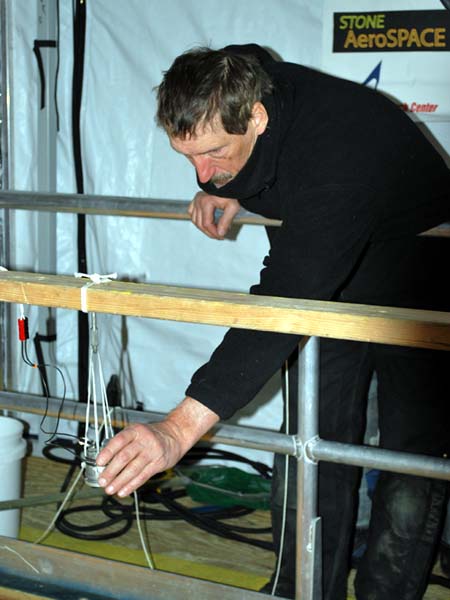
Shilpa inspects the placement of the visual homing light. The bot sees the blinking light with the upward looking camera at the top center and uses this light to navigate its way straight up the narrow hole.

Reporting by Vickie Siegel
November 3, 2009 By Stone Aerospace

ENDURANCE: Mission 2: November 3, 2009

West Lake Bonney, Taylor Valley, Antarctica
Reporting from East Lake Bonney Basecamp

To our delight, a large, irregularly shaped chunk of ice was floating on the surface of the melt hole this morning—the trombone melter had cut off the large flake Vickie had seen underwater yesterday. Removing this 1 meter long by half meter tall by 10 centimeter thick chunk of ice was a little tricky. We ended up screwing an ice screw into each end and lifting it out of the hole with the bot hoist.

This chunk of ice is all that remains of a large lump that was one of our problem spots around the bottom of the melt hole. We were able to saw it off with a trombone melter over night and it floated to the surface.

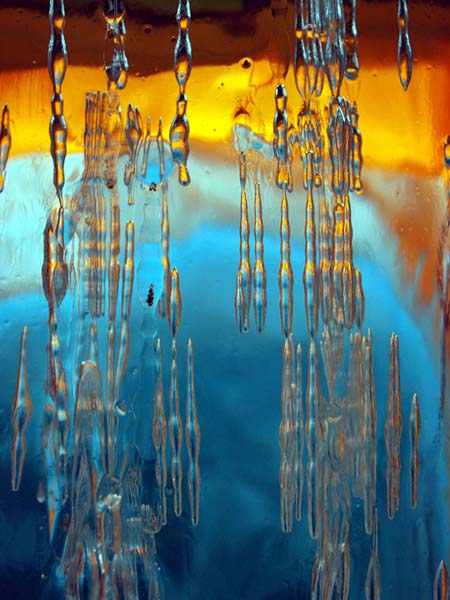
A close-up view of the ice chunk we sawed off, showing the elongated air bubbles that are present in most of the lake ice.

Once the rest of the morning ice crust had been broken up and hauled out of the hole, Rachel did some final adjustments with the syntactic mounts, Shilpa, Kristof, and Chris started going through the daily pre-dive procedures, and Bill and Vickie went out to get GPS coordinates of the Bot House for the programmers to use for the vehicle’s navigation. At some point in the middle of all this a helo landed and delivered our new, 2000 meter-long fiber optic cable.

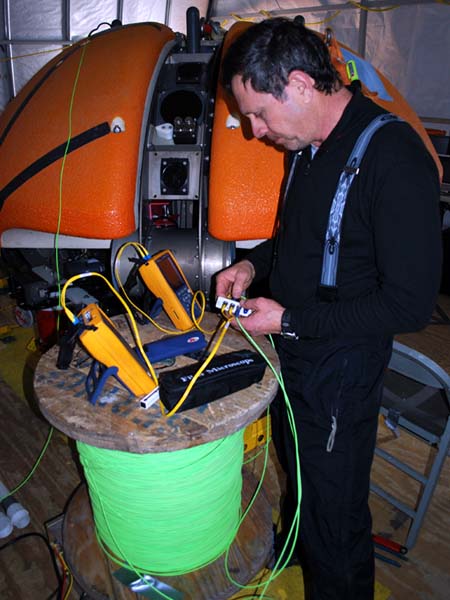
A technician from McMurdo tests our new 2 kilometer long fiber optic cable. We will use this longer line for our missions to the far east end of the lake.

Our morning tasks completed, we regrouped after lunch and worked together to put the bot in the water and work on the ballast. Like last year, it was difficult to nail down how much lead we need to put on to achieve neutral buoyancy because of the microbubbles that form on the robot’s surfaces (see last year’s blog entry on microbubbles). Eventually we got it narrowed down and left the fine tuning for tomorrow.

Reporting by Vickie Siegel
November 2, 2009 By Stone Aerospace

ENDURANCE: Mission 2: November 2, 2009

West Lake Bonney, Taylor Valley, Antarctica
Reporting from East Lake Bonney Basecamp

After some hard work by our night shift melters, the hole looked much more promising this morning. We kept the Hotsies running as we got down to work. We ran through the pre-dive checklist and hoisted the vehicle, again without syntactic, above the melt hole. This time, instead of doing a full-vehicle dunk we kept the bot hanging above the hole and ran sonde up and down to check that we had successfully troubleshot the sonde camera communications problem. We had, and the profiler was functioning well, so we turned attention back to working on the hole.

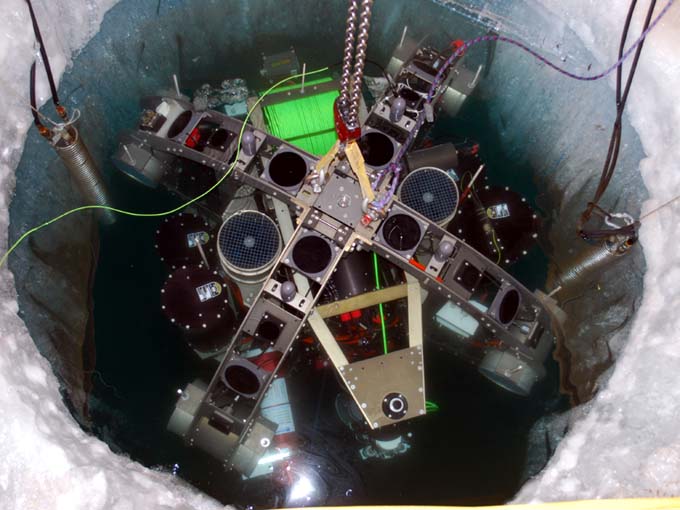
We suspended the bot above the water and ran the sonde down into the water for testing.

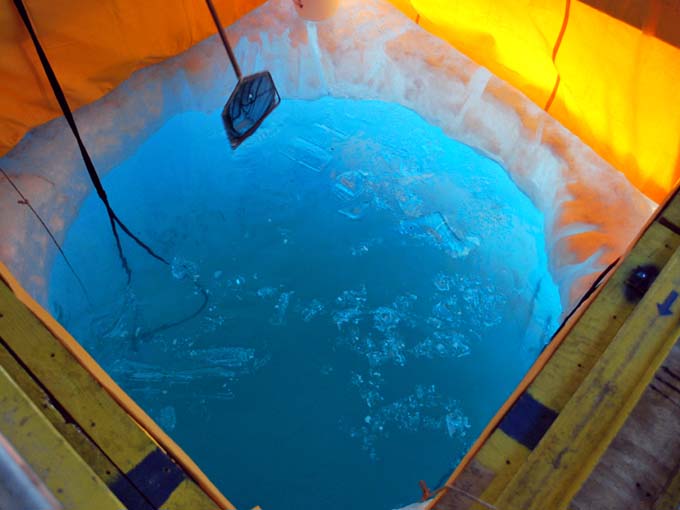
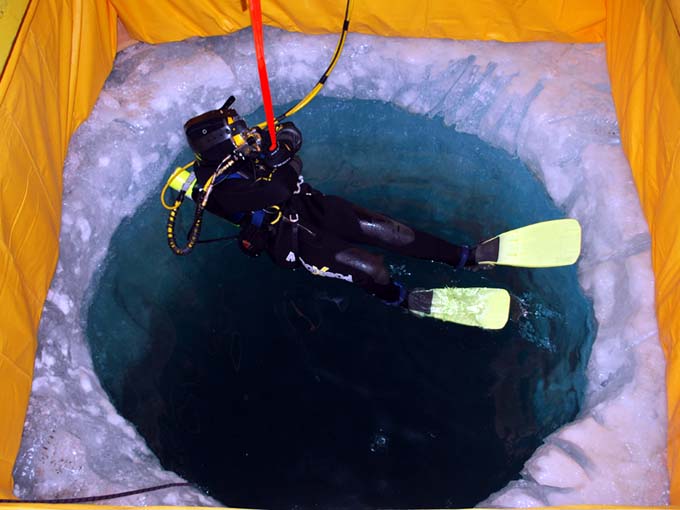
The lake water is typically crystal clear but it is also super-saturated with gases. The vibrating Hotsies knock some of that gas out of solution, making the water in the melt hole very fizzy like a glass of soda, as tiny bubbles of gas escape the water. While interesting, the effervescence decreases the visibility such that we cannot see the bottom of the ice hole. In order to get a better feel for how the lower reaches of the hole were progressing, we decided to send a human diver into the water. Vickie and Bill assembled the surface-supply diving equipment and suited up in their drysuits. Vickie did the dive and found a few hook-shaped knobs of ice sticking around the bottom and chopped these off with an ice axe, helped the people on the surface measure the diameter of the hole along the bottom, and strategically placed a trombone melt finger so that it would cleanly cut off a particularly large flake of ice.

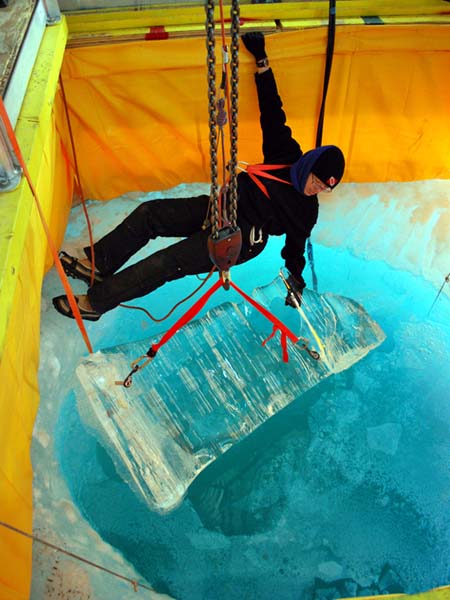
Suited up for the cold water, Vickie is lowered into the melt hole. She is the first woman to dive in Lake Bonney.

Vickie inspects the lower reaches of the melt hole.

Satisfied with our new melting strategy, after Vickie’s dive we spent the remainder of our time this evening installing the bot’s syntactic blocks so that we are ready to go with the next steps first thing in the morning.

Reporting by Vickie Siegel
November 1, 2009 By Stone Aerospace

ENDURANCE: Mission 2: November 1, 2009

West Lake Bonney, Taylor Valley, Antarctica
Reporting from East Lake Bonney Basecamp

We continue to struggle with the melt hole. Since we are starting our work here nearly a month earlier than we did last year the ice is both colder and thicker (4 meters thick, compared to 3 meters last year), making melting much trickier. Last year the hole took 3 days to melt out. This year’s hole was started 13 days ago and while the wind shield we put up yesterday has helped significantly, so far the hole is still too small for the bot to fit all the way through. Bart and Kristof have become amateur Hotsy wranglers, coaxing the fussy machinery to work and readjusting the melt coils throughout the course of the day. Our original ice cowboys, Maciej and Jim, take the night shift. Between the four of them we have the Hotsies running 24 hours a day.

Vickie and Bill left the Bot House for a brief trip to set up a GPS base station at the nearest benchmark, located at the Blood Falls Camp, where we were based last year. The base station will remain anchored to the benchmark for the duration of our work here. The GPS system will allow us to obtain real-time, high-precision coordinates for the sonde-drop points that the bot will travel to once we start running missions.

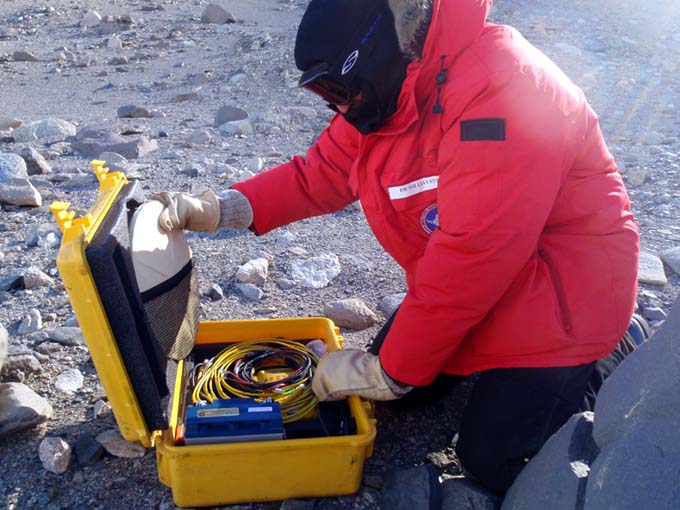
Bill unpacks the base station for our Real Time Kinematic (RTK) GPS system.

Later in the day, the hole finally cleared out enough that we could just barely submerge the bot, without the orange syntactic blocks, to run some basic tests and check that none of the electronics housings were leaking. No leaks turned up and all systems functioned normally, with the exception of some minor problems with a data line to the sonde camera.

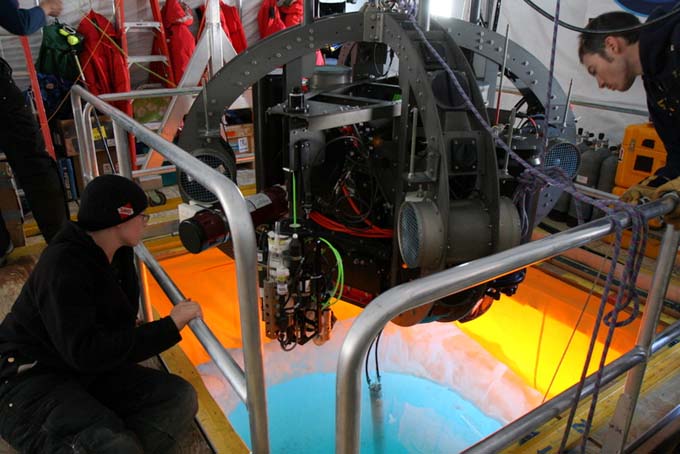
Vickie and Kristof watch to make sure the bot will not bump the side of the melt hole as it is lowered into the water for the first time this season.

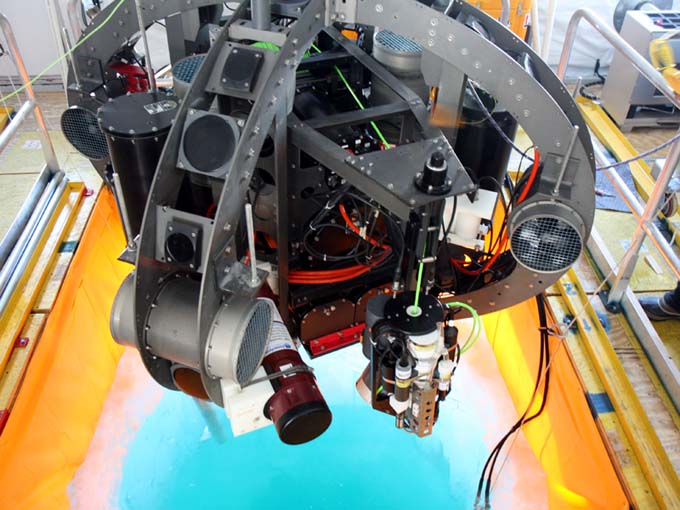
The bot, minus syntactic blocks just barely fits in the melt hole for some initial in-water testing. Two Hotsy fingers (coils) continue to melt the ice during the tests.

As of this evening, the bottom of the hole is still too narrow, so it will be another long night out on the lake for the Hotsy cowboys. Thanks guys!

Reporting by Vickie Siegel

« Previous Page
Next Page »

Footer

Corporate headquarters:
Austin, Texas

Smart tools for exploring the frontier
  • Facebook
  • Instagram
  • LinkedIn
  • Twitter
  • YouTube

Copyright © 2026 · Stone Aerospace, Inc.