• Skip to main content
  • Skip to footer

Stone Aerospace

Smart tools and systems for exploring the frontier

  • Home
  • About us
    • What we do
    • History
    • Design philosophy
  • Projects
    • BEAGLE
    • PARTI-Pucks
    • Thor
    • PROMETHEUS
    • ARCHIMEDES
    • ARTEMIS
      • Description
      • Field notes
      • Photo gallery
    • VALKYRIE
      • Description
      • Field notes
      • Photo gallery
    • ENDURANCE
      • Description
      • Field notes
    • DEPTHX
      • Description
      • Field notes
  • News
  • Employment
  • Contact us
  • Stone Aerospace in One Page

Stone Aerospace

December 5, 2008 By Stone Aerospace

ENDURANCE: Mission 1: December 5, 2008

West Lake Bonney, Taylor Valley, Antarctica
Reporting from Blood Falls Basecamp

The first people bringing their breakfasts into our camp mess tent this morning found Bart already on the phone with the servo driver manufacturer. Fortunately, when the comm techs set us up for internet, they also gave us a VOIP phone. After breakfast we tore ourselves away from eavesdropping on Bart’s conversation with tech support to start work out in the Bot House. Just because the profiler is temporarily stalled doesn’t mean we can’t proceed with other tests, so the plan of the day was to put the bot in the water with the syntactic on and take it for its first Antarctic swim.

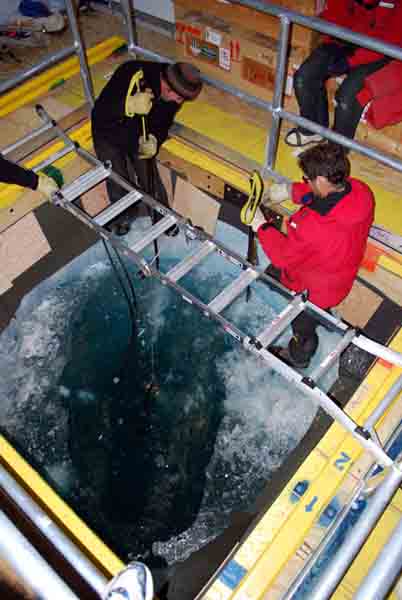
Before taking the bot down under the ice, we wanted to make sure that the bottom perimeter of the ice hole was snag free. The lake ice is about 3 meters thick and the level of the lake water in the melt hole is about 30 centimeters below the ice surface. The other 2.7 meters of the hole is underwater and this makes it difficult for us to judge if the wall surface is smooth or jagged. To give us a definitive answer, Peter decided to do an ice dive and have a look. As he donned all of the gear associated with ice diving in Antarctica—layers of fleece, a drysuit, dry gloves, and a full face mask—Vickie hooked up his air supply. In these kinds of ice dives, it is nice to keep the scuba tanks in the warm air at the surface and run long hoses from the tanks to the diver’s full face mask. This keeps the tanks and first stage regulators warm, making the dive safer and more enjoyable. The full face mask includes a comm unit so we could talk to Peter during his dive. He took an ice chipper bar down and busted off all of the jagged corners at the bottom of the ice hole.

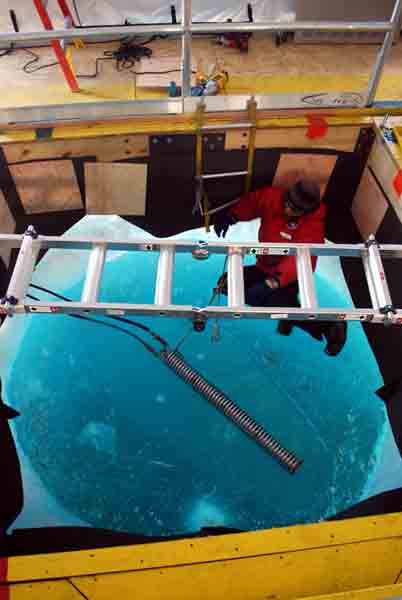
Once the melt hole was prepared it was time to get the bot ready to swim. We put the syntactic blocks on, lifted the vehicle with the hoist and set it in the water. To make the bot as power-efficient as possible, we always ballast and trim the vehicle. To ballast, we add or remove lead weights to the bot to make it neutrally buoyant, so that without hooks attached it floats just under the surface of the water and neither sinks nor rises. To trim the bot we place the lead weights we’re using for ballast in specific locations on the bot’s frame so that it sits level in the water. The whole process is a little time consuming but a neutrally buoyant and well-trimmed bot won’t use much battery power for thrusting, so it is important to get it just right. In our previous tests in tanks or at the Quarries in Austin, it was easy to add and remove lead because you could just lean over the vehicle. Here, however, there is about a meter drop from the top of the platform to the water level, where the vehicle is floating, and you would have to lean out horizontally as well to work with the ballast. Since we didn’t want to drop either a person or our lead weights into the icy water, Vickie rigged a climbing rope to the gantry and, wearing a harness and using climbing ascenders, hung just above the robot to adjust the lead weights more easily.
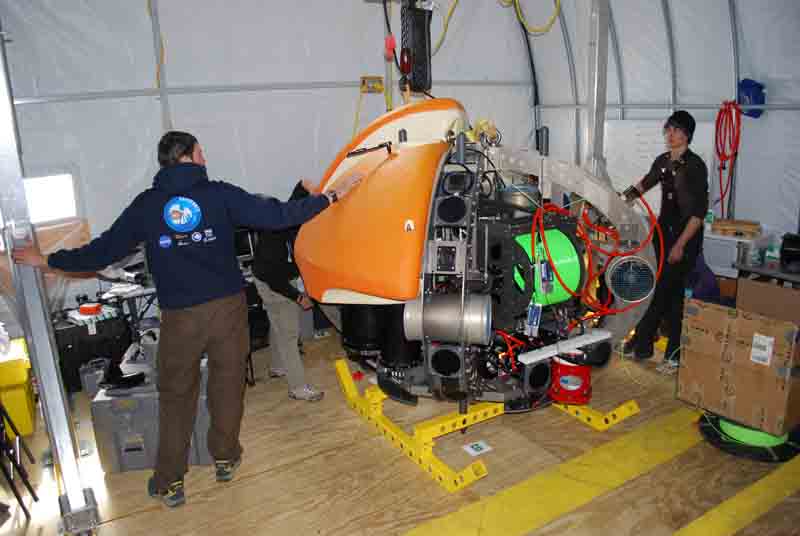
We put the orange syntactic blocks onto the vehicle to provide flotation.
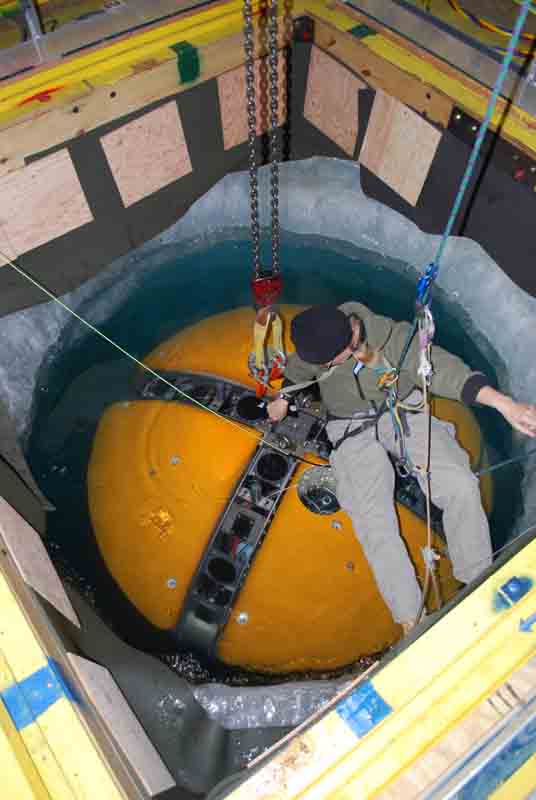
Vickie gets on rope to ballast the vehicle and get the buoyancy just right.

Once we felt confident that the vehicle was ballasted properly, Kristof, Shilpa and Chris took their seats at the mission control table and drove the vehicle down and under the ice for the first time.

“The ice is smooth!” Shilpa reported.

This was a relief. The top surface of the lake ice is anything but smooth: it is scalloped and cracked with plateaus and valleys and in places can vary in height by half a meter. So naturally we wondered about the underside of the ice. We hoped it would be smooth because it would make navigation easier and it would be less likely for our fiber optic line to become ensnared. We all crowded around the monitor displaying the view of the horizontal-facing camera. Yes, the ice was smooth as glass.

We motored the bot around under the ice testing the various sensors in action. After a while we noticed that some of the sensors that use sonar elements started to drop out and we didn’t know why. We brought the vehicle back to the surface to check it out. As the bot rose up through the hole we noticed that it looked different, kind of…fuzzy. Also, it was too buoyant. At the end of its ascent, the bot was riding almost 2 inches higher in the water than it had when we ballasted it half an hour before. Looking closer we learned that the white “fuzz” we were seeing on the bot was actually thousands and thousands of tiny bubbles coating the entire exterior of the vehicle.
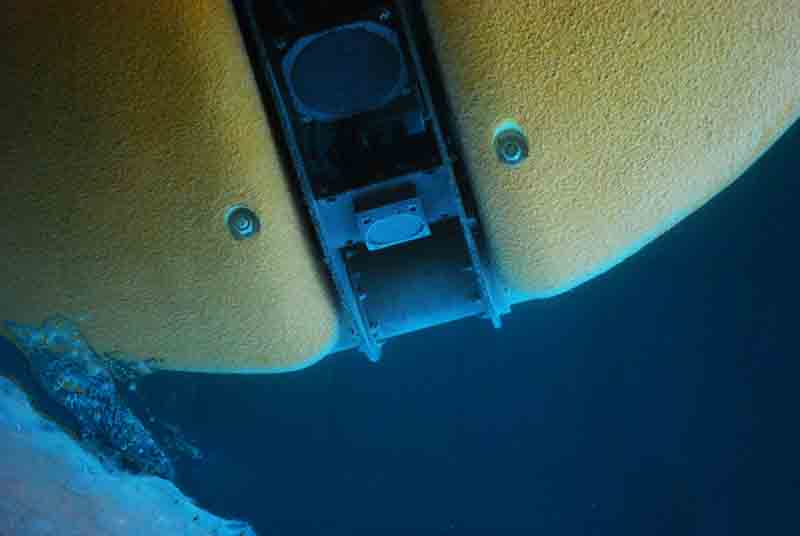
The white speckles and fuzz on the bot in this photo are actually thousands of tiny, trouble-making microbubbles.

The lake water is supersaturated in dissolved gases and as the bot moved through the water, some of this gas was apparently coming out of solution and forming these microbubbles on the robot’s surfaces. The microbubbles were making the bot significantly more buoyant and were interfering with the acoustics of the sonar transducers. We’ve never had the bot in such gas-rich waters before and didn’t predict this kind of problem.

While we found this surprise to be another puzzle we’d have to deal with, Peter reminded us all that this is the kind of stuff we are here to learn about. There are two parts to the Endurance mission here in Antarctica: one is to collect data from Lake Bonney and the other is to develop some of the technology that an AUV on Europa would use. In this way, our fieldwork here is proving to be a good analog for a mission on Europa. The exploration of Europa is bound to contain some surprises, just like our exploration of Lake Bonney and the microbubbles. The more we can learn about possible issues like these in the experimental phase here on Earth, the better we could design an AUV for alien environments.

Our attempt at a quick fix for the microbubbles on the sonars was to take a small amount of Simple Green hand cleaner and rub it over the sonar faces. This seems to keep the bubbles from forming on these surfaces but we might be able to find a better substance to act as a surfactant here. To counter the extra lift given by the bubbles, for now we just threw an extra pound of lead on the vehicle.

We took the bot back down under the ice for some more tests. For one thing, we wanted to test one of our bot recovery procedures. Now that we knew that the underside of the ice was smooth, we figured that if the bot were to die, that is, lose communications with mission control or run out of battery power, we could pull it back in by hand by tugging on the fiber optic line we use to communicate with the bot’s cPCI (the bot’s main computer). To make sure, we did a practice run of physically pulling the bot back in with an extra safety cord we had tied on. It worked very easily, so we know that in a crisis we have a way to get the bot back.

During this emergency practice, we had the upward-looking camera on, and were displaying its images on one of the mission control monitors. The upward-looking cam is at the top of the bot and faces directly up. Normally we would only use it for visual homing to help the bot return to the melt hole at the end of a mission. What we didn’t expect is the kind of images we would see while the bot was just running around under the ice. We found that the ice was amazingly clear and that a lot of sunlight came through. There are thousands of bubbles in the ice. Some bubbles contain sediment that was blown onto the ice from the land and frozen in, some bubbles are white and clear. They form columns going from the bottom towards the top. It was beautiful and Peter added enthusiastically that the views from this upward camera were a source of data that no one had recognized before. The ice was clear enough that we could even tell when we had crossed under the Bot House floor.

When we finished the remaining tests for the day we pulled the bot up for the night, put the batteries on charge and went back for dinner.

Reporting by Vickie Siegel
December 4, 2008 By Stone Aerospace

ENDURANCE: Mission 1: December 4, 2008

West Lake Bonney, Taylor Valley, Antarctica
Reporting from Blood Falls Basecamp

Today we put the bot in the water. Since the vehicle hasn’t been wet since our last tests at NBL (NASA’s Neutral Buoyancy Lab) in August we wanted to check all of the electronics pods for leaks and check that all of sensors and instruments were working. The bot has traveled halfway around the world, after all. To do these checks we hung the bot from the hoist without the orange syntactic blocks we normally use to make the vehicle float. John and Peter paid particular attention to their scientific instruments on the drop sonde. They adjusted the water pump on the sonde, raising the bot out, priming the pump and lowering it again a few times to watch its behavior. With the pump in order, Chris, Shilpa and Kristof ran through the checklist of sensors and electronics: No pod leaks, sonars, DVL (Doppler Velocity Log), depth sensors, IMU (Inertial Measurement Unit), cameras, lights and so on, all working. Check, check, check…

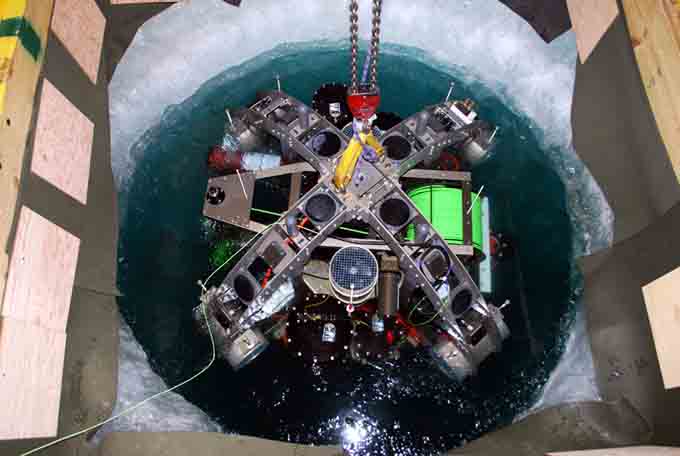
Kristof, John, and Peter watch intently as the bot is lowered into the melt hole for the first time.

John and Peter get the Seabird pump on the drop sonde working.

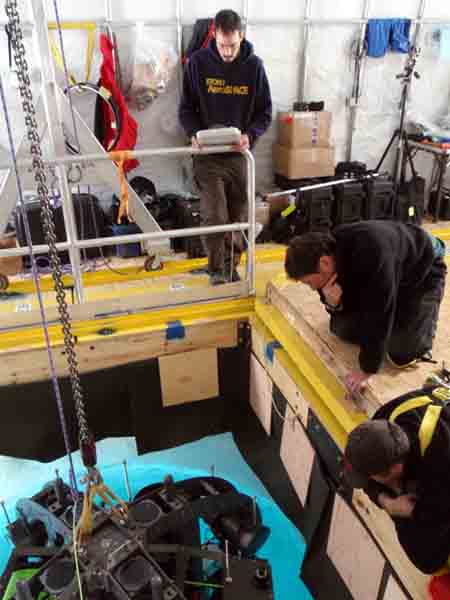
One of the last few tests was to check the science payload package, the profiler. The profiler is made up of several parts. First there is the drop sonde, basically an aluminum frame with all of Peter and John’s water chemistry instruments strapped onto it. This sonde hangs from the bot by a Kevlar reinforced Ethernet cable. The cable feeds over a pulley and onto a large spool on the opposite side of the vehicle. Servo motors spin the spool to raise and lower the sonde through the different water strata in the lake. Normally, with the floatation blocks in place, we are not able to see much of the spooler functioning; only the up and down motion of the sonde is visible. Since we left the blocks off for this test we were able to watch the entire profiler in action underwater. It was satisfying to see how smoothly the level winder guided the green Ethernet cable between the spool and the pulley as it wound and unwound, raising and lowering the sonde. Several minutes into the test run, however, the spooler stopped unexpectedly. Chris noted that the software was reporting a temperature fault – it was too cold. What we found was that if we heated the electronics pod for the profiler in air with the Herman Nelson heater, the driver would function correctly, but once the pod had cooled to 10°C in the nearly freezing water, the driver would stop.

We watch from above as the spooler drum (on the right) unwinds the bright green Ethernet cable that holds the sonde (underwater on the far left).

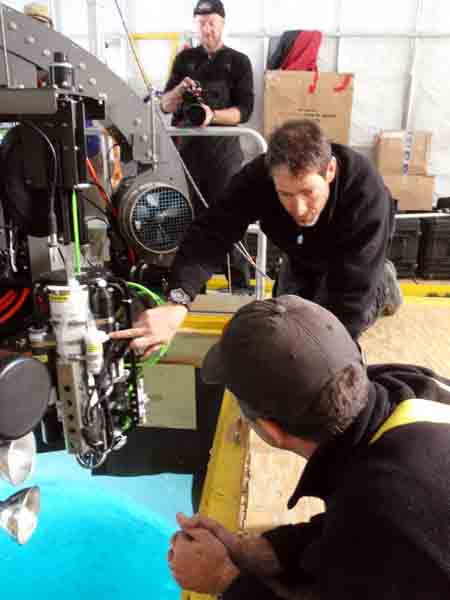
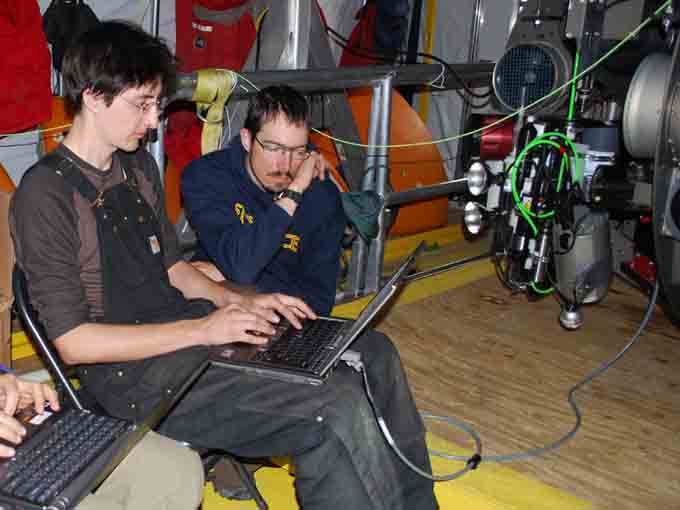
With the bot back on the surface, Chris plugs directly into the profiler electronics pod to investigate the servo motor malfunction while Kristof looks on.

Of course we had considered the effects of Antarctic temperatures on the vehicle before. We wondered if such cold water would cause equipment malfunctions. In February we operated the bot under ice in Lake Mendota in Madison, Wisconsin. Those tests identified a problem with the electronics that control the thrusters. We later traced that problem back to some poorly soldered connections – a slip in quality control from the manufacturer. The faulty electronics were immediately replaced and the bot suffered no further problems from the cold. But during the February tests in Wisconsin the profiler was still in the design phase; it didn’t exist and thus couldn’t be cold tested. So what exactly is the problem? Is there a way we can fix it in the software settings, a minimum temperature parameter we can change to allow the servos to run at a lower temperature? There isn’t anything about it in the servos’ manual and, given the time difference between here and the States, we’ll have to wait until morning to ask the manufacturer.

Reporting by Vickie Siegel
December 3, 2008 By Stone Aerospace

ENDURANCE: Mission 1: December 3, 2008

West Lake Bonney, Taylor Valley, Antarctica
Reporting from Blood Falls Basecamp

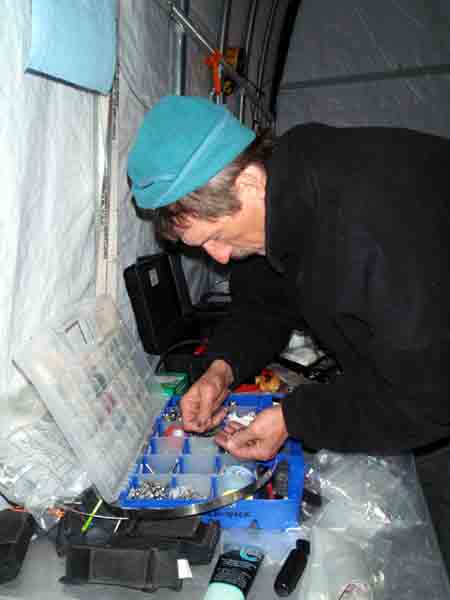
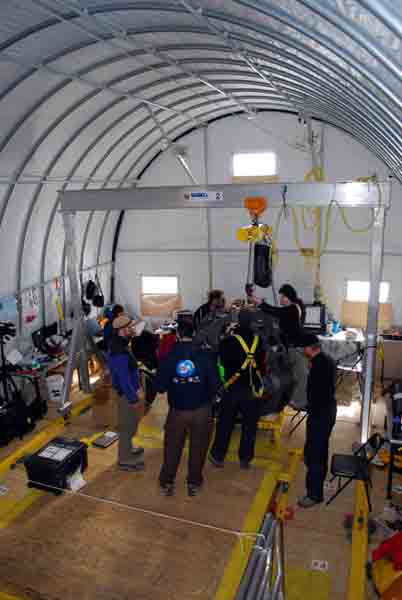
After our brief stint as Antarctic carpenters, we have returned to doing what we do best—working with the robot. Today we got the Bot House set up as a working mission control. The programmers set up their computers along the far wall and boxes of tools, robot batteries and spare parts were unpacked and set up on tables along the two long walls of the building. The bot and gantry dominate our workspace and setting up desk and bench space for eight programmers and technicians was a little tricky. With everything unpacked and the empty shipping cases stacked high along the walls, we set about getting the bot into working order.

First of all, the bot had to be put back together. In Texas, before we shipped the bot to the Ice, we removed the most delicate sensors and packed them in padded cases to be shipped separately. This ensured that they weren’t damaged in transport and it reduced the weight of the remaining vehicle so that it would be light enough to be flown on the helo trip from McMurdo to Lake Bonney. Now that we’re here though, all of these sensors had to go back on before we can think about putting the bot in the water.

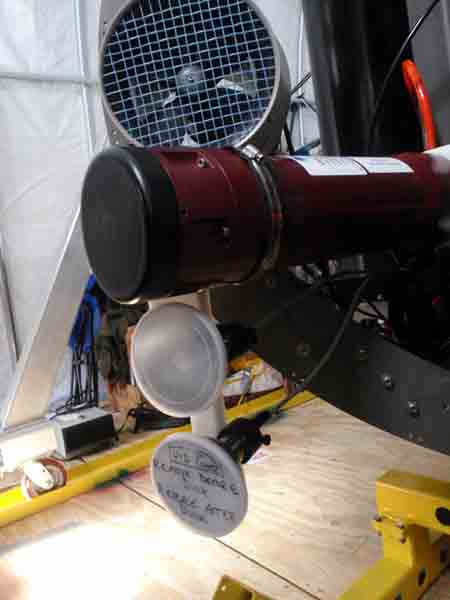
The USBL (ultra-short baseline transceiver) and HID (high-intensity discharge)lights were just a few of the components to attach to the bot today.

As Vickie bolted each sensor back to its proper place, Shilpa and Kristof worked on some of the vehicle code. Chris and Bob assessed the bot’s giant batteries and started charging them up. Bart sorted hardware and worked on developing mission plans. When Vickie went to mount the Delta T sonar to the vehicle she noticed that the bracket that should attach the instrument to the bot wasn’t here. Talking with Bill, they realized that somehow in the rush and confusion of packing the vehicle, tools, spare parts and whatnot in Texas, the bracket they had ordered had never been delivered and thus never brought. Bill and Peter therefore designed and constructed a new mounting bracket out of some extra prototyping materials we had brought along for just this kind of thing. So far this looks like the only thing that didn’t make it to Antarctica from Texas—not bad!

Bill finds some hardware to use on a new mounting bracket for the Delta T sonar.

The team works to get the bot put back together and get the Bot House set up as a workshop/mission control.

At the end of the day, most of the vehicle is back together and we should be able to start real testing tomorrow.

Reporting by Vickie Siegel
December 2, 2008 By Stone Aerospace

ENDURANCE: Mission 1: December 2, 2008

West Lake Bonney, Taylor Valley, Antarctica
Reporting from Blood Falls Basecamp

What a difference a day makes. Kristof was the first one up and about this morning and he immediately set out on a mission. He drove the ATV from our somewhat sheltered camp on the shore to our Bot House site on the ice. After a brief stop at the platform to assess the situation, he returned to camp directly to report his findings. The rest of us awoke to the sound of two cooking pots banging together and Kristof shouting, “Everybody up! The wind has died down! Let’s get to work!”

We were all still exhausted from our efforts yesterday but this news rousted us from our sleeping bags. As we hurriedly ate our breakfasts and gulped down some of Bob’s coffee we wondered, “Can we do it? Can we get the rest of the tent up before the wind kicks in again?”

We marched out to the melt hole and found that yes, it was much calmer out there. But was it enough? With trepidation we unpacked the liner tarp and once again tied on the ropes and tossed them over the frame. With the first few tugs on the ropes we found that things really were much easier. We had the liner tarp up and secured and the end walls in place in no time. We had just started to pull the middle insulating layers onto the tent when a helo carrying our carpenter friends from McMurdo arrived to help us. From there on out the Bot House was abuzz with productivity. It was difficult to even keep track of all the activities that were happening simultaneously the insulating blankets and outer cover were pulled over the tent and secured; inside, the bot’s lifting gantry and hoist were assembled; electrical outlets were installed; heaters were brought in and propane tanks were staged outside; generators were set up; communications technicians arrived and set us up with solar powered wireless internet; the crust of ice that had refrozen on the surface of the hole was melted and chipped out; stairs up to the front door were installed; shipping containers full of our equipment were sorted and the contents brought inside; and finally the shipping containers themselves were pulled in close against the outside walls and secured with cargo straps to ensure that nothing could blow away.

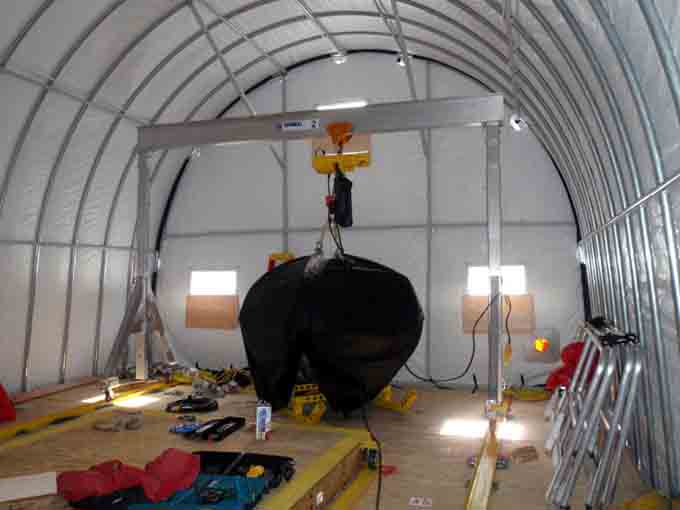
The gantry and hoist are set up inside our completed tent.

Maciej starts the melting coil on the refrozen cap on our melt hole.The steam generated from this made the Bot House into a sauna for a few minutes.

Once the melter punched through the frozen cap, Maciej and Johnworked on chipping out some of the ice around the sides of the hole.

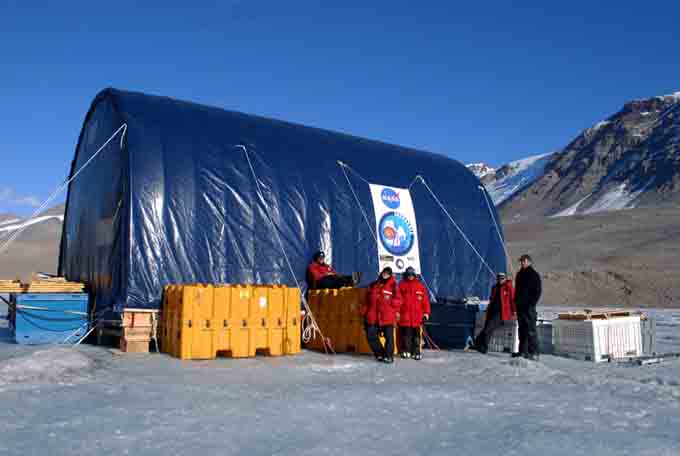
The Bot House is open for business! Bob, Vickie, Shilpa, Bart and Peter (left to right) pose in front of the haven.

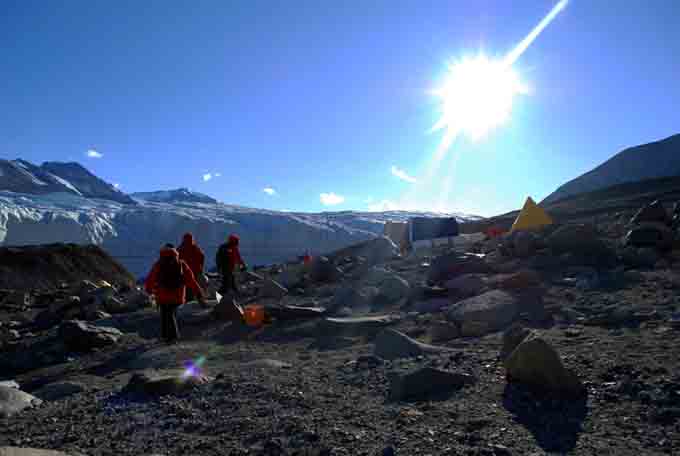
The commute back home after a satisfying day.

Tired but happy we plodded home slowly tonight. It was a good day.

Reporting by Vickie Siegel
December 1, 2008 By Stone Aerospace

ENDURANCE: Mission 1: December 1, 2008

West Lake Bonney, Taylor Valley, Antarctica
Reporting from Blood Falls Basecamp

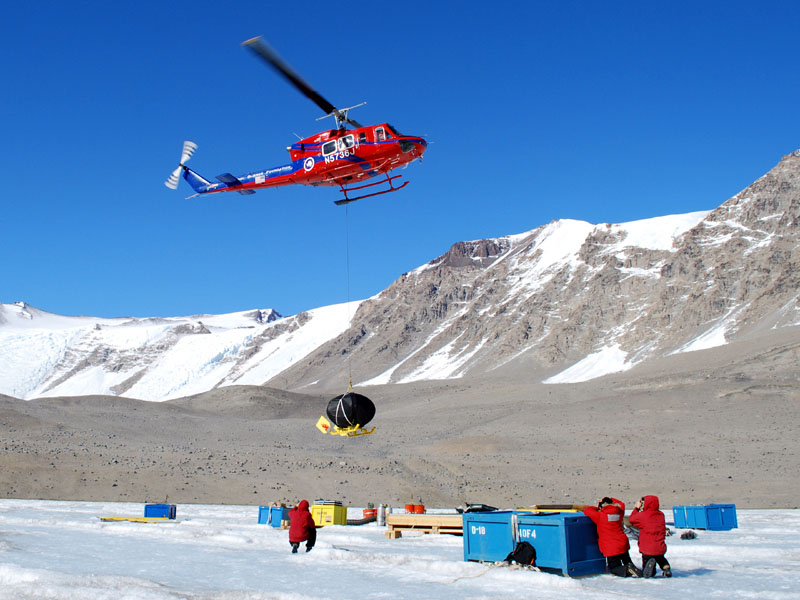
In accordance with our hopes, the winds died down enough by this morning that helos were flying today. In addition to the much-anticipated delivery of the bot, we were expecting several other sling loads, including the final bits of plywood for the bot house floor and the roll-away cover for the melt hole, now referred to as the moon pool. These items arrived first thing in the morning and we wasted no time getting everything in place. The next sling load to come over the horizon was a black oval with yellow feet and flame-decaled yellow fins. Everyone scurried to pull out their cameras and hunker down behind the various large shipping crates that are scattered around the platform. With a 2000 lb sling load, a Bell 212 helo creates a tremendous amount of rotor wash and certainly a lot of noise. The physical turbulence made the emotional rush of seeing the pilot set the bot squarely down on the platform all the more exhilarating. The pilot unclipped the cable and thundered off. Now it was time to get to work.

We look on nervously as the helo lowers the bot onto our Bot House platform.

The next step on our agenda was to build the polar haven tent structure of the Bot House around the bot. We learned the procedure in McMurdo: assemble the pipe arches and walls that make up the frame of the haven; pull the insulated blankets (tarps) on the end walls; pull a liner tarp over the arches and tie it down to the floor on either side; on top of this go insulating layers over the arches; and then finally a large, weather resistant cover goes over it all. Our entire practice run in McMurdo took six hours.

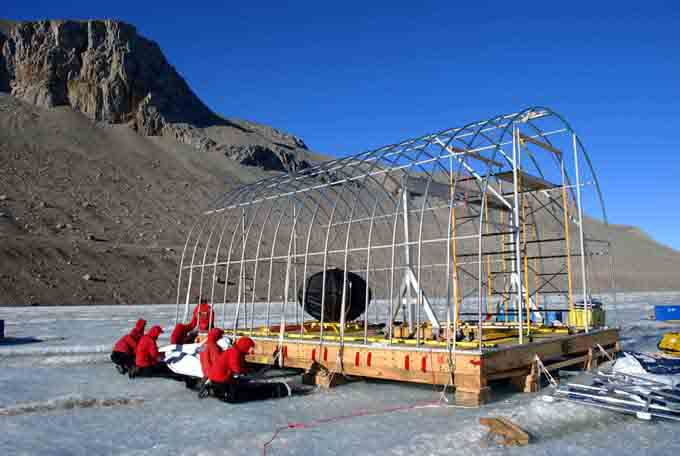
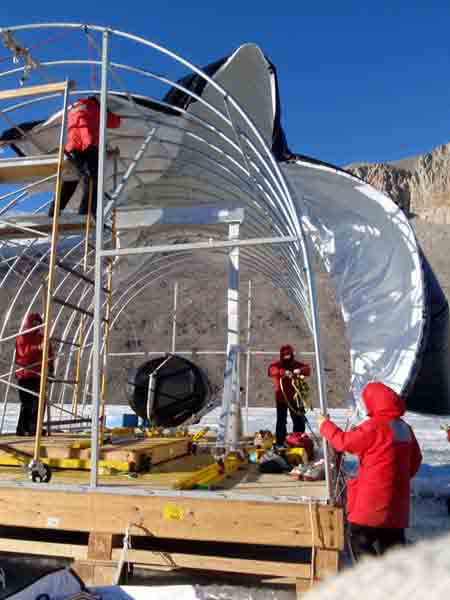
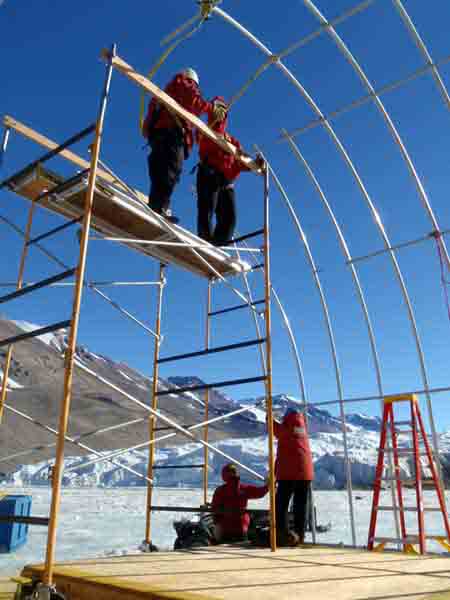
Things started off well enough. Though it was slightly breezy, we made quick process in constructing the pipe frame. Two people worked from the top of some scaffolding and the rest scrambled around arranging pipes and fitting them together. Over the course of the afternoon the wind began to build, but in our concern to get a shelter built over the bot we didn’t take much notice—yet. Once the frame was together we pulled out the liner tarp and prepared to install it on the 16-foot-tall frame. We lined the tarp up on the ground along one side of the arches and tied ropes to one edge of the fabric. Then we threw the other end of each rope over the entire frame to people standing on the other side of the structure. Half of the team pulls the ropes to drag the tarp up and over the arches while the other half feeds the tarp up and manages any snags that occur. This is when we really noticed the wind. We were trying to pull the tarp from the upwind side of the structure to the downwind but the force from the wind meant that the tarp simply pressed against the pipe frame with enough pressure that it was incredibly difficult to drag it up to the peak and over. Once we did get it over the top, everything got worse. With no wall to press into, the downwind end of the tarp whipped up violently against the four ropes we had tied to it. It became a sail. Helpers jumped in to assist the rope haulers, who were nearly being whisked away on the ends of their ropes. The points where we had tied the ropes on the tarp began to rip through, giving the raging beast a greater range for its erratic motions. With the whipping and cracking of the tarp, the gusting wind, and our layers of hats and hoods, shouts and instructions were snuffed out. This was the stuff of epic sea chanteys, not field robotics. Somehow we managed to tie down, at least marginally, both sides of the tarp. Worried that the liner tarp would rip further unless we put up the end wall tarps quickly, we plunged into this next struggle. By now we had been working on the tent for about eight hours. After some time spent fighting more of the same battle with the first end wall, Peter made the call that we were in a losing battle; the wind was just too strong. The rest wearily agreed and after the equally arduous task of removing the tarps from the frame and corralling the unruly masses of fabric back into boxes for the night we dragged ourselves back to camp. Sometimes it’s just best to try again tomorrow.

Members of the team work together to construct the final pipe arches (there are 17 total) of the tent frame.

With the frame completed we begin to unroll the liner tarp on the up wind side of the structure. We plan to tie ropes to one edge and pull it over the frame to tie off on the downwind side.

This quick photo, the only one snapped during our epic battle, does little to convey the chaos of the gusting wind and the tarp that threatened to carry us all away.

Reporting by Vickie Siegel
« Previous Page
Next Page »

Footer

Corporate headquarters:
Austin, Texas

Smart tools for exploring the frontier
  • Facebook
  • Instagram
  • LinkedIn
  • Twitter
  • YouTube

Copyright © 2026 · Stone Aerospace, Inc.