• Skip to main content
  • Skip to footer

Stone Aerospace

Smart tools and systems for exploring the frontier

  • Home
  • About us
    • What we do
    • History
    • Design philosophy
  • Projects
    • BEAGLE
    • PARTI-Pucks
    • Thor
    • PROMETHEUS
    • ARCHIMEDES
    • ARTEMIS
      • Description
      • Field notes
      • Photo gallery
    • VALKYRIE
      • Description
      • Field notes
      • Photo gallery
    • ENDURANCE
      • Description
      • Field notes
    • DEPTHX
      • Description
      • Field notes
  • News
  • Employment
  • Contact us
  • Stone Aerospace in One Page

Stone Aerospace

November 30, 2008 By Stone Aerospace

ENDURANCE: Mission 1: November 30, 2008

West Lake Bonney, Taylor Valley, Antarctica
Reporting from Blood Falls Basecamp

Since our next moves can only happen after the bot is delivered tomorrow, today was a natural day to just take a break. The winds continued to barrel down the valley but some folks decided to take the free time as a chance to do some hiking anyhow. The others caught up on office work, read books and drank cocoa. Around the dinner table Peter explained the origins of the incredible wind we’ve been experiencing. The Antarctic continent is shaped like a giant dome, more or less. The land in the interior of the continent is covered with a massive ice sheet over two kilometers thick and the highest elevation of this dome is around the center of the continent. During the winter the rock and ice radiate their heat out to space and temperature drops. As the land cools, the air does, too. The air grows denser as it cools and gravity starts to drive it downhill. The phenomenon is called a katabatic wind and in Antarctica they are known to be fierce, cold and persistent.
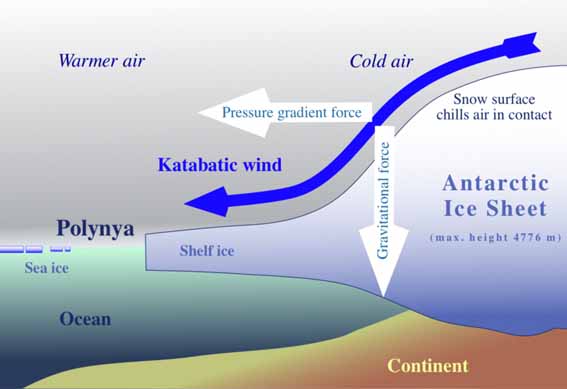
This diagram by Hannes Grobe was copied from the Wikipedia page on katabatic wind.

Reporting by Vickie Siegel
November 29, 2008 By Stone Aerospace

ENDURANCE: Mission 1: November 29, 2008

West Lake Bonney, Taylor Valley, Antarctica
Reporting from Blood Falls Basecamp

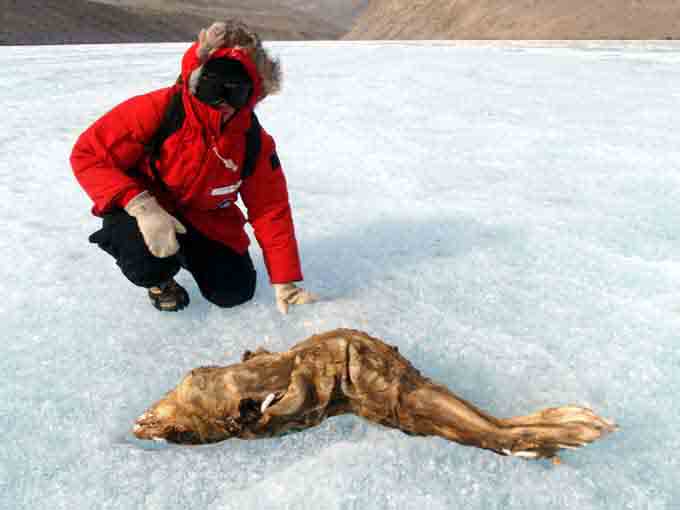
In US Antarctic Program tradition, Thanksgiving is celebrated the Saturday after the actual holiday so that everyone gets a long weekend, both Saturday and Sunday off work! Of course, we are hardly the sort of people to argue with that kind of a tradition and we had an invitation from John and the folks at the Lake Bonney camp to join them for turkey dinner. Around midday we headed over to the camp on the east lobe of Lake Bonney. Most folks opted for the 20 minute ATV ride to the camp and Bill and Vickie decided to walk. Along the way they came across several mummified seals. For unknown reasons, seals and penguins occasionally wander away from the sea and travel up the Dry Valleys. A long way from home and with no chance of finding food in the barren valleys, these animals die before finding their way back. Since there are no insects to consume them and the climate is extremely dry and cold, the corpses remain remarkably intact for years.

Hiking from Blood Falls Camp to Lake Bonney camp, Vickie and Bill found several mummified seals on the ice.

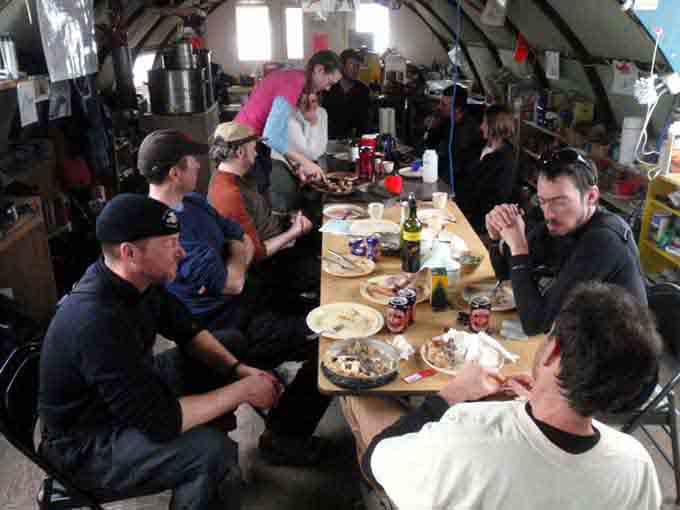
The last stragglers arrived at Lake Bonney Camp just as the turkeys were coming out of the oven. Noshing away on our stuffing and sweet potatoes we admired our surroundings. Unlike our camp at Blood Falls, the Lake Bonney camp is a permanent installation that is used every season. It is larger than our camp, with several large tents in addition to personal sleeping tents and a 15′ x 40′ jamesway building which is the kitchen and community space for the group there. Also they have WiFi. It was field camp nirvana. After thoroughly enjoying the good food and good company provided by the Bonney Camp researchers we took ATVs back to Blood Falls for the night.

Everyone relaxes after Thanksgiving dinner in the Lake Bonney jamesway.

Reporting by Vickie Siegel
November 28, 2008 By Stone Aerospace

ENDURANCE: Mission 1: November 28, 2008

West Lake Bonney, Taylor Valley, Antarctica
Reporting from Blood Falls Basecamp

Things have been going very well with our fieldwork for the last two days—the weather has been pleasant, we made good progress on the Bot House platform and we’ve even had some tasty camp dinners in our mess tent. One could almost forget we’re in Antarctica… Well, today we got a little reminder. Late last night several of us woke up to find the walls of our tents whipping and popping in our faces, straining against the tent poles. The mild wind from yesterday has built up into violent gusts and from what we hear on the VHF radio, the weather in McMurdo is deteriorating, too. As a result, no helos are flying today and the official operations in McMurdo, helo and otherwise, will be shut down Saturday and Sunday for the Thanksgiving holiday. After all our rush, the bot won’t be delivered until Monday.

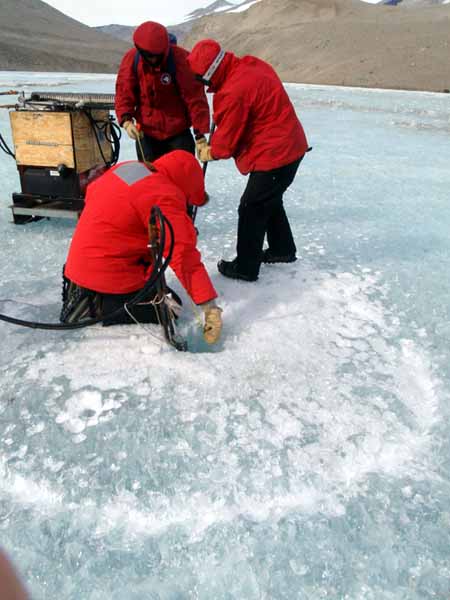
Of course in the field there is always work that needs to be done so we used our new-found free time to work on mission planning and choose the spot for our second melt hole. Lake Bonney lies in the bottom of the Taylor Valley and the lake’s shape is dictated by the valley walls. It is narrow and long, too long for us to drive the vehicle to all points in the west lobe of the lake from a single point, so we will work from two different ice holes – one close to the Taylor Glacier face and the second further east. About halfway through our fieldwork schedule we will move the bot house to the second hole but first we need to make the hole.

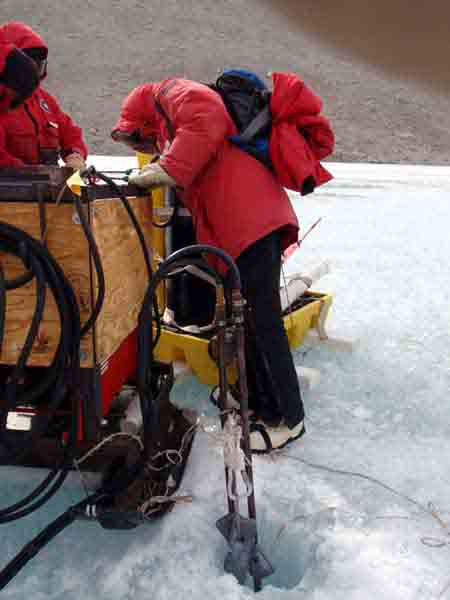
To initiate us as true scientists in the Dry Valleys, Peter decided that we needed to drill the pilot hole in the ice. Annika was our designated “drill sergeant” and showed us how to operate the Jiffy drill, a machine that requires two people and a drill bit 10 inches in diameter. After we drilled the hole, Peter, Maciek and John Priscu returned and helped us place a melter in our pilot hole. Someone has to return to refuel the generator here every 4 or 5 hours and in two days we should have another 8′ hole in the ice.

The trombone melter in the pilot hole we drilled.

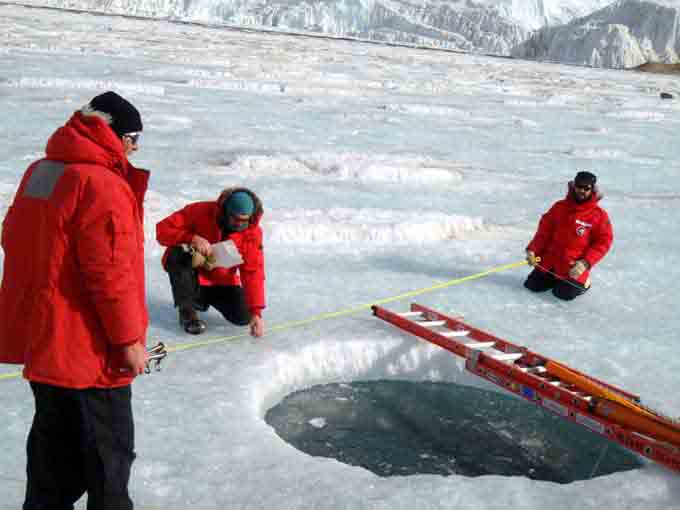
Peter, Bill and Maciej mark the perimeter of the 8′ diameter hole we will melt out.

Reporting by Vickie Siegel

November 27, 2008 By Stone Aerospace

ENDURANCE: Mission 1: November 27, 2008

West Lake Bonney, Taylor Valley, Antarctica
Reporting from Blood Falls Basecamp

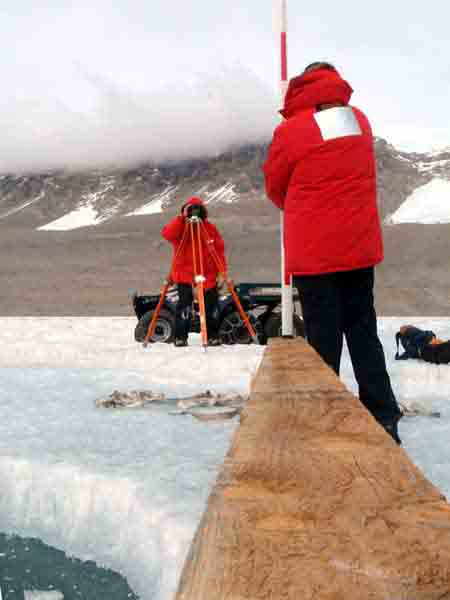
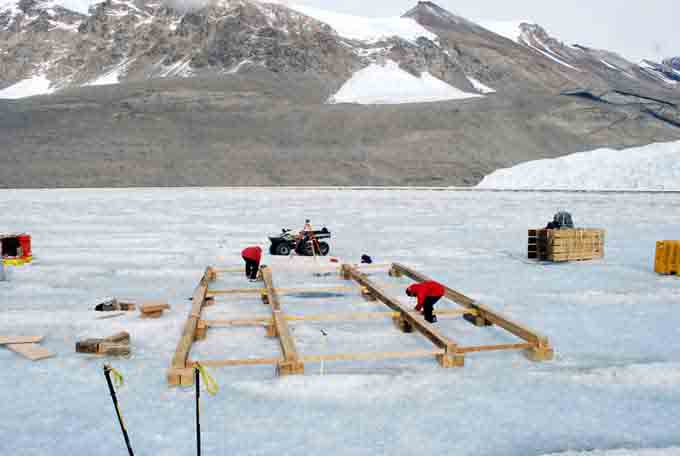
We returned to the floor supports we placed yesterday. To ensure that our finished floor sits level, Bill and Peter took some time to measure the height of each floor support as the others placed the 8″x8″ timbers that hold the floor panels. With their measurements, we shimmed some of the timbers with plywood to bring them to the proper height. The 8×8’s are held in place end to end by steel moment plates. We attached these and then added 2×4 spacers that keep the four rows of 8×8’s parallel.

Peter and Bill level the timbers.

The 8×8 timbers are in place and ready for the floor panels.

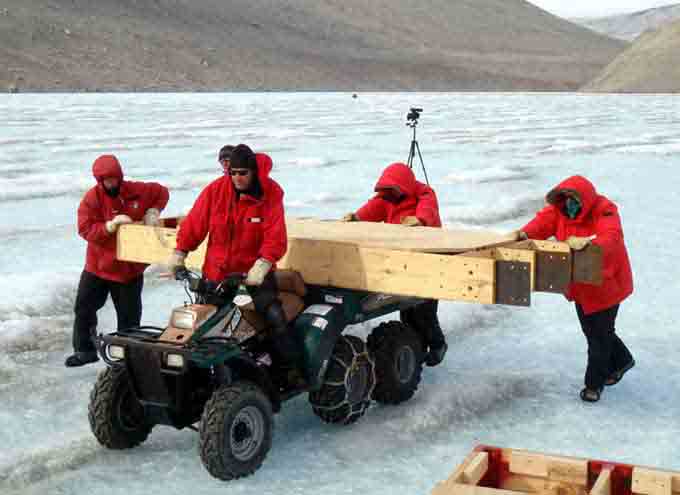
With the 8×8 timbers in place, our next move was to start placing floor panels. During our test-build of the Bot House in McMurdo, we learned that the floor panels are heavy (~500 lbs), but manageable when many people work together to lift them. The difference between our test build and the real thing, however, is that here we are working on the uneven and slick surface of the lake ice instead of the flat gravel yard at McMurdo. Slowly and cautiously, we inched the first few platform sections across the ice until Maciej brought our attention to another tool we have at our disposal here: the ATV. The new procedure became to have several lifters carefully place a platform section onto the bed of the ATV and then walk alongside the vehicle to make sure it didn’t slide off the bed as someone drove the ATV to the platform-in-construction. From there it was easy to transfer the section from the ATV to the 8×8’s.

Moving the floor panels with the ATV was much easier than lifting them.

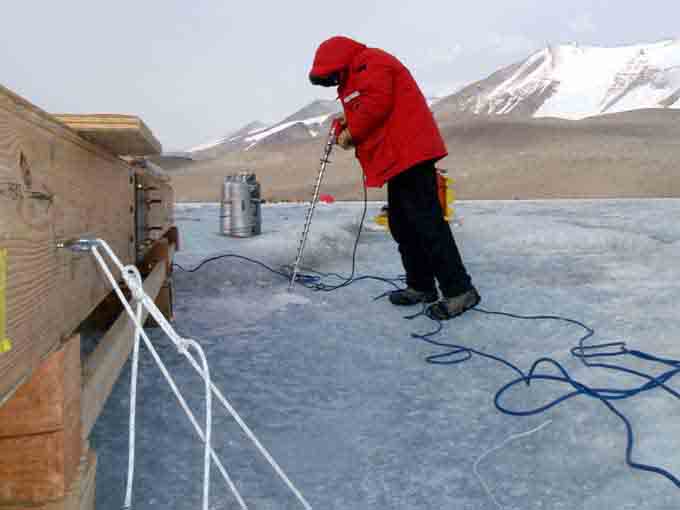
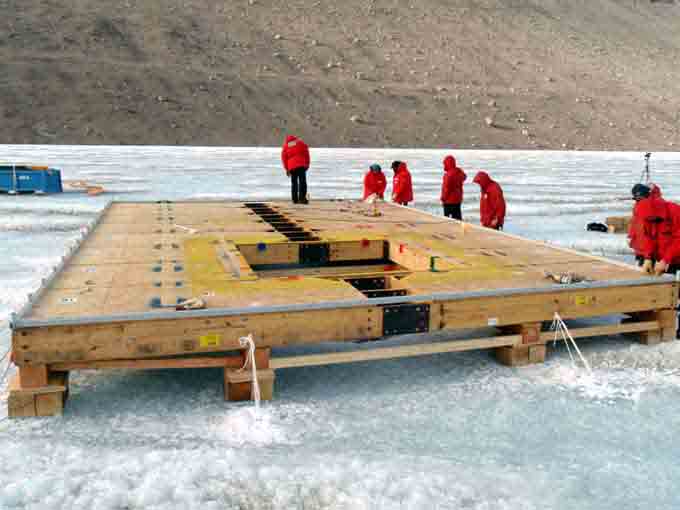
As one crew moved the floor sections into place, other folks worked to line the panels up and bolt them to each other. Then the floor sections needed to be anchored to the ice. For this Peter drilled two holes into the ice at the end of each panel. The holes intersected under the surface in a V-configuration. We threaded rope through the ice holes and tied off to eye bolts in the sides of the panels. The finishing touch for the day was to secure the base frame of the tent to the edge of the floor.

Peter drills holes in the ice to anchor the platform.

A completed floor at the end of the day.

We are ready to build the tent after the bot arrives tomorrow!

Reporting by Vickie Siegel

November 26, 2008 By Stone Aerospace

ENDURANCE: Mission 1: November 26, 2008

West Lake Bonney, Taylor Valley, Antarctica
Reporting from Blood Falls Basecamp

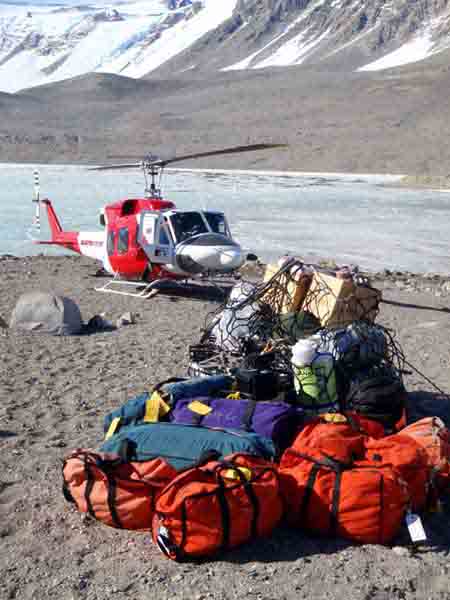
Our first day in the field! This morning we started off by enjoying our last prepared breakfast in the McMurdo Station dining hall and then checked out of our rooms and headed down to the helo pad for our flight to the west lobe of Lake Bonney. The plan was that Peter, Bill, Kristof, Bob, Annika, Maciej and Vickie would head out to the Blood Falls campsite and start to set up the Bot House platform on the lake ice. Chris and Shilpa would join us in the field on Friday. Maciej and Annika left town on the first flight to run some errands at the Lake Bonney camp before the rest of us arrived. After we selected our helmets and weighed ourselves, the helo technicians loaded our duffel bags into the Huey and we all squished into the remaining seats. The rhythmic thud of the rotors accelerated and we were carried over the white expanse of the Ross Ice Shelf and into the stark grey granite walls of the Taylor Valley.

After the scenic 40 minute flight we arrived at the Blood Falls Camp site, named for the dark orange streaks in the iron stained glacier nearby. McMurdo carpenters had already set up two small weather haven tents for us and a couple helo sling loads of our camp gear had already been delivered that morning. We took a couple of hours to set up camp. We decided to use the smaller weather haven as a kitchen and the larger red haven as a dining room. We set up our tables and chairs, moved food into the kitchen and set up our personal tents.

A sling load and our duffel bags on the shore of Lake Bonney, at Blood Falls Camp.

After a quick lunch we walked out to the 8 diameter ice hole that Maciej and Annika melted for us last week. For a quarter mile radius around the hole, the ice was strewn with sling loads of our gear lumber, tools, drums of fuel, and the wood panels that will make up the floor of our Bot House. The first task was to unload some of the tool boxes and lumber pallets. Once we had some tape measures in hand we were ready to start real work towards building the platform. Over the course of the afternoon we surveyed out the locations for the floor supports, stopping occasionally to duck low when additional helo deliveries arrived. By evening all of the floor supports were in place. The last sling load was set on the ice just as we all crawled into our tents for the night.

Bob, Bill and Bart decide where to place the floor supports around our ice hole. A couple inches of ice have refrozen on the water surface, making it safer for us to work around the hole.

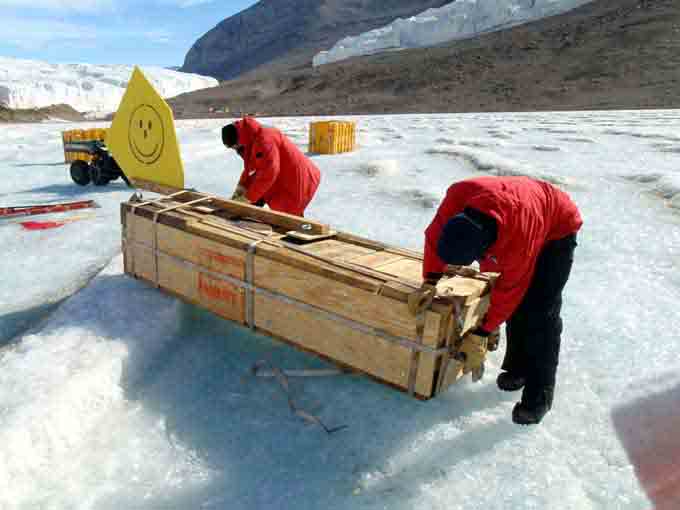
Bob and Kristof unwrap a lumber sling load on the lake ice. The yellow wings are placed on the sling loads by the helo techs to stop the load from spinning as the helicopter flies through the air.

Reporting by Vickie Siegel

« Previous Page
Next Page »

Footer

Corporate headquarters:
Austin, Texas

Smart tools for exploring the frontier
  • Facebook
  • Instagram
  • LinkedIn
  • Twitter
  • YouTube

Copyright © 2026 · Stone Aerospace, Inc.