• Skip to main content
  • Skip to footer

Stone Aerospace

Smart tools and systems for exploring the frontier

  • Home
  • About us
    • What we do
    • History
    • Design philosophy
  • Projects
    • BEAGLE
    • PARTI-Pucks
    • Thor
    • PROMETHEUS
    • ARCHIMEDES
    • ARTEMIS
      • Description
      • Field notes
      • Photo gallery
    • VALKYRIE
      • Description
      • Field notes
      • Photo gallery
    • ENDURANCE
      • Description
      • Field notes
    • DEPTHX
      • Description
      • Field notes
  • News
  • Employment
  • Contact us
  • Stone Aerospace in One Page

DEPTHX

February 2, 2007 By Stone Aerospace

DEPTHX: Mission 1: February 2, 2007

Rancho la Azufrosa, Aldama, Tamaulipas, Mexico
Reporting from Zacaton Basecamp

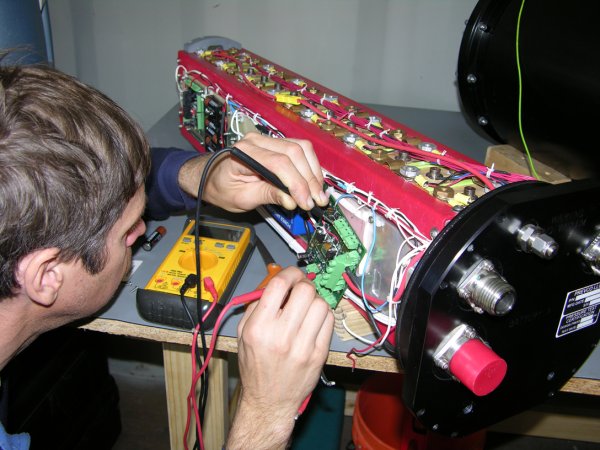
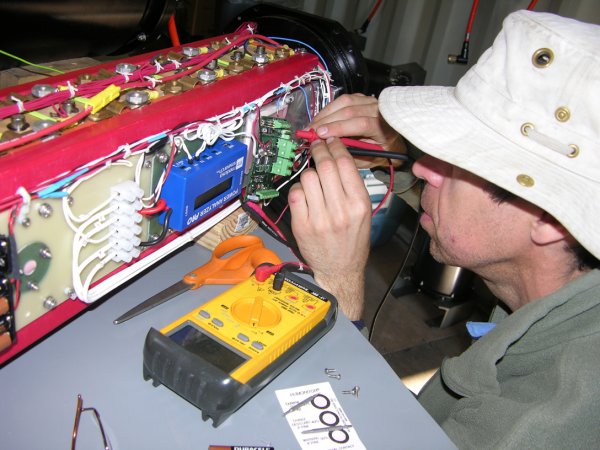
Resolution. John Kerr was up at dawn and on the cell phone with Nigel Jones going over possibilities for why the new disconnect boards were not functioning. After a few rounds the problem was isolated to one particular chip. John then began methodically testing that chip and found one of the eight tiny solder connections to be non-contacting. When he re-soldered that the system came up. With this resolved we completed the checkout of the E-stop system with the batteries (now fully charged) back in the loop. John then powered up SIOP (the system basic Input-Output onboard interface computer) and was able to interrogate the various sub-systems and their associated sensors. The batteries were online and giving good readings and, following entry of the local GPS coordinates which Vickie Siegel collected outside the lab, the IMU portion of the guidance system came up with a proper alignment.
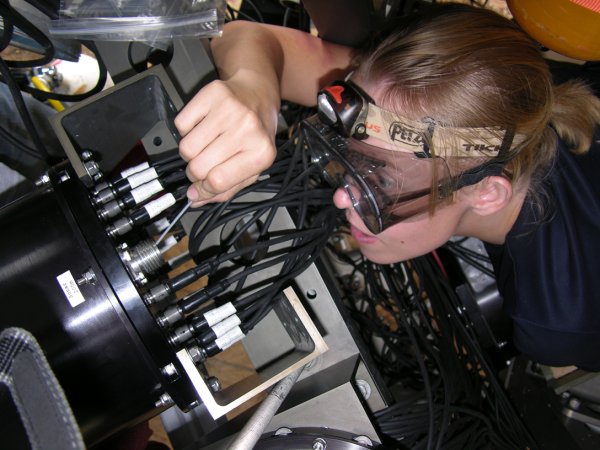
Above: Vickie Siegel doing final checkout on the 100m sonar array
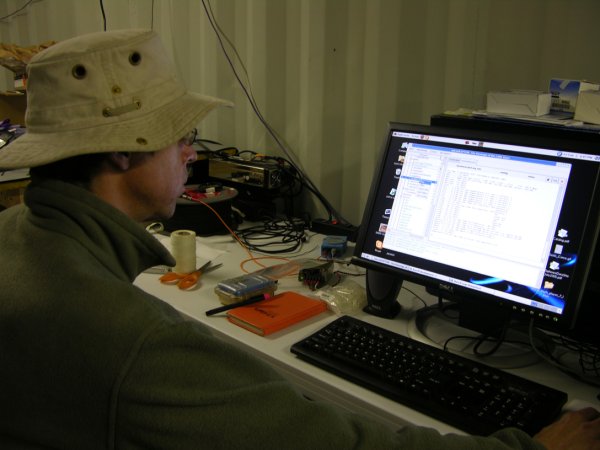
Above: John Kerr (SAS) interrogating the bot with the microRAPTOR real-time interface tool from the lab.

Above: Screen capture from microRAPTOR showing both batteries online and charged (a very good thing indeed, considering where we were on Tuesday !).
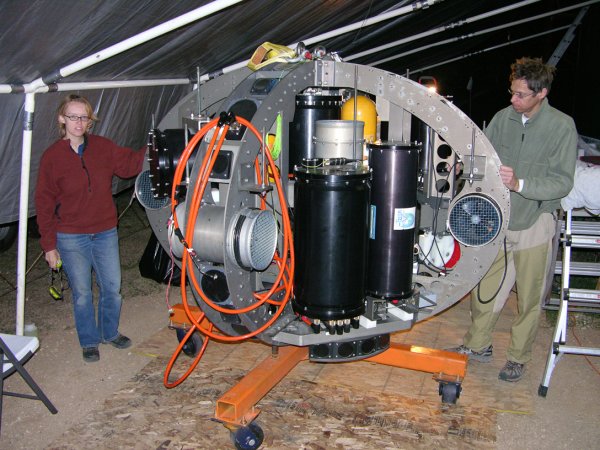
Above: Vickie Siegel and John Kerr with DEPTHX at 10pm on February 2. We are now about one day from being fully operational, assuming no more field glitches.

At this point we continued with routine assembly tasks until 10pm. Marcus Gary meanwhile had completed installation of ceiling vent fans in the lab. Although seemingly unnecessary given the cold temperatures we’ve been experiencing the past few days, it will be required once the normal hot weather returns.

In all, a very good day. Barring any unforeseen problems we should have the bot close to complete assembly by late tomorrow and ready for transport to cenote La Pilita on Sunday, where we will begin the first true exploration field tests in a truly unexplored environment.

Bill Stone
Stone Aerospace
February 1, 2007 By Stone Aerospace

DEPTHX: Mission 1: February 1, 2007

Rancho la Azufrosa, Aldama, Tamaulipas, Mexico
Reporting from Zacaton Basecamp

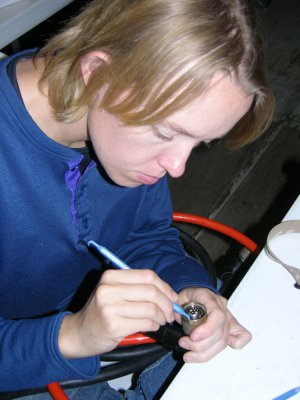
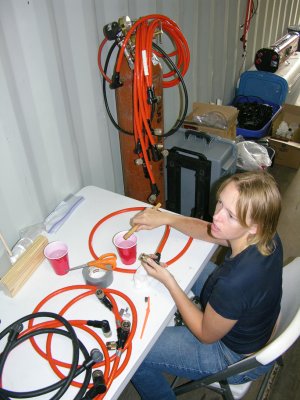
A good day today. We received word early via email from Marcus Gary’s Blackberry wireless that he had made it to Harlingen and that the replacement disconnect boards had arrived intact at FedEx. It would still be another six hours before he would arrive at Rancho la Azufrosa. Meanwhile it was a full day for those of us at the ranch. Vickie Siegel and I began an assembly line to clean all of the electrical connectors for DEPTHX and replace all of the oring seals associated with them. Given that this would be the final system assembly before DEPTHX could see service at up to 1,000 m water depth this was a necessary preventive maintenance task.


Above: Vickie Siegel takes on the tedious task of replacing all the oring seals on the electrical cables for DEPTHX. Some of the eleven electronics housings have more than a dozen such connections each, so this was an all day task.

Once that was done each cable end was individually sealed to prevent ingress of dust… of which there was a lot flying around outside as stormy weather blew in from the north.

While waiting for the disconnect boards to arrive John Kerr made good use of time by integrating the main cPCI computer housing, the science payload computer, and two of the sonar array digital signal processors into the vehicle.
Marcus Gary finally arrived at 7pm with the replacement boards. When installed, however, they did not deliver the necessary output voltages. Further emails ensued but by 11 pm the boards were still non-functional and the team went to bed. Nonetheless a lot of progress had been made today.

Bill Stone
Stone Aerospace

January 31, 2007 By Stone Aerospace

DEPTHX: Mission 1: January 31, 2007

Rancho la Azufrosa, Aldama, Tamaulipas, Mexico
Reporting from Zacaton Basecamp

We awoke early to the knowledge that the bot was dead until we resolved the disconnect board issue. John Kerr began a continuous stream of emails with Nigel Jones back in the states while Vickie Siegel, myself, and two visitors coming north from the 2007 Tabasco caving expedition made our way into Aldama (the nearest town) in search of a Mexican cell phone to see if we could get voice communications out from the ranch. We considered Skype but it doesn’t work well when run off satellite relay (we were using a customized version of a HughesNet link).

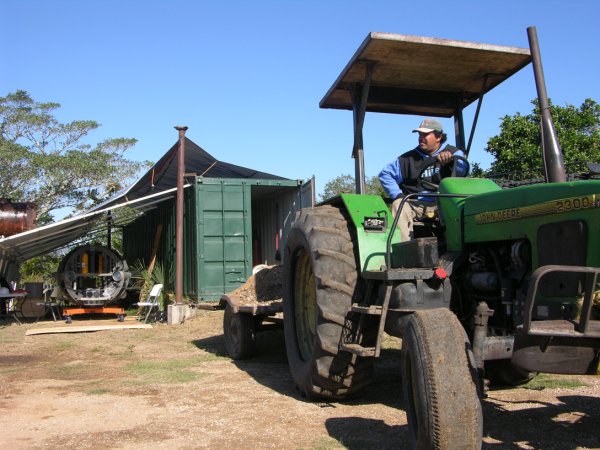
Above: Nacho, the main ranch hand at Rancho la Azufrosa, brings over one of many loads of sand used to level out the “bot garage” so that sheets of plywood could be laid down to serve as a surface for maneuvering the bot (it’s lower orange frame rides on four heavy shop casters, but these need a flat surface to work on.

So off we went while John continued his asynchronous stream of emails with Nigel (our lead embedded systems electrical engineer). A plan was developed to produce more boards. Component parts were FedExed to Jones and he spent most of the day assembling the prototype boards – a tedious process that involved placing 2×3 mm surface mount chips on the board and using a large magnifying lens to help with guiding a fine point soldering iron to get all the chip pins properly soldered to their respective pads on the board. Nigel also programmed the onboard logic chips and then re-FedExed them to Harlingen, Texas where, if all went according to plan, they would be picked up by Marcus Gary who was due to begin driving back on February 2.

Bill Stone
Stone Aerospace

Above: John Kerr debugs the disconnect board following email discussions with Nigel Jones.

January 30, 2007 By Stone Aerospace

DEPTHX: Mission 1: January 30, 2007

Rancho la Azufrosa, Aldama, Tamaulipas, Mexico
Reporting from Zacaton Basecamp

Not everything goes according to plan. After unpacking most of the hardware into the field lab the previous day the first order of business was to top off the charge on the twin litihium-ion power stacks used to run DEPTHX, since all subsequent electronics check-outs are based on being on system power.

Unbeknownst to us (possibly from vibration on the trip down) a loose wire on the charging cable crossed circuits and sent full stack voltage (48 volts) down a line normally used for digital communications to control a number of electronics boards on the battery. Before we caught the problem it had fried all three (two primary and one backup) of the E-Stop (emergency stop) power disconnect boards on site here at Zacaton. For human safety reasons DEPTHX has the equivalent of a “big red STOP” button on the top of the vehicle. But because the full power draw from the vehicle can be large (scores of amps) that E-stop switch is not like your normal house light switch—it’s a digital switch that in turn “talks” to a very high power relay board in each battery which in turn enables high amp flow from the batteries. And it was the communications line (and all the microchips) to that “Disconnect” board that got fried. It took all of today to sort out the source of the problem that caused the loss of the boards and to permanently preclude the incident from re-occurring. But that still left us with a dead bot until the E-stop could be renabled. No solution had been found as of midnight and the team retired with the unpleasant knowledge that we had just 4 days in the jungle to sort this out before the arrival of the main research team.

Bill Stone
Stone Aerospace

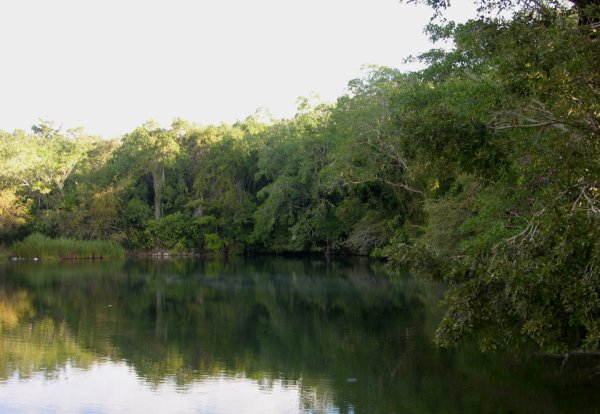
Above: source of “El Nacimiento” (the spring) lies just 100 m west of the main field lab at Zacaton. The horizontal black slot at center is the entrance to the Pasaje de la Tortuga Muerta (dead turtle passage) leading upstream and underground to the main Zacaton cenote. It was first explored in 1989 by Jim Bowden and Gary Walton and leads 220 m underground to where it re-emerges on the southwest corner of Zacaton.

January 29, 2007 By Stone Aerospace

DEPTHX: Mission 1: January 29, 2007

Rancho la Azufrosa, Aldama, Tamaulipas, Mexico
Reporting from Zacaton Basecamp

Marcus and Robin Gary left for Austin today – Robin returning to her job at USGS and Marcus to fetch an additional load of supplies for basecamp. This left us with a skeleton crew of John Kerr and myself to work the finer issues of setting up the field lab and re-assembling the bot until further reinforcements arrive.


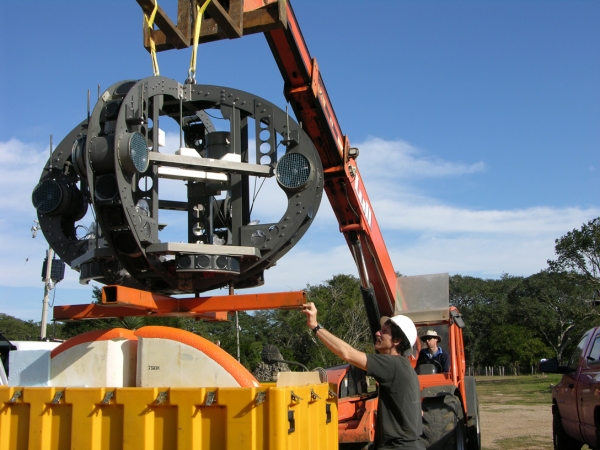
First order of business was to uncrate the bot. At 1.5 metric tons DEPTHX is an industrial strength machine (rated to 1,000 m ocean depth), but this also means it’s not something you toss about by hand. Alejandro Davila, the owner of Rancho la Azufrosa, kindly made arrangements with a local Tampico-based crane company to ship a mobile handler to the site. We then began unloading all the electronics modules into the field lab for individual checkout.

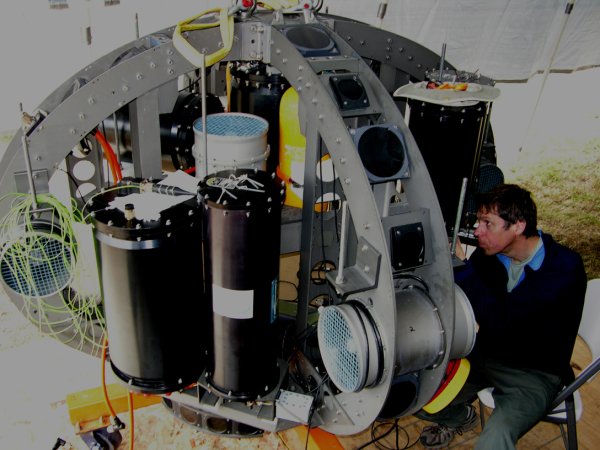
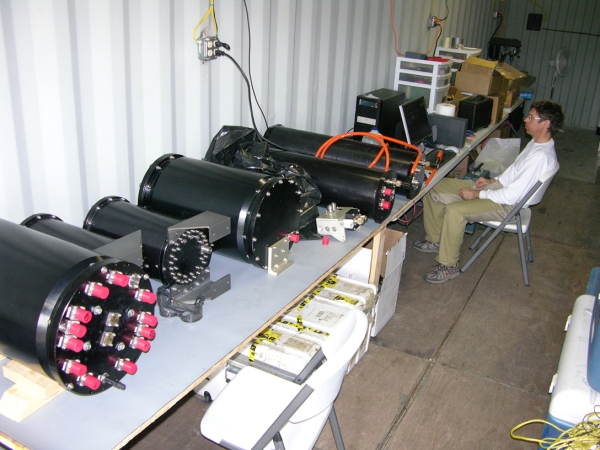
Above: about half of the pressure vessels that go inside DEPTHX, at the field lab.

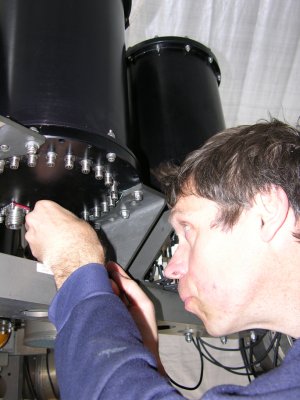
Although it seems like a simple process, DEPTHX has over 500 electrical connections, all of which run through scores of dis-connectable pressure rated cables… and each of those, along with the housing closures, have hundreds of orings, which are lubricated and therefore attract dust… of which there is plenty at Rancho la Azufrosa. So every make-and-break of a cable connection or housing lid means replacing orings, re-lubing, and sealing before any contamination can enter.

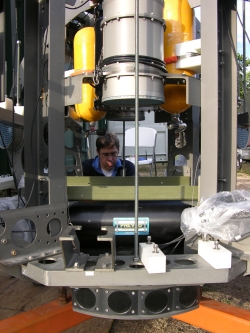
Today we managed to load the variable buoyancy engine (VBE) ballast as well as the two pressure housings for the redundant lithium-ion power supplies into the bot frame. We also charged up the VBE pressure drive tanks (5,000 psi carbon-epoxy construction) and mounted those.

The weather has been cooperative, partially sunny, a bit windy, and 70F. The only point of serious concern today was that while totally focused on our work we began hearing strange “clacking” noises outside the lab trailer and emerged to find a large herd of goats inspecting the bot at close range… in fact they had it surrounded and were licking the sonar transducers. Fortuitously we caught them before they got the idea to chew on the cables. New line item on the pre-flight checklist: remove goats from bot vicinity.


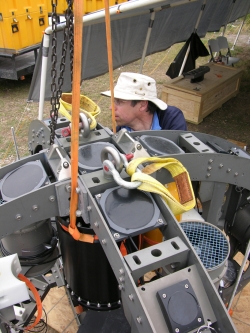
John Kerr attaches the Variable Buoyancy Engine (VBS) ballast tank to the top of the bot – the VBS has a differential displacement of 26 kg to compensate for compression-induced buoyancy loss as the vehicle descends.

Mounting the pressure housings for the twin Li-Ion power supplies that drive DEPTHX. The yellow cylinders are 5,000 psi carbon-epoxy pressure vessels that are used to drive the VBS. The gray cylinder at top center is one of two vertical ducted thrusters that work in concert with the VBS to vertically stabilize the bot and allow it to hover.

Bill Stone
Stone Aerospace

« Previous Page
Next Page »

Footer

Corporate headquarters:
Austin, Texas

Smart tools for exploring the frontier
  • Facebook
  • Instagram
  • LinkedIn
  • Twitter
  • YouTube

Copyright © 2026 · Stone Aerospace, Inc.